

Lighting a golf course after sunset sounds simple enough. You need powerful lights, plenty of visibility, and enough coverage to keep golfers moving around the course. But once you start looking at the actual numbers, things get a little more complicated.
A golf course is a large outdoor space with tees, fairways, greens, hazards, paths, and other areas that may all have different lighting needs. Simply choosing the highest-wattage fixture or the fixture with the most lumens does not necessarily create a better-lit course.
Watts tell you how much electrical power a light uses, while lumens tell you how much visible light it produces. There is also another measurement worth knowing: lux. Lux tells you how much light actually reaches a surface, which makes it particularly useful when planning golf course lighting.
Understanding the difference between these measurements can make it much easier to choose the right LED floodlights, estimate energy consumption, and create a lighting system that provides good visibility without wasting electricity.
Watts and Lumens: What Is the Difference?
What Are Watts?
Watts (W) measure electrical power. In simple terms, wattage tells you how much electricity a lighting fixture consumes while it is switched on.
For example, a 500-watt LED floodlight uses 500 watts of electrical power when operating at full output. If 20 of these fixtures are running at the same time, the total electrical load would be 10,000 watts, or 10 kilowatts.
Wattage is useful when estimating electricity consumption and operating costs. However, it does not tell you exactly how much light a fixture produces.
This is particularly relevant with LED lighting because different fixtures can produce different amounts of light while consuming the same amount of electricity.
What Are Lumens?
Lumens (lm) measure the amount of visible light produced by a light source.
Generally speaking, a fixture producing 80,000 lumens produces more light than one producing 40,000 lumens. But that does not necessarily mean the 80,000-lumen fixture is the better choice for a golf course.
How the light is distributed matters just as much as the amount of light produced. A fixture may have a very high lumen output, but if much of that light falls outside the intended playing area, the extra output is not doing much useful work.
What Are Lumens Per Watt?
Lumens per watt, often written as lm/W, gives you a basic way to look at lighting efficiency.
The calculation is straightforward:
Lumens per watt = Lumens ÷ Watts
For example, a 500-watt fixture producing 90,000 lumens has an efficacy of 180 lm/W.
Another 500-watt fixture might produce only 70,000 lumens. It uses the same amount of electricity but produces less light.
That is why comparing wattage alone can be misleading when choosing LED golf course lighting.
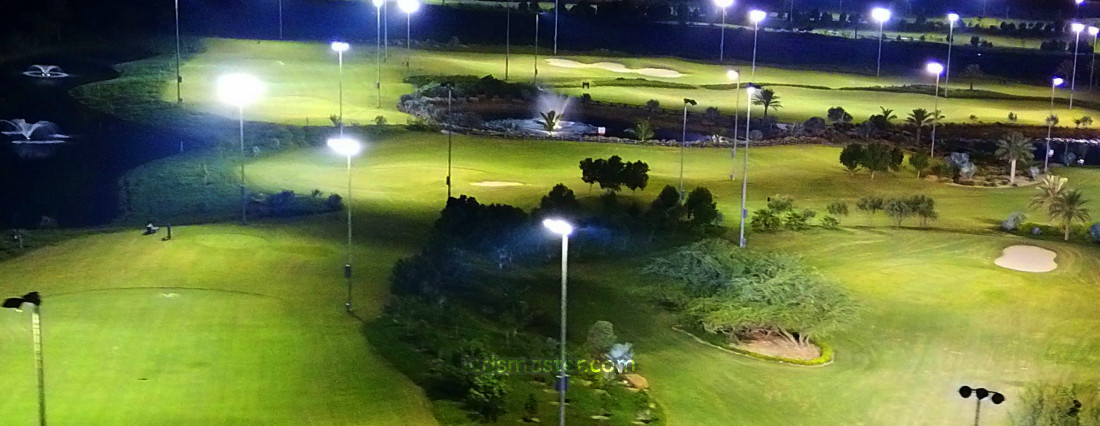
Why Lighting Matters on a Golf Course
Visibility for Golfers
Golfers need to see much more than the grass immediately in front of them. They need to identify the teeing area, follow the fairway, see hazards, locate the green, and track the ball as it moves through the air.
Poor lighting can make these tasks uncomfortable. A course with excessive brightness in some areas and dark patches in others can also create distracting changes in contrast.
The goal is not simply to make everything extremely bright. The goal is to provide a consistent and comfortable visual environment.
Energy Consumption
Golf course lighting can involve a large number of fixtures operating for several hours after sunset. Even relatively small differences in fixture wattage can add up across an entire installation.
For example, replacing a 600-watt fixture with a 500-watt fixture saves 100 watts per fixture. Across 50 fixtures, that represents a 5,000-watt reduction in connected load.
Over hundreds or thousands of operating hours, the difference can become noticeable on the electricity bill.
Lighting Quality
A good golf course lighting system needs to balance brightness with uniformity, glare control, light distribution, and energy use.
Installing extremely powerful fixtures may increase the amount of light on the course, but it can also create glare, bright spots, unwanted shadows, and light spill.
In other words, more light is not automatically better light.
Lumens vs. Lux for Golf Course Lighting
What Is Lux?
Lux measures illuminance, which means the amount of light reaching a surface.
One lux is equal to one lumen per square meter.
This makes lux particularly useful for golf course lighting because the designer is interested in how much light actually reaches the tee, fairway, or green.
A fixture could produce 100,000 lumens, but those lumens have to travel from the fixture to the playing surface. Mounting height, beam angle, distance, fixture positioning, and optics all affect the final result.
Why Lux Is Useful
Imagine two golf courses using fixtures with the same total lumen output.
Course A distributes the light evenly across the playing areas.
Course B has very bright areas directly below the fixtures but much darker spaces between them.
Both systems may produce a similar number of total lumens, but the experience for golfers can be very different.
That is why lighting design generally looks at illuminance and uniformity rather than relying only on total fixture lumens.
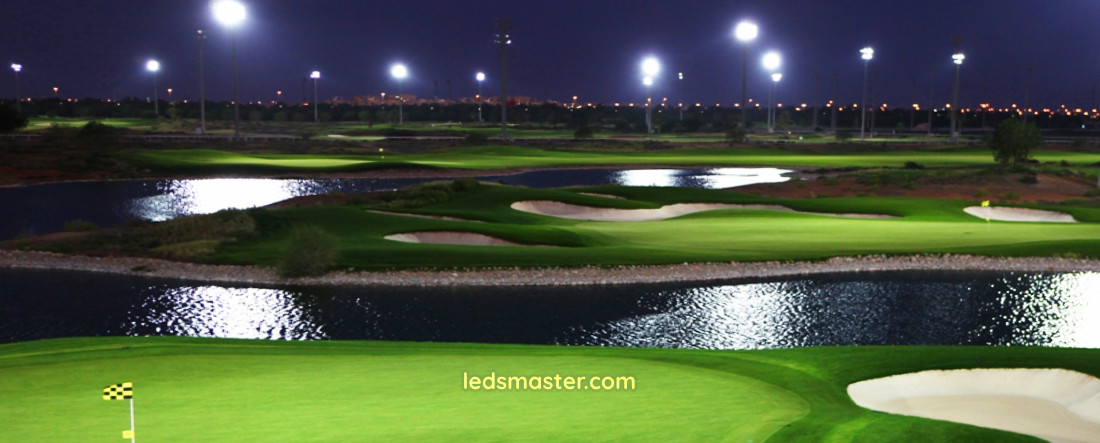
How Many Lumens Does a Golf Course Need?
| Lighting factor | Typical / example range | What it means |
|---|---|---|
| Fairway illuminance | 30–80 lux | General reference range that may be used depending on the course and level of play |
| Tee and green illuminance | 50–200 lux | Higher lighting levels may be used where golfers need greater visibility |
| Example illuminated area | 2,000 m² | Example area used for a basic lumen calculation |
| Example target illuminance | 50 lux | Example target for demonstrating the calculation |
| Example required light | 100,000 lumens | 50 lux × 2,000 m² |
| Lower-wattage LED fixtures | 100–300 W | Often suited to smaller areas, entrances, paths, or lower-output applications |
| Medium-wattage LED fixtures | 300–600 W | Common range for larger outdoor and sports-lighting applications |
| High-wattage LED fixtures | 600–1,000+ W | Used for high-output applications and areas requiring long-distance illumination |
| Small/medium LED fixture output | 10,000–30,000 lm | Example range for smaller outdoor lighting applications |
| Medium LED fixture output | 30,000–60,000 lm | Suitable for a range of larger outdoor applications depending on the design |
| High-output LED fixture | 60,000–100,000+ lm | Used for larger sports and outdoor lighting applications |
| Example fixture A | 600 W / 100,000 lm | About 167 lm/W |
| Example fixture B | 400 W / 80,000 lm | About 200 lm/W |
| Example fixture quantity | 10 fixtures | 1,000,000 lumens ÷ 100,000 lumens per fixture |
There Is No Single Lumen Number
There is no universal number of lumens that will work for every golf course.
A small recreational facility, driving range, nine-hole course, and large night-golf facility can have very different lighting requirements.
The required light level can also vary between different areas of the same course. A green may need a different lighting level from a fairway, while a parking area or pathway may need something completely different.
Typical Lighting Levels
As a general reference, golf lighting designs may use illuminance levels somewhere around 30 to 80 lux for fairways and roughly 50 to 200 lux for tees and greens, depending on the application and level of play.
These figures should not be treated as a universal rule. The correct lighting level depends on the type of facility, expected use, local requirements, playing conditions, and the lighting design.
The figures are useful because they show why a golf course cannot be designed around one simple lumen number.
Why Area Size Matters
The size of the area being illuminated has a direct effect on the amount of light required.
A simple starting formula is:
Required lumens ≈ Target lux × Area in square meters
For example, imagine a 2,000-square-meter area with a target of 50 lux.
50 × 2,000 = 100,000 lumens
This gives you a theoretical starting point of 100,000 lumens.
Real installations are more complicated because not every lumen produced by a fixture reaches the target surface. Light distribution, fixture optics, mounting height, maintenance, and other factors have to be considered before deciding on the final fixture output.
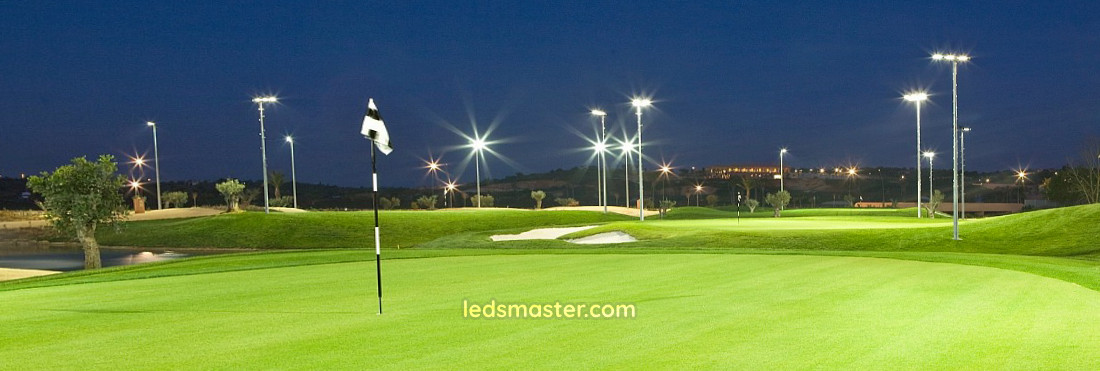
Common Wattages for Golf Course LED Lighting
Lower-Wattage Fixtures
LED fixtures in the 100- to 300-watt range may be suitable for smaller outdoor areas, paths, entrances, or applications that do not require long-distance high-output illumination.
They may also be useful in areas where the required lighting level is relatively modest.
However, whether a fixture in this range is suitable depends on its lumen output and optical distribution rather than wattage alone.
Medium-Wattage Fixtures
Fixtures around 300 to 600 watts are commonly found in larger outdoor and sports-lighting applications.
A 500-watt LED floodlight, for example, could potentially provide a substantial amount of light when paired with suitable optics and mounting conditions.
The same fixture may perform very differently depending on whether it is mounted 10 meters or 30 meters above the ground.
High-Wattage Fixtures
Large sports and golf lighting projects may use fixtures rated at 600, 800, 1,000 watts or more.
These higher-output fixtures can be useful when light needs to travel long distances or cover large areas from high mounting positions.
However, choosing a high-wattage fixture simply because it produces more light can backfire. If the beam is too wide, too narrow, or poorly aimed, much of the output may not reach the areas where golfers actually need it.
| Lighting Category | Typical Wattage | Typical Lumens | Typical Use / Notes |
|---|---|---|---|
| Lower-Wattage | 100–300 W | 10,000–30,000 lm | Paths, entrances, smaller outdoor areas, and lower lighting requirements |
| Medium-Wattage | 300–600 W | 30,000–60,000 lm | Larger outdoor areas and sports-lighting applications |
| High-Wattage | 600–1,000+ W | 60,000–100,000+ lm | Large golf/sports areas, high mounting positions, and long-distance illumination |
| Very High Output | 600 W+ | 100,000+ lm | Large-area applications requiring substantial light output |
Common Lumens for Golf Course LED Fixtures
Small and Medium Output
Commercial LED fixtures can produce a wide range of lumen outputs.
For smaller outdoor applications, you may see fixtures producing around 10,000 to 30,000 lumens. Medium-output fixtures may produce around 30,000 to 60,000 lumens.
These products can be useful for smaller areas or applications where the fixture does not need to illuminate a large space from a great distance.
High-Output Fixtures
Large sports-lighting fixtures can produce 60,000 to 100,000 lumens or more.
Some high-output LED floodlights can exceed 100,000 lumens from a single fixture.
Again, the number on the specification sheet only tells part of the story. A 100,000-lumen fixture is not automatically twice as useful as a 50,000-lumen fixture.
The beam pattern and optical efficiency determine how effectively that light is used.
Comparing Lumens and Watts
Suppose one fixture produces 100,000 lumens at 600 watts.
Another produces 80,000 lumens at 400 watts.
The first fixture produces more total light, but the second fixture may be more energy-efficient.
The first fixture has an efficacy of about 167 lm/W, while the second produces about 200 lm/W.
This is why it is useful to look at lumens, watts, and lumens per watt together.
How Many LED Fixtures Are Needed?
A Simple Calculation
Once you know the approximate lumen requirement, you can estimate the number of fixtures.
For example, suppose an area theoretically requires 1,000,000 lumens and each fixture produces 100,000 lumens.
1,000,000 ÷ 100,000 = 10 fixtures
On paper, that looks simple.
In practice, the final number may be different because the fixtures have to be positioned to achieve the desired illuminance and uniformity.
Why Fixture Placement Matters
Imagine placing ten very powerful fixtures around a golf course. If they are poorly positioned, some areas may be extremely bright while other areas remain too dark.
Moving the fixtures, changing their mounting height, or using a different beam angle can sometimes improve the result without increasing total wattage.
This is why professional lighting projects often use photometric calculations before installation. The design can be tested digitally to see where the light will fall before the poles and fixtures are installed.
Other Factors to Consider When Lighting a Golf Course
Uniformity
Uniformity describes how evenly light is distributed across the playing area.
A course does not need every square meter to have exactly the same light level, but large differences between bright and dark areas can affect visibility and comfort.
Good fixture spacing, appropriate beam patterns, and careful aiming can help create a more consistent lighting environment.
Glare
Glare is one of the easiest problems to notice when outdoor lighting is poorly designed.
A powerful fixture positioned directly within a golfer’s line of sight can be distracting, even when the actual playing surface has a suitable lighting level.
Shielding, fixture orientation, mounting height, beam angle, and pole positioning can all help reduce glare.
Beam Angle
Beam angle determines how broadly the fixture distributes its light.
A narrow beam can throw light farther, while a wider beam can cover a broader area.
For example, a high pole positioned far from a green may require a different optical distribution from a fixture installed close to a tee.
Choosing the beam angle based on the actual site is much better than choosing it simply because the product specification looks impressive.
Pole Height
Pole height affects both coverage and light distribution.
Higher poles can help cover larger areas and may reduce the number of poles needed in some layouts. However, they also change the distance and angle at which the light reaches the playing surface.
Pole height should therefore be considered together with fixture output, beam angle, spacing, and aiming.
Light Spill
Golf courses are often located close to residential areas, roads, natural areas, or other properties.
Light that spills beyond the course can create problems for neighbors and contribute to unwanted nighttime illumination.
Using precise optics and carefully aiming fixtures can help keep more of the light on the course rather than sending it into surrounding areas.
Color Temperature
Color temperature affects the appearance of the light.
LED golf course lighting is commonly available in several color-temperature options, and the right choice depends on the visual environment, player preferences, surrounding conditions, and project requirements.
Rather than selecting a color temperature purely because it looks bright, it is better to consider how the light interacts with the grass, sky, surroundings, and playing environment.
Maintenance and Light Depreciation
LED fixtures generally have long service lives, but their light output can still change over time.
Dirt, dust, aging components, and environmental exposure can affect performance.
A lighting design should therefore consider how the system will perform after years of operation rather than only how it performs on the first night.
How to Estimate Golf Course Lighting Energy Use
Basic Energy Formula
Once the total fixture wattage is known, estimating energy use is fairly simple:
Energy consumption (kWh) = Total watts × Operating hours ÷ 1,000
Suppose a golf course has 40 fixtures rated at 500 watts each.
40 × 500 = 20,000 watts
That equals 20 kW of connected lighting load.
If the lights operate for five hours each night:
20 × 5 = 100 kWh per night
Over 300 operating nights, that would be approximately 30,000 kWh.
The actual cost depends on the local electricity rate, operating schedule, controls, and other factors, but this gives you a useful way to estimate the system’s energy demand.
Using Controls to Reduce Energy Use
Lighting controls can make a noticeable difference when a course does not need full output all the time.
For example, a facility might use different lighting levels during maintenance, practice sessions, general recreational play, and special events.
Dimming fixtures when full output is not needed can reduce energy consumption while still maintaining a suitable lighting environment.
Getting the Right Balance of Light
The question of how many watts and lumens are needed to light a golf course does not have one simple answer. The right numbers depend on the size and layout of the course, the areas being illuminated, the desired lux level, fixture efficiency, pole height, beam angle, spacing, and the type of play.
A good starting point is to determine the target illuminance for each area and then calculate the approximate amount of light required. From there, fixture wattage and lumen output can be selected based on real photometric performance rather than a number on a product label. The goal is not to use the most powerful lights available, but to use the right amount of light in the right places.
For a new golf course lighting project or a major LED upgrade, a detailed lighting calculation can help determine the fixture quantity, mounting positions, aiming angles, and expected light levels before installation. When watts, lumens, lux, uniformity, glare, energy consumption, and light spill are considered together, the result can be a brighter and more comfortable course without turning the entire property into a giant stadium light.