
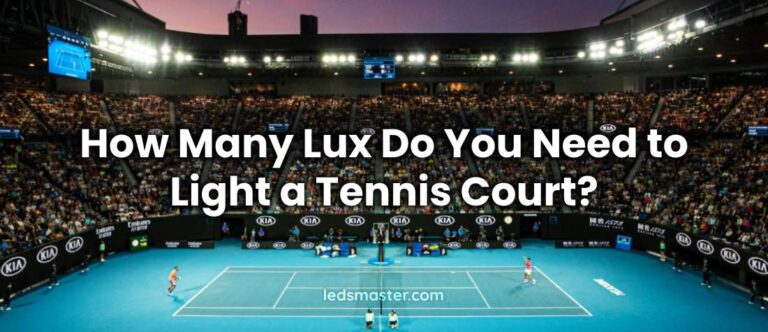
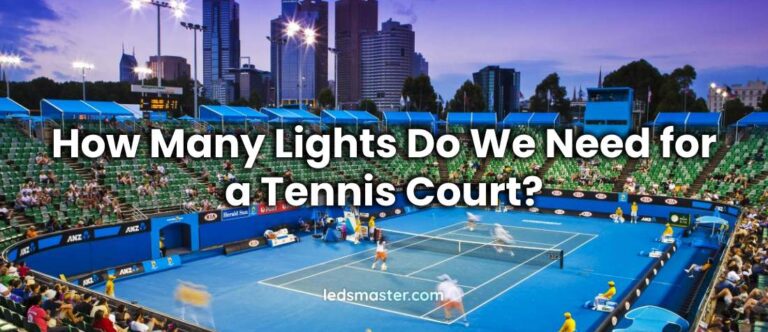
Designing tennis court lighting isn’t just about throwing a few bright fixtures around and hoping for the best. A proper lighting plan considers illumination levels, color temperature, glare control, uniformity, and layout, while also factoring in pole height, aiming angles, and the number of fixtures. Each element works together to create a court that’s not only visible and functional but also comfortable for players’ eyes, whether it’s a casual evening rally or a competitive tournament.
| Parameter | Recreational/Community | Club/Competitive | Professional/Broadcast | Notes |
|---|---|---|---|---|
| Horizontal Illumination | 300–500 lux (30–50 fc) | 700–1000 lux (65–90 fc) | 1300–1500 lux (120–140 fc), up to 2000 lux | Measured on court surface |
| Vertical Illumination | 200–400 lux (20–40 fc) | 500–700 lux (45–65 fc) | 1000–1500 lux (90–140 fc) | Light on ball and player faces |
| Uniformity Ratio (Emin/Eavg) | ≥0.7 | ≥0.7 | ≥0.7 | Ensures even illumination, avoids dim spots |
| Color Temperature (K) | 4000–4500K | 4500–5000K | 5000–5700K | Cooler tones improve ball visibility |
| CRI (Color Rendering Index) | 70–80 | 80–90 | 90+ | Higher CRI = better color accuracy |
| Typical Ball Speed | ~100 km/h (62 mph) | ~150 km/h (93 mph) | 200+ km/h (124+ mph) |
Most people think brightness is all you need, but for tennis, both horizontal and vertical illumination play a huge role.
Horizontal illumination refers to the light that falls on the playing surface. It’s what determines how well players can see the court lines, the net, and where the ball bounces. Recreational courts usually require 300–500 lux (roughly 30–50 foot-candles), which is enough to keep casual games and evening practice well-lit without wasting energy. Club-level courts or competitive setups push this up to 700–1000 lux (around 65–90 fc) to make spin, speed, and ball trajectory easier to follow.
Vertical illumination measures light on a vertical plane, such as the height of the ball or a player’s face. This is especially important because tennis balls travel fast — sometimes over 200 km/h (124 mph) in professional play — and players need to track them mid-air. Professional or broadcast-grade courts often target 1300–1500 lux (120–140 fc), and international events can go as high as 2000 lux for optimal visibility on camera.
It’s not just about hitting a specific lux number. The uniformity ratio, which is the minimum brightness divided by the average, should be at least 0.7. This ensures the court doesn’t have dim spots or overlit areas that make tracking the ball tricky. Poor uniformity can create visual fatigue, cause mistakes, and even increase the risk of injury during fast rallies.
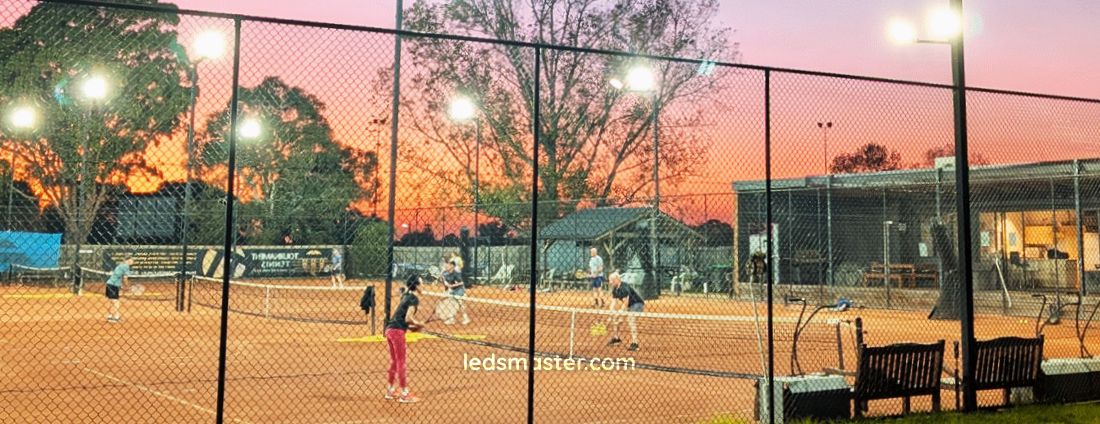
Color temperature determines whether light looks warm or cool, measured in Kelvin (K). Warm light below 3500K can feel cozy and yellowish, which may reduce contrast between the ball and the court. Light that’s too cool, above 6000K, can feel harsh or sterile, which isn’t great for player comfort or spectator enjoyment.
Most modern tennis courts use a range between 4000K and 5700K. 4000K–4500K provides a soft, neutral white that’s easy on the eyes, perfect for residential or community courts. 5000K–5700K, however, is ideal for professional or outdoor competition courts because it mimics daylight and improves contrast, helping players see yellow or green balls more clearly. Studies have even shown that players’ reaction times can improve by 15–20% under 5000K lighting compared to warmer tones.
Color Rendering Index (CRI) is another key factor. A CRI above 80 ensures colors appear natural, so players can clearly see the court lines and ball. High-end competitive or broadcast courts often aim for 90+ CRI for crystal-clear visibility and accurate color representation on TV.
Glare is one of the most common issues in tennis lighting. It happens when the beam hits a player’s eyes directly, causing discomfort or even temporary blindness during a fast serve. Proper glare management is about more than comfort — it can directly affect gameplay and performance.
The best approach is to use asymmetric beam optics, which throw light forward and downward instead of outward. This directs illumination onto the court while keeping light away from spectators, neighboring properties, or passing players.
Most designers aim for a Unified Glare Rating (UGR) below 22 for outdoor tennis courts. This keeps the light visually comfortable without sacrificing brightness. Pole height and aiming angle also play a role. Poles are usually 8–12 meters (26–40 feet) tall, with fixtures angled 20–25 degrees downward. This setup directs light onto the playing surface, reduces unwanted spill, and minimizes shadows around the baseline or net.
Some modern LED fixtures include anti-glare shields or visors, which further improve visual comfort. In multi-court setups, smart controls can dim or brighten sections based on the type of match or time of day, helping save energy and keeping glare in check.
Ever played on a court where one side seemed brighter than the other? That’s what happens when uniformity is ignored. Uneven lighting can make it difficult to judge depth, spin, or ball trajectory.
The uniformity ratio (Emin/Eavg) ensures that the darkest area of the court is still at least 70% of the average brightness. Achieving this usually requires photometric simulations with software like DIALux or AGi32. These programs calculate how light spreads from each fixture, helping determine exact placement, beam angles, and wattage.
Uniformity isn’t just about numbers. A well-lit court should feel naturally illuminated. Players should be able to follow the ball seamlessly from one corner to another without adjusting their vision or losing track of the ball mid-rally.
High uniformity also helps cameras capture consistent images for televised events. Without it, broadcast footage can look patchy, with overly bright or dim sections that distract viewers.
It’s worth noting that horizontal and vertical uniformity are equally important. Horizontal uniformity affects the court surface, while vertical uniformity affects visibility of balls in flight and player faces. A typical design target is 0.7 or higher for both. Lower ratios can make serves and lobs particularly hard to judge, especially for competitive matches.
In addition to brightness and uniformity, designers must consider beam angles. Fixtures with adjustable beam spreads (typically 30°, 60°, or 90°) allow more precise targeting of the light, reducing dark corners and overspill. Narrow beams are often used for higher poles or focused areas like baselines, while wider beams fill in general court areas.
Spill control is also key, particularly for courts near homes or public spaces. Ideally, light beyond the property line should remain under 5 lux at 10 meters, achieved with cutoff optics or shields. This prevents complaints and avoids light pollution while keeping the court fully illuminated.
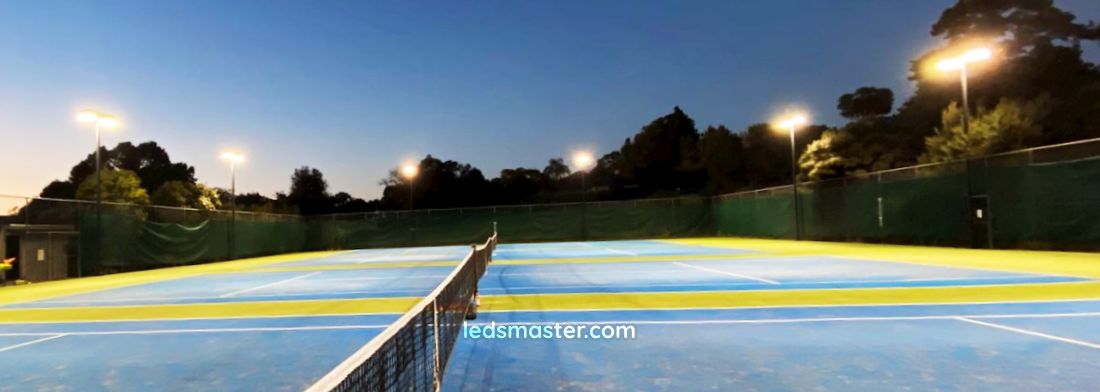
One of the most common questions when planning tennis court lighting is: how many lights do you actually need? The answer depends on a few factors — whether you have a single court or multiple courts side by side, the level of play you’re aiming for, and how bright you want the surface to be.
For a standard outdoor tennis court, the typical setup uses 8 light poles, with 4 on each side of the court. Each pole usually holds 2 fixtures, resulting in 16 fixtures in total. This configuration tends to deliver balanced illumination across the entire court, ensuring both horizontal and vertical light levels are adequate.
For smaller or residential courts, you can often get away with 6 poles and 12 fixtures, especially if you’re using modern high-efficiency LEDs. LEDs allow for more precise beam control, which means fewer fixtures can still provide even coverage.
Pole height plays a big role in light spread and glare control. Poles generally range from 8 to 12 meters (26–40 ft) tall. Taller poles help reduce glare, spread light more evenly, and increase uniformity across the court. The trade-off is that taller poles often require slightly higher wattage fixtures to maintain the same illuminance.
It’s also smart to place poles at least 1–1.5 meters outside the sidelines. This prevents them from obstructing player movement or interfering with ball trajectory near the edges. Spacing poles too close to the playing area can create blind spots or even pose a safety hazard during intense rallies.
Aiming angle is another crucial detail. Fixtures are typically tilted 20–25 degrees downward toward the court, which focuses the light on the surface while minimizing spillover into neighboring properties or spectator areas. Improper aiming can lead to hot spots on the court, shadows near the baseline, or unwanted glare directly in players’ eyes.
Beam angles also make a difference. Using fixtures with adjustable spreads — usually 30°, 60°, or 90° — allows designers to fine-tune the coverage. Narrow beams are great for corners or baselines, while wider beams handle general court illumination. Combining beam angles properly ensures uniform light without over-lighting certain sections.
When upgrading from older systems like metal halide lamps, it’s helpful to know the power requirements. Traditional 1000W metal halides can often be replaced with 300W–600W LED floodlights, depending on the desired brightness. A single court usually requires a total lighting power of around 3–5 kW.
LEDs are more efficient, so you get similar brightness while using significantly less electricity. They also reach full brightness instantly, unlike metal halides, which may take several minutes to warm up.
If you’re lighting multiple courts side by side, proper layout becomes even more important. Fixtures should be positioned and angled to avoid spillover between courts and maintain consistent brightness for all courts. Some modern setups include smart controllers that can dim certain sections or adjust output depending on the type of play. This is especially useful in clubs where casual play and tournaments happen at different times.
Even the flashiest, most expensive fixtures won’t perform well if the overall lighting design isn’t thought through. There are a few mistakes that keep popping up, even in professional setups, and avoiding them can make a huge difference in both playability and comfort.
A surprisingly common misconception is that more brightness automatically means better visibility. In reality, too much light can create glare, harsh reflections, and uneven shadows on the court. Players may see bright spots near the net or baseline while other areas look dim, which can make it tricky to track fast serves or high lobs.
Over-lighting also increases energy consumption unnecessarily. For context, a standard broadcast-level tennis court may reach 1500–2000 lux, but recreational or club courts often function perfectly well at 300–1000 lux. Using fixtures beyond what’s needed not only wastes electricity but can also irritate nearby residents if the court is in a neighborhood.
Another frequent pitfall is uneven or inconsistent spacing of fixtures. Placing poles too close together, too far apart, or at mismatched angles can create “hot spots” — areas that are significantly brighter than the rest of the court. These hot spots make the court feel uneven and can throw off a player’s depth perception.
Designers should aim for even spacing and ensure that the light beams overlap slightly. For a standard outdoor court, 8 poles with 2 fixtures each typically work well, but the exact positioning should be validated using photometric software like DIALux or AGi32 to simulate coverage before installation.
Some designs focus solely on the horizontal surface, forgetting that tennis is a fast-moving sport and the ball spends a lot of time in the air. This leads to insufficient vertical illumination, making it difficult for players to track high serves or lobs.
For professional or club courts, vertical illuminance should generally match or be slightly lower than horizontal levels. For example, a club-level court with 700–1000 lux horizontal illumination should have vertical levels around 500–700 lux to maintain good visibility of airborne balls. Ignoring this aspect can drastically reduce playability, especially for competitive matches.
Color temperature can make or break the visual experience. Using warm light below 3500K can make yellow or green tennis balls blend into the court background, making it harder to follow fast rallies. On the other hand, overly cool lighting above 6000K may feel harsh, sterile, or uncomfortable during long evening sessions.
Most designers settle in the 5000–5700K range, which mimics daylight and improves contrast between the ball and the court surface. Pairing this with a CRI of 80–90 ensures colors appear natural, helping players distinguish lines, balls, and opponents clearly.
Glare is another common headache. Lights that are mounted too low or aimed incorrectly can shine directly into players’ eyes, causing discomfort and visual fatigue. Using asymmetric optics or anti-glare visors helps direct the beam onto the court while keeping it away from players’ sightlines.
Unified Glare Rating (UGR) is a useful metric here. For outdoor tennis courts, keeping UGR below 22 is a good target, ensuring players can focus on the game without squinting or losing track of the ball.
If your court is near homes, schools, or public areas, it’s crucial to consider light pollution regulations. Many municipalities limit spill to less than 5 lux at 10 meters beyond the fence. Ignoring these rules can lead to complaints, fines, or forced fixture adjustments.
Simple solutions include cutoff shields, precise beam optics, or dimming controls. Modern LED systems often allow you to adjust brightness depending on the time of day or event type, which keeps the court functional while being neighbor-friendly.
Avoiding these mistakes isn’t complicated, but it requires planning and attention to detail. Proper fixture selection, pole height, aiming angles, beam spreads, and photometric analysis can save energy, enhance player performance, and ensure that your court feels bright, even, and comfortable for years to come.
At the end of the day, tennis court lighting design is all about balance — enough brightness for gameplay, enough consistency for comfort, and enough control to keep the light where it belongs. Whether you’re planning a backyard setup or upgrading a professional complex, taking time to get the design right pays off for years to come.
With today’s LED technology, achieving professional-grade lighting has become easier and more energy-efficient than ever. A well-designed system doesn’t just illuminate the court — it enhances the experience, making every rally, serve, and volley feel smooth and natural.
When the lighting is done right, you’ll know it. The court feels bright but not blinding, shadows disappear, and every shot feels just a bit cleaner. That’s the beauty of great tennis court lighting — it’s not about noticing the lights; it’s about forgetting they’re even there.