
You might wonder why we’re spending so much time talking about cost. Well, tennis court lighting isn’t cheap, and there are a bunch of factors that can influence the total bill. Are you installing a single residential court or a club-level multi-court facility? Are you going for high-end broadcast-quality lights or just enough to hit some evening serves with friends? The answers can swing the budget anywhere from a few thousand to tens of thousands of dollars.
Ignoring costs can also mean cutting corners—buying cheap lights that burn out fast, skimping on wiring or poles, or underestimating electricity bills. Over time, those “savings” can turn into higher maintenance, replacement, and energy costs. A little planning upfront can actually make lighting cheaper and more effective in the long run.
When planning tennis court lighting, it helps to break down the total cost into several categories: the fixtures themselves, installation and labor, running expenses, and miscellaneous items like connectors, controllers, and surge protection. Each category can vary widely depending on the size of the court, level of play, and the quality of equipment.
| Cost Category | Typical Range | Notes & Details |
|---|---|---|
| Lighting Fixtures | $6,400 – $12,800 (residential), $16,000 – $40,000 (club/tournament) | 16 LED fixtures per court; 300–400W for recreational, 500–600W for competitive; IP65–IP67 ratings; adjustable beam angles 30°–90° |
| Installation Labor | $2,000 – $5,000 | Qualified electricians, riggers, and installers; taller poles may require cranes/lifts ($500–$1,500 extra) |
| Installation Materials | $1,000 – $3,000 | Concrete footings, conduit, junction boxes, anchor bolts, weatherproof fittings; pole cost $500–$1,200 each depending on height and type |
| Running Costs | $700 – $1,000/year (LED), $1,800 – $2,200/year (metal halide) | 3–5 kW LED system, 3 hours/night; LEDs last 50,000–100,000 hours vs 2,000–3,000 hours for metal halides |
| Miscellaneous Costs | $300 – $2,000+ | Surge protection, waterproof connectors, smart controllers/dimmers; reduces energy usage by 30–40% and prevents early failures |
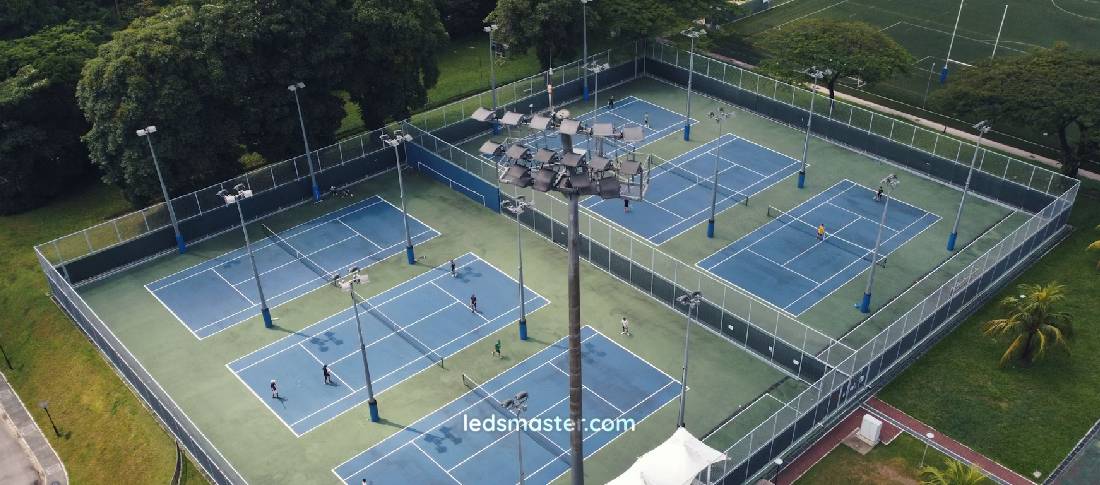
Fixtures often make up the largest portion of the upfront budget. Modern LED floodlights are the go-to choice because they last longer and are far more energy-efficient than older metal halide lamps. For recreational or residential courts, each LED fixture typically costs $400–$800, depending on the brand and wattage. A standard outdoor court with 16 fixtures—usually 2 per pole on 8 poles—can therefore run $6,400–$12,800 just for the lights.
For higher-level courts, like club or tournament setups, the fixtures are brighter, usually 500–600 watts each, producing roughly 60,000–80,000 lumens per fixture. These units cost between $1,000 and $2,500 each, meaning a full 16-fixture setup could be anywhere from $16,000–$40,000. Investing in these higher-end units ensures more uniform lighting, less glare for players, and better coverage for cameras if matches are being recorded or broadcast.
Beam angle and IP ratings also affect costs. Adjustable optics, such as 30°, 60°, or 90° beams, allow installers to fine-tune the spread of light, while IP65–IP67 ratings make fixtures resistant to rain, dust, and coastal salt air. Fixtures with these specifications are slightly more expensive but often prevent future replacement or maintenance costs, saving money over the long run.
Labor and installation are another major factor. For a single-court installation, hiring qualified electricians, riggers, and general installers typically costs $2,000–$5,000. If you’re installing poles taller than 10 meters, you may need cranes or lifts, which can tack on an extra $500–$1,500. Multi-court complexes increase labor costs proportionally because more poles, fixtures, and wiring are involved.
Material costs are also part of installation. Concrete for pole footings, conduit for wiring, weatherproof junction boxes, anchor bolts, and high-quality fittings usually run $1,000–$3,000 for a single court. Poles themselves can vary, with standard steel or aluminum poles costing $500–$1,200 each, depending on height and whether they have telescoping or tilting mechanisms for easier maintenance. Taller poles and heavier-duty systems increase foundation costs because deeper footings and reinforced concrete are needed to withstand wind loads, sometimes over 100 km/h.
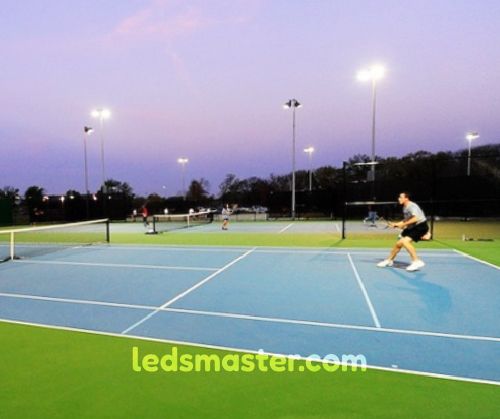 People often underestimate the ongoing costs of electricity and maintenance. Modern LED systems are much cheaper to run than older 10–12 kW metal halide systems. A typical 3–5 kW LED setup running three hours per night costs roughly $2–$3 per night, while the older metal halide equivalent might be $5–$6 per night. Over a year, that difference adds up to $700–$1,000 for LEDs versus $1,800–$2,200 for metal halides, and if you continue using LEDs for 10 years, the cumulative savings can reach several thousand dollars.
Maintenance is another area where LEDs shine. With lifespans between 50,000 and 100,000 hours, you might not need to replace bulbs for 10–15 years, compared to metal halide lamps that often need replacement every 2,000–3,000 hours. Less frequent maintenance means savings on both replacement parts and labor. It also reduces downtime—players won’t have to wait weeks for repairs or new bulbs.
Other costs can sneak in but are worth considering because they protect your investment. Surge protection devices help prevent damage from voltage spikes, particularly in storm-prone areas. High-quality, IP-rated connectors and waterproof fittings prevent corrosion, especially if the court is in a coastal region or high-humidity climate.
Smart controllers and dimming systems are another consideration. Installing programmable timers, dimmers, or motion sensors may cost $300–$1,000 extra, but they can reduce electricity usage by up to 30–40%, which translates into long-term savings. These systems also allow partial-court lighting, which is handy for practice sessions without wasting energy on the entire setup.
Even though miscellaneous costs seem small compared to fixtures or labor, ignoring them can lead to early failures. In many cases, spending a few hundred or a couple thousand dollars more upfront prevents repairs or replacements that could easily double in cost over time.
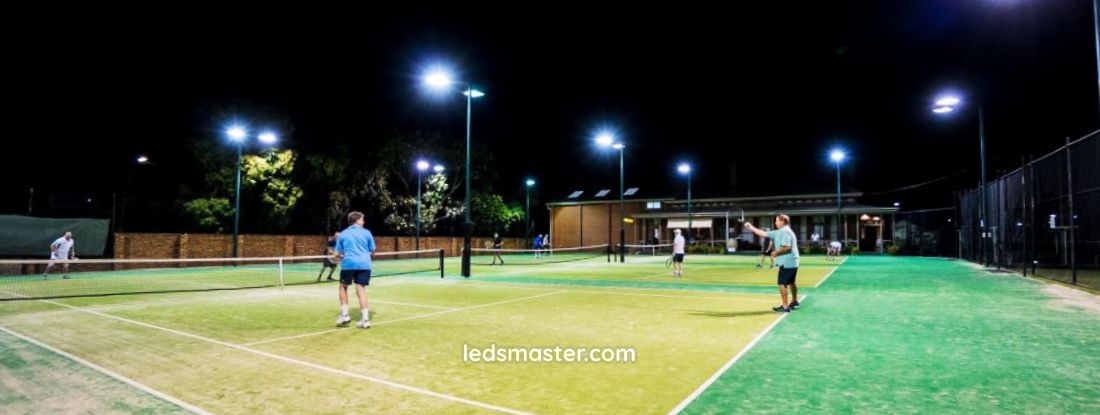
Planning ahead is key if you want a bright, safe court without overspending. There are several strategies to keep costs manageable while still getting good performance.
One of the easiest ways to save is by picking fixtures that actually match your needs. It’s tempting to go for the biggest, brightest, and most expensive lights, assuming they’ll automatically make the court better. But for recreational courts, you rarely need more than 300–400 watts per fixture, which produces around 36,000–48,000 lumens. Using higher-wattage fixtures not only costs more upfront—sometimes $1,000 or more per light—but also increases electricity usage. Running unnecessary 500–600 watt units for casual practice can add $1–2 per night extra, which stacks up over a year.
For club or tournament courts, higher-wattage units are justified because they provide 700–1,500 lux on the playing surface and better vertical illumination for fast-moving balls. But even here, smart planning of beam angles and pole height can sometimes reduce the total number of fixtures needed, saving several thousand dollars.
Where you put your poles can dramatically affect both cost and performance. Poles placed too close together force you to add extra fixtures to avoid dark spots and shadows near baselines or sidelines. On the other hand, taller poles—around 10–12 meters—paired with wide or asymmetric beam optics can illuminate the court more evenly, reducing the total number of fixtures.
Using asymmetric optics is especially handy in multi-court complexes. They focus light only on the intended court, preventing spillover to neighboring courts or nearby houses. This not only reduces energy waste but also helps you avoid potential fines or complaints related to light pollution.
Buying fixtures in bulk can significantly lower your upfront costs. Many suppliers offer discounts when you order complete court packages—usually 16 fixtures for a single outdoor court. You might save 5–15% per fixture compared to buying individually, which can add up to $500–$2,000 in savings on a full court.
Combining bulk orders with a reputable local installer experienced in sports lighting is another money-saver. Experienced installers know the right pole foundation depth, wiring techniques, and light aiming strategies. This reduces mistakes that can be costly to fix, such as improperly angled fixtures, uneven illumination, or premature equipment failure.
Smart lighting systems aren’t just convenient—they save money. Dimmers, timers, or motion sensors can cut energy consumption by 30–40% annually. For example, if your court runs 3 hours per night and costs $2–3 per night with LEDs, smart controls could save $200–$400 a year on electricity alone.
Some LED systems even allow partial court lighting, so you don’t have to turn on all 16 fixtures for a single-player practice session. For multi-court facilities, this feature is even more useful, reducing unnecessary electricity use across multiple courts simultaneously.
A final way to save is by thinking about maintenance early. Choosing LEDs with 50,000–100,000 hours of lifespan, weatherproof IP65–IP67-rated connectors, and surge protection reduces replacement and repair costs. Even a single blown fixture or corroded connector can cost $200–$500 to replace, not including labor. Spending a bit more upfront on high-quality components can save thousands over 10–15 years.
Upgrading or installing tennis court lighting can feel expensive, but there are a number of grants, rebates, and funding options that can make the investment more manageable. Whether you run a community club, a school program, or a municipal sports facility, knowing where to look for financial support can save thousands of dollars and allow you to install higher-quality, energy-efficient lighting.
Eligibility usually revolves around public access and community benefit. Courts that are open to the public, part of youth or recreational programs, or managed by nonprofits and local councils are often prioritized. Even private clubs sometimes qualify if they offer public access or community programs.
Applications generally ask for a project plan, including the number of courts, type of lighting fixtures (LEDs are usually preferred), pole height, and a breakdown of costs. Grant bodies often like to see energy-efficient designs, such as LED floodlights with dimming or smart controls. They also favor projects that reduce light pollution, improve player safety, or extend usage hours without significantly increasing running costs.
Grants can cover various aspects: some cover only fixtures, others include installation labor, concrete pole foundations, wiring, and electrical work, while a few programs even support smart controllers or energy management systems. Depending on the grant, you might receive partial or full coverage of these costs.
One of the main sources of funding in the United States is the United States Tennis Association (USTA). Through their Tennis Venue Services (TVS) program, they provide grants for facility upgrades, including LED court lighting. For small-scale projects, grants can cover up to $5,000, while larger renovations or new multi-court setups can receive $12,500 to $55,000 depending on the number of courts and scope of the project. Club-level or tournament-grade courts generally receive higher funding due to the scale and community impact.
Utility companies are another great option, especially for LED lighting. Many electricity providers offer energy-efficiency rebates that cover 10–30% of the project cost. For example, if your total project costs $20,000 for a single-court LED lighting system, a 25% rebate would reduce your out-of-pocket expense by $5,000. Some utilities even offer pre-approval for rebate eligibility, helping you plan your project more confidently.
State and federal programs can also provide financial support, particularly for public schools, recreation centers, or nonprofit sports programs. For instance, energy efficiency initiatives may allocate tens of thousands of dollars for facility improvements like LED lighting. While each application varies, schools or community centers may see grants of $5,000–$25,000 per court or project.
Timing and documentation are key. Collect detailed quotes from fixture suppliers, installation labor estimates, and projected running costs before applying. Showing that your design uses IP-rated waterproof connectors, energy-efficient LEDs, and smart controllers increases your chances of success.
Sometimes, combining funding sources works best. For example, you might use a USTA TVS grant to cover fixture costs and apply for a utility rebate to offset installation and wiring expenses. Some programs even allow layering state, federal, and private grants for maximum support.
Energy efficiency also makes a difference. Many programs favor LED systems because they reduce energy consumption by 60–70% compared to traditional metal halide fixtures. Highlighting annual savings on electricity and maintenance can strengthen your grant application, showing long-term financial and environmental benefits.
Even if you’re eligible for grants or rebates, it’s wise to plan for upfront costs. Many grants reimburse after the project is completed, so having a financing plan ensures the project isn’t stalled. Some programs allow partial pre-funding or advance approval, which helps manage cash flow.
Including extras like smart dimmers, timers, or motion sensors in your proposal can increase upfront costs, but grants may cover these features. Over time, these devices save energy and maintenance costs, which can make your project more cost-effective and appealing to grant committees.
In short, knowing where to apply, what documentation to provide, and emphasizing energy efficiency can make tennis court lighting projects much more affordable. Leveraging a combination of USTA grants, utility rebates, and local or state funding often allows facilities to install higher-quality, more reliable lighting than they could with cash alone, all while minimizing long-term running costs.
The takeaway is that tennis court lighting cost is not just a single number—it’s a combination of fixture price, labor, materials, running costs, and long-term maintenance. Overspending on high-end equipment you don’t need or skimping on installation can both be expensive mistakes. Thoughtful planning, proper fixture selection, and exploring grants or rebates can help you get the best lighting while keeping costs reasonable.
Good lighting makes evening play possible, keeps players safe, and even adds a professional feel to your facility. Spending some time understanding the costs and planning accordingly means your court will shine brightly for years without burning through your budget.