
Before grabbing a wrench or climbing a ladder, it pays to really understand the lighting fixtures themselves. Most modern tennis courts rely on LED floodlights, which have largely replaced older metal halides. LEDs are not only more energy-efficient—they can cut electricity costs by 60–70% compared to traditional lamps—but they also last longer, often 50,000 to 100,000 hours, which translates to a decade or more of minimal maintenance.
Each fixture comes with several specifications that help determine how it will perform on the court. Watts and lumens tell you how much energy the light consumes and how bright it will be. For residential courts, a 300–400 watt fixture producing roughly 36,000–48,000 lumens is usually sufficient. For club-level or tournament courts, you might be looking at 500–600 watt fixtures that pump out 60,000–80,000 lumens, giving that uniform, broadcast-quality illumination players need.
Beam angles are another key factor. Adjustable optics—like 30°, 60°, or 90°—allow precise control over how the light spreads across the court. Narrow beams focus on baseline or net areas, while wider angles cover general court surfaces. The IP rating, usually IP65 or higher for outdoor fixtures, indicates resistance to rain, dust, and other environmental factors. Coastal areas or courts with heavy rain will benefit from IP66 or even IP67-rated fixtures.
Knowing these specifications upfront influences pole height, number of fixtures, and positioning. Taller poles, say 10–12 meters, spread light farther, reducing the total number of fixtures needed and minimizing glare. Shorter poles, around 8 meters, may require extra lights and precise angling to avoid dark spots near the sidelines.
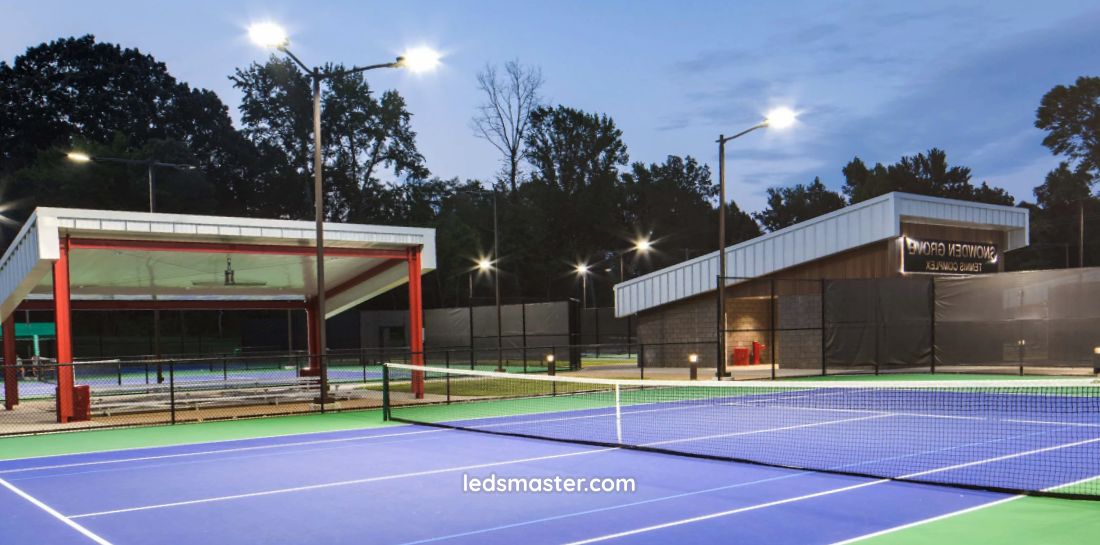
Wiring is the backbone of a safe and reliable lighting system. Every connection needs to be properly grounded, protected from water ingress, and compliant with local electrical codes. Typically, each pole houses a conduit running from the base to the top, connecting the fixture to the main power supply. For multi-court installations, it’s common to use dedicated circuits for each pole or each side of the court, so a single outage doesn’t plunge the entire complex into darkness.
LEDs use drivers instead of ballasts, which can change how wiring is configured, especially when retrofitting older metal halide systems. Modern drivers often have dimming capabilities, so installing a compatible wiring setup allows for smart controls that adjust brightness based on time of day or type of match.
Weatherproof junction boxes and outdoor-rated cables are not optional—they protect the system from shorts, corrosion, and long-term wear. Many installers also add surge protection devices to handle sudden voltage spikes, which can damage sensitive LED electronics.
One of the most overlooked parts of lighting installation is waterproofing. Even the best fixtures fail if moisture reaches the electrical connections. Every terminal box, driver compartment, and cable end should have rubber gaskets, silicone seals, or heat shrink tubing. Using IP65-rated connectors ensures the system survives heavy rain or humidity without degradation.
For courts near the ocean or in highly humid climates, corrosion-resistant connectors or marine-grade fittings can extend the lifespan by years. Sealing compounds applied at joints add an extra layer of protection, preventing slow leaks that might not be visible immediately but could damage LEDs over time.
Poles need a rock-solid foundation to keep the system stable. Standard tennis court poles range from 8–12 meters (26–40 feet) in height, anchored in concrete footings at least 1 meter deep, depending on soil type. Taller poles spread light more evenly but also require heavier-duty foundations to handle wind loads, which can exceed 100 km/h (62 mph) in open areas.
Fixture weight is another consideration. A typical LED fixture weighs 15–30 kg (33–66 pounds), and with 2–4 fixtures per pole, you’re talking about 60–100 kg (132–220 pounds) per pole, not including mounting hardware. Poles are usually rated with a 20–30% safety margin to accommodate this load plus wind, vibration, and extra equipment.
Once poles are installed, mounting the fixtures requires careful attention to angles. Standard practice tilts the lights 20–25 degrees downward, directing the beam onto the playing surface while minimizing glare. Asymmetric optics are especially useful for multi-court setups, focusing light forward and downward to prevent spillover onto neighboring courts or properties.
During installation, a lux meter can help measure horizontal and vertical illuminance, making sure the uniformity ratio stays above 0.7, which avoids overly bright or dim patches. Horizontal lux values often target 300–500 lux for residential courts and 700–1500 lux for club or professional courts. Vertical lux, measured at about 1.5–2 meters above the court, ensures players can track balls traveling at high speeds—sometimes over 200 km/h (124 mph).
After the hardware is in place, the system needs careful testing. Turn everything on and check for flickering, uneven light, or glare issues. Adjust angles and beam spreads as needed. In multi-court setups, it may take a few tries to balance light across all courts so that each has even coverage without creating hotspots.
Modern LED systems often come with dimmer controls or smart lighting options. This lets you dial down brightness for casual practice sessions and crank it up for tournaments or televised matches. Smart controls can even integrate with timers, motion sensors, or energy management systems, helping reduce power consumption while keeping the court fully illuminated when needed.
A final walk-through should include checking fixture stability, wiring integrity, and waterproof seals. Even small misalignments or loose bolts can affect performance, safety, and longevity. Taking the time to fine-tune each fixture ensures that the court feels professional and looks great, whether it’s under casual floodlights or stadium-level illumination.
| Step | Key Details | Typical Numbers / Specs | Notes |
|---|---|---|---|
| Understanding Fixtures | Choose LED floodlights, check wattage, lumens, beam angles, IP rating | Residential: 300–400W, 36,000–48,000 lm; Club/Pro: 500–600W, 60,000–80,000 lm; Beam angles: 30°, 60°, 90°; IP65–IP67 | Affects pole height, number of fixtures, and glare control |
| Planning Wiring | Install grounded, weatherproof circuits; use LED drivers; surge protection | Dedicated circuit per pole or court; outdoor-rated cables | Ensures safety and reliability, allows dimming/smart control |
| Waterproof Connections | Seal all terminals, driver compartments, cable ends | IP65+ rated connectors; silicone gaskets or heat shrink; marine-grade in humid/coastal areas | Prevents corrosion and fixture failure over time |
| Pole Installation | Anchor poles in concrete, consider height and load | Pole height: 8–12 m (26–40 ft); concrete footing ≥1 m deep; wind load up to 100 km/h (62 mph); Pole load: 60–100 kg (132–220 lbs) | Taller poles spread light evenly; foundation must handle wind and fixture weight |
| Fixture Mounting | Mount and angle fixtures for optimal coverage | Tilt 20–25° downward; horizontal lux: 300–500 (residential), 700–1500 (club/pro); uniformity ratio ≥0.7; vertical lux: 500–600 at 1.5–2 m | Use asymmetric optics for multi-court setups to prevent spillover |
| Testing & Fine-Tuning | Measure illuminance, check glare, adjust angles, verify stability | Lux meters for horizontal/vertical; uniformity ratio ≥0.7; ensure IP seals intact |
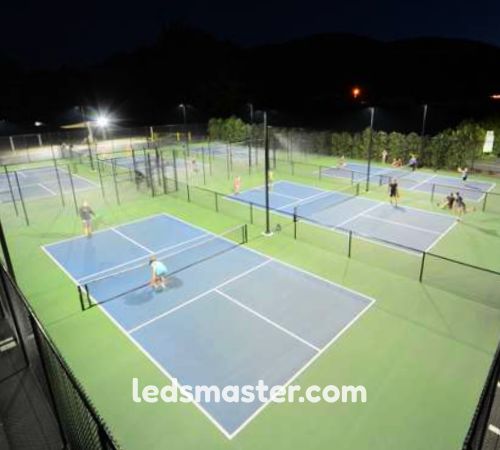 Even seasoned installers can run into issues if certain aspects aren’t carefully considered. Some mistakes are subtle, while others can have a noticeable impact on play, energy costs, and even safety.
One trap is thinking that brighter is always better. Cranking up the wattage or adding extra fixtures may seem like it will improve visibility, but in reality, it often backfires. Excessive light can cause glare, harsh shadows, and reflections off glossy court surfaces, making it harder for players to track the ball. Recreational courts generally need 300–500 lux (30–50 foot-candles), while club-level setups perform well around 700–1000 lux (65–90 foot-candles). Professional or broadcast courts can go up to 1300–1500 lux, but pushing beyond that rarely improves play and often irritates neighbors, especially in residential areas. Matching the light intensity to the court’s use keeps energy costs reasonable and maintains visual comfort.
Another common issue is poor positioning of poles and fixtures. Poles too close together, unevenly spaced, or misaligned can create hot spots, where parts of the court are overly bright, while other sections—like the corners—remain dim. Even a small difference in horizontal illuminance can affect ball tracking and depth perception. Using consistent spacing, overlapping beams, and photometric layouts ensures even light distribution, which improves gameplay and prevents unnecessary strain on players’ eyes.
A lot of attention goes to lighting the court surface, but vertical illuminance is just as important. Players need to see the ball in mid-air, especially during serves, volleys, or lobs that can travel over 200 km/h (124 mph) in competitive matches. Club-level courts typically aim for 500–600 lux at player height (around 1.5–2 meters), while professional or broadcast courts may reach 1200 lux vertically. Neglecting this aspect makes tracking fast balls much harder and reduces reaction time, even if the horizontal court lighting seems sufficient.
Outdoor courts face rain, humidity, and sometimes coastal salt spray. Improper waterproofing is a frequent culprit behind early fixture failures. Moisture entering connectors, driver compartments, or terminal boxes can short-circuit the system within months, leading to costly replacements. Using IP-rated enclosures (IP65 or higher), rubber gaskets, silicone seals, and heat shrink tubing prevents water ingress. In humid or coastal regions, even small lapses can drastically reduce fixture lifespan, so waterproofing isn’t optional—it’s a safeguard for longevity.
Poles are the backbone of the lighting system, and if they’re unstable, everything else suffers. Wobbly poles affect light angles, create vibrations that can stress fixtures, and in extreme cases, pose safety hazards. A proper installation includes concrete footings at least 1 meter deep, anchor bolts rated for both the weight of fixtures (often 15–30 kg per light, 2–4 lights per pole) and wind loads exceeding 100 km/h, and periodic inspections for loosening or corrosion. Overlooking these details not only compromises performance but also increases liability risks during storms or maintenance.
Another subtle mistake is overlooking glare control and light spill, particularly in courts near houses or streets. Lights aimed too low or without asymmetric optics can send beams directly into players’ eyes or neighboring yards. Keeping fixture angles around 20–25 degrees downward and using shields or visors reduces glare, while proper beam orientation ensures the light stays on the court. Neglecting this can result in complaints, fines in some municipalities, and a less enjoyable playing experience.
Finally, rushing through the installation without lux measurements can leave you with uneven or insufficient lighting. Using a lux meter to check horizontal and vertical illumination ensures that every corner of the court meets design targets. Uniformity ratios below 0.7 or large discrepancies in vertical lux can ruin gameplay, so skipping this step is more costly than it seems—it’s much harder to adjust beams after the concrete poles and fixtures are set.
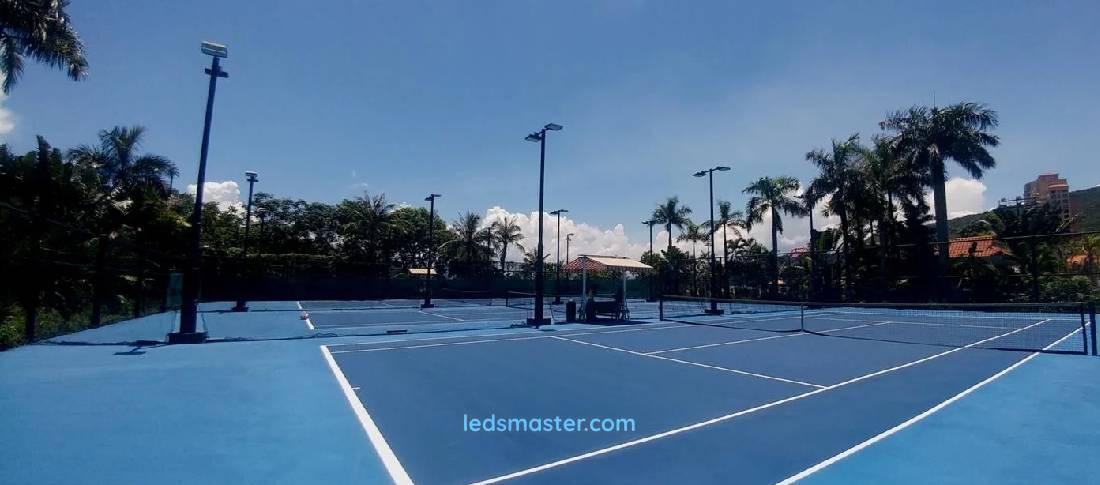
When it comes to lighting a tennis court, cost can vary widely depending on the type of court, the level of play, and the quality of materials and labor. It’s not just about buying lights—you also have to factor in poles, wiring, foundations, and ongoing electricity use.
Fixtures often take up the biggest slice of the budget. For recreational courts, LED floodlights usually cost between $400 and $800 each, while high-end professional units can range from $1,000 to $2,500 per fixture. A standard outdoor court typically uses 16 fixtures—2 on each of 8 poles—so just buying the lights can cost anywhere from $6,400 to $20,000 depending on quality and brand.
It’s worth noting that the wattage of each fixture affects both upfront and running costs. Residential courts often use 300–400 watt LEDs, producing roughly 36,000–48,000 lumens per fixture, while competitive or club-level setups might use 500–600 watt units for higher brightness and better uniformity. Investing in slightly higher-quality LEDs can reduce maintenance and replacements over the years, making it a more cost-effective choice in the long run.
Installation labor can be another significant part of the total cost. Professional electricians, riggers, and general installers usually charge $2,000–$5,000 for a single-court installation. Multi-court setups scale up proportionally.
The complexity of the job also affects cost. Courts with taller poles around 10–12 meters (33–40 feet) often require cranes or lifts for mounting fixtures, which adds $500–$1,500 to labor expenses. Tilting or telescoping poles can simplify maintenance but might increase initial labor because of their extra components.
Don’t forget materials beyond the lights themselves. Concrete for pole foundations, conduit, wiring, junction boxes, weatherproof fittings, and anchor bolts can add $1,000–$3,000 to the bill. Poles need strong footings—usually at least 1 meter deep, sometimes more in softer soils—and high-quality IP-rated connectors, silicone seals, and surge protection devices are worth the investment. Cutting corners on materials might save a few hundred dollars upfront but can lead to premature failure of the entire lighting system.
One of the main advantages of modern LED systems is energy efficiency. A typical 3–5 kW LED setup used for three hours per night might cost $2–$3 per night, whereas a traditional 10–12 kW metal halide system could cost $5–$6 per night. Over a year, assuming daily use, that’s roughly $700–$1,000 for LEDs versus $1,800–$2,200 for metal halides, saving thousands of dollars over the system’s lifespan.
LEDs also last much longer, often 50,000–100,000 hours, meaning you might not have to replace bulbs for 10–15 years. Maintenance savings on labor, replacement bulbs, and down-time can be just as meaningful as the energy savings.
| Cost Component | Typical Range | Notes |
|---|---|---|
| Lighting Fixtures | $400–$800 each (residential); $1,000–$2,500 each (professional) | 16 fixtures per standard outdoor court; 300–400W for residential, 500–600W for club/pro courts |
| Labor & Installation | $2,000–$5,000 per court | Taller poles (10–12 m) may require cranes/lifts, adding $500–$1,500 |
| Materials | $1,000–$3,000 | Includes concrete footings, conduit, junction boxes, IP-rated connectors, surge protection |
| Running Costs (Electricity) | $2–$3 per night (LED, 3–5 kW); $5–$6 per night (metal halide, 10–12 kW) | LED systems save ~$1,000–$1,500 per year for daily use; lifespan 50,000–100,000 hours |
| Total Upfront Cost | $9,400–$28,000 | Combines fixtures, labor, and materials for a single court; varies by quality and setup |
When planning an installation, it helps to think beyond the sticker price. Choosing slightly more expensive, energy-efficient LEDs with proper waterproofing, surge protection, and durable poles pays off over time. It’s the difference between a system that needs constant tweaks and one that works reliably for a decade or more. Even investing in better beam control optics or dimmers can save energy and improve player comfort, making the court more enjoyable without extra operational costs.
A well-planned installation balances initial spending with running and maintenance costs. Spending a bit more upfront on quality fixtures, wiring, and poles often prevents headaches, reduces energy bills, and keeps your tennis court looking professional for years to come.