
Color temperature, measured in Kelvin (K), refers to the hue of light emitted by a fixture. Lower Kelvin numbers produce warmer, yellowish light, while higher numbers give cooler, bluish-white light. On a tennis court, color temperature influences how clearly players can see the ball, judge depth, and react during fast rallies.
For example, yellow tennis balls are easier to track under neutral to cool white lighting, typically in the 5,000–6,000K range. If the lights are too warm, like 3,000–3,500K, the yellow ball can blend with the background, making quick movements harder to follow. Conversely, overly cool lights above 6,500K can cause glare and eye strain, especially on reflective surfaces like hard courts.
Color temperature also affects perceived brightness. A 500-watt LED at 5,500K might look brighter than the same fixture at 3,500K because our eyes are more sensitive to cooler tones. That means players can see clearly even without increasing wattage, which saves energy and reduces costs.
In short, choosing the right color temperature impacts player performance, safety, and comfort, and can even affect how attractive your court looks for evening matches or events.
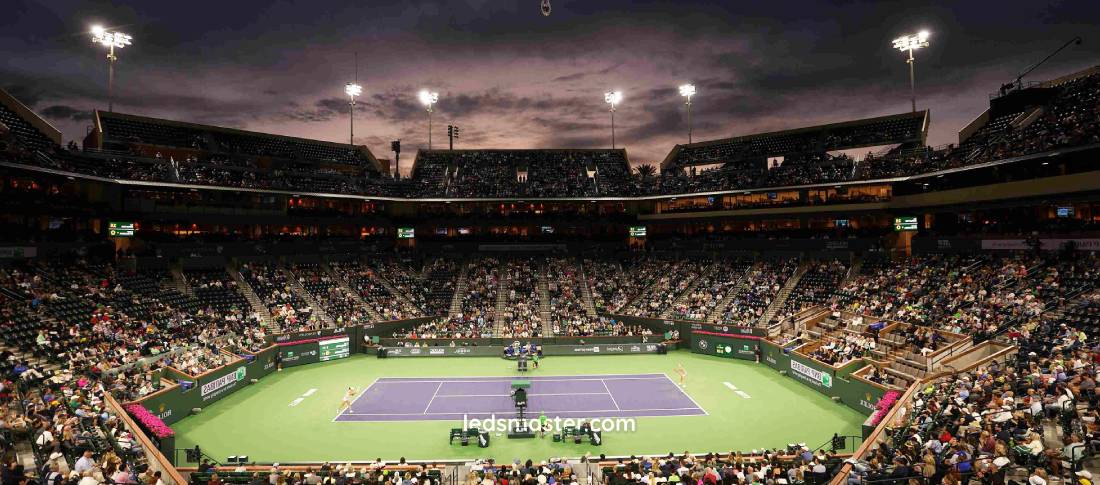
Not all tennis courts are created equal, and neither is their lighting. Factors like the level of play, court size, surface type, and intended usage all influence what color temperature works best. Choosing the right temperature helps players track the ball, reduces glare, and ensures the court looks inviting during evening sessions.
| Court Type | Color Temperature (K) | Horizontal Illuminance (lux) | Vertical Illuminance (lux) | Poles | Fixtures per Pole | Fixture Wattage (W) |
|---|---|---|---|---|---|---|
| Recreational / Backyard | 3,500–4,500 | 200–400 | N/A | 8–10 | 2–3 | 250–400 |
| Regional / Club-Level | 4,500–5,500 | 500–700 | 400–600 | 10–12 | 2–4 | 300–500 |
| Competition / Tournament | 5,500–6,500 | 1,200–1,500 | 1,000+ | 12–16 | 4–6 | 500–600 |
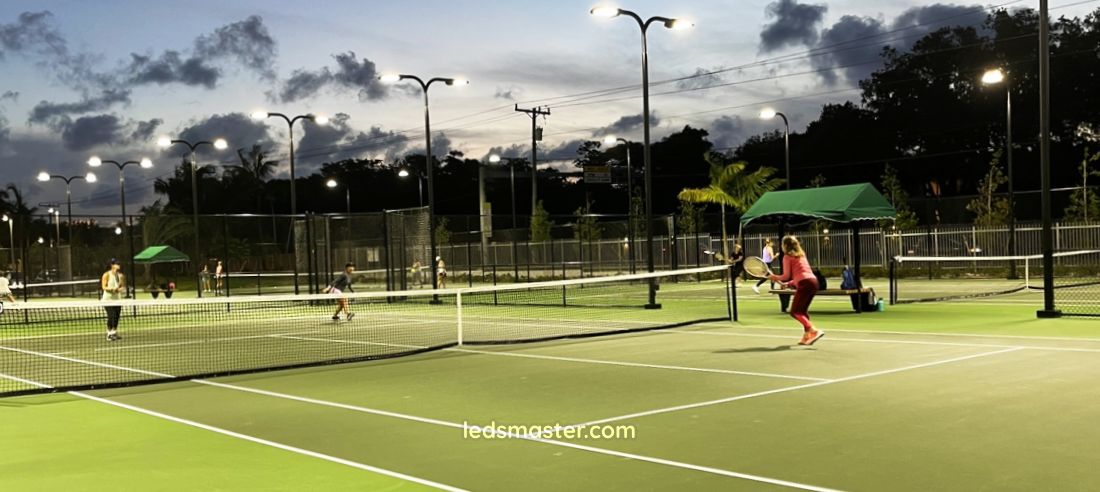
Community or backyard courts typically see casual play, maybe a few hours in the evening after work or school. For these courts, a color temperature between 3,500 and 4,500K is usually ideal. This produces a warmer, slightly yellowish-white light that feels comfortable without being harsh.
Even with horizontal illuminance around 200–400 lux, players can clearly see the ball, judge depth, and avoid shadows that might interfere with play. Warmer lighting also softens the overall ambiance, which is especially useful for residential areas where neighbors might be sensitive to bright lights spilling over property lines.
Smaller courts, like those in private homes or small clubs, often use 8–10 poles with 2–3 fixtures per pole, usually in the 250–400 watt range. Warmer light helps hide minor inconsistencies in illumination, which can make the court feel more evenly lit even if it’s not as intense as professional setups.
When moving up to club or regional courts, players expect a more professional experience. These courts host structured practice, tournaments, or league play, so visibility becomes more important. A color temperature range of 4,500–5,500K works well here, offering neutral white light that balances clarity and comfort.
Clubs often aim for horizontal illuminance of 500–700 lux, with vertical lux around 400–600 lux at roughly 1.5–2 meters above the court surface. This ensures players can track fast serves, high lobs, and volleys without struggling to see the ball in mid-air. Neutral white light also improves contrast for yellow or green balls, which is particularly important in competitive practice or coaching scenarios.
Many club courts use LED fixtures in the 300–500 watt range, sometimes paired with asymmetric optics to minimize glare and reduce light spill to surrounding areas. With 10–12 poles and 2–4 fixtures per pole, a full court setup provides uniform coverage, while still keeping electricity usage reasonable. Neutral white light at this level also enhances video recording quality, making it easier to capture training sessions or matches.
At the highest level, like professional, televised, or multi-court tournament venues, lighting requirements are significantly more demanding. These courts typically use cool white light in the 5,500–6,500K range, which gives sharp, daylight-like visibility across the entire playing surface.
Horizontal illuminance often reaches 1,200–1,500 lux, while vertical lux may hit 1,000 lux or more, allowing players, referees, and cameras to follow every ball clearly, even under floodlights. Cool white light also reduces shadows, which is crucial for televised broadcasts where inconsistent lighting can create distracting dark spots or uneven footage.
Tournament courts often have 12–16 poles with 4–6 high-power LED fixtures per pole, sometimes rated 500–600 watts each. Asymmetric optics and precise aiming are used to focus light on the court while avoiding spillover onto neighboring courts or surrounding areas. Some facilities even use adjustable LED fixtures to fine-tune color temperature slightly depending on weather conditions, time of day, or broadcast needs.
Cooler lights at 6,000–6,500K also help make the court feel vibrant and professional during evening matches. Players benefit from improved contrast, spectators notice clearer visuals, and the court maintains a uniform look that enhances the overall experience. In addition, these fixtures are often paired with smart controls or dimmers, letting tournament organizers adjust brightness or color temperature slightly to save energy without compromising visibility.
Each type of court has different lighting goals. Recreational courts focus on comfort and affordability, club courts on visibility and training performance, and tournament courts on broadcast-quality light and player precision. Choosing the right color temperature, along with lux levels and beam angles, ensures a court is safe, enjoyable, and energy-efficient.
Using too warm a light on a competitive court can reduce contrast and make the ball harder to track, while overly cold light on a recreational court can feel harsh and create glare for casual players. In practice, sticking within the ranges of 3,500–4,500K for recreational, 4,500–5,500K for club, and 5,500–6,500K for tournament courts hits the sweet spot for most scenarios.
Choosing the wrong color temperature for tennis court lighting can noticeably affect both player performance and spectator experience. The effects aren’t just about aesthetics—they can influence how quickly players react, how easy it is to track the ball, and even how long people feel comfortable playing.
Warm lighting below 4,000K gives a cozy, yellowish glow. While this feels inviting for evening recreational play, it can create some challenges. Yellow or green tennis balls can blend with the court surface, especially clay or grass courts, making them harder to see during fast volleys or overhead smashes. Players may experience slightly slower reaction times because their depth perception is subtly affected by the softer light.
Shadows under warm lights also tend to be longer and softer. On smaller courts with multiple poles, this can create uneven lighting patches. If the horizontal illuminance drops below 300 lux in corners or along baselines, players may misjudge ball bounces or foot placement. Warm lights also tend to feel dimmer than they actually are, tempting operators to add extra fixtures or increase wattage unnecessarily. For instance, adding two extra 300–400 watt LED fixtures could cost an additional $800–$1,200 upfront, plus extra energy costs over time.
On the other end, color temperatures above 6,500K produce bluish-white light, which can feel harsh. This is especially noticeable on polished hard courts, acrylic surfaces, or even wet courts after rain. The glare can lead to eye strain, headaches, and quicker visual fatigue during extended practice or tournaments. Players often report discomfort after just 60–90 minutes under very cold lights.
Cold lights can also make courts appear sterile or overly bright to spectators. This can impact clubs in residential neighborhoods, where glare and light spill may become a nuisance or even violate local lighting ordinances. Energy-wise, operators may overcompensate with additional fixtures to reduce perceived shadows, unnecessarily increasing electricity costs by 10–20%.
Color temperature doesn’t work in isolation. Fixture placement, beam angle, and aiming all play a role. A cooler fixture with a wide asymmetric beam, for example, can minimize glare and provide uniform coverage, while poorly positioned warm lights can create dark spots or bright patches that disrupt gameplay.
For instance, a club court with 500 watt LEDs at 5,000K combined with a 60° beam angle can cover a standard 78 × 36 feet court with horizontal illuminance around 600–700 lux and vertical illuminance of 450–500 lux at player eye height. If the lights were warmer (around 3,800K) with the same setup, players might struggle to track the ball mid-air, especially under shadows near the net posts.
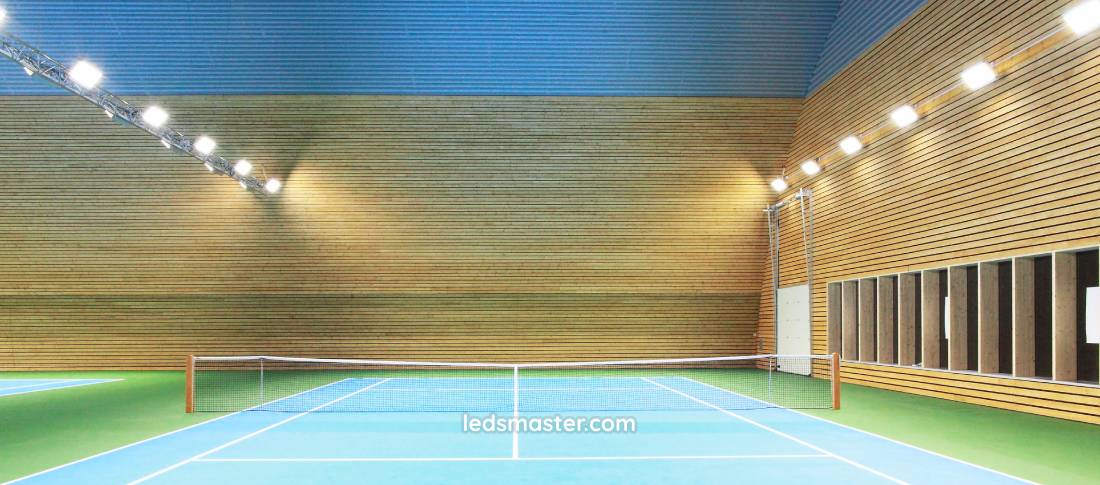
When planning tennis court lighting, the type of fixture you pick plays a huge role in how players perceive the light. Modern LED systems have made color temperature control much easier than older metal halide or fluorescent setups, which were fixed and often too harsh or too warm.
LEDs now come in both fixed and adjustable color temperature options. Fixed units are simple and reliable, usually offering a neutral white around 5,000–5,700K. They’re cheaper upfront, generally $400–$800 per fixture for recreational courts, and provide consistent lighting without needing extra controls.
Adjustable or tunable LEDs, on the other hand, allow courts to change color temperature depending on the use case. For example, a club could use 4,500K for casual evening practice to reduce glare and make the space feel warmer, and then switch to 5,500–6,000K for tournaments or matches that are filmed for broadcasts. Some high-end fixtures even allow dimming and color tuning together, giving complete control over both brightness and tone. This flexibility can reduce complaints from players about eye strain or poor ball visibility and also help lower energy costs. A system like this might cost $1,200–$2,500 per fixture for professional setups, but the long-term benefits in performance and energy efficiency often outweigh the upfront cost.
Even with the right color temperature, fixture durability and optics remain just as important. Outdoor courts face rain, humidity, dust, and even salt if located near the coast. Fixtures rated IP65 or higher are well-sealed to survive these conditions without performance degradation. Some competition-level fixtures are rated IP66–IP67 for extra protection in extreme environments.
Optics—especially asymmetric lenses—work hand-in-hand with color temperature. By directing light forward and downward, asymmetric optics ensure the court is brightly and evenly illuminated, while minimizing spillover onto nearby houses, streets, or other courts. This combination of proper optics and the correct color temperature not only improves visibility but also makes the court more visually comfortable for players and spectators alike.
For a standard 78 × 36 feet club court with eight poles and two 500 watt fixtures per pole, using adjustable LEDs at 5,000–5,700K can provide horizontal lux of 600–700 and vertical lux around 450–500 at player height. Switching to 4,500K for casual practice reduces glare slightly and creates a warmer feel for less formal play. Without adjustable fixtures, operators would need to compromise or install extra controls to mimic this effect.
Color temperature is more than a technical specification—it directly affects how players see the ball, perceive depth, and enjoy the game. Choosing the right range for your court type, using LEDs with proper optics, and balancing lux and placement can dramatically improve both performance and energy efficiency.
For recreational courts, 3,500–4,500K provides comfort and clarity, club-level courts benefit from 4,500–5,500K, and professional or broadcast courts need 5,500–6,500K for high-visibility, uniform illumination. Avoiding extremes—too warm or too cold—ensures safer, more enjoyable matches, while LED fixtures can reduce running costs by 50–70% compared to older lamps.
Ultimately, paying attention to color temperature, along with fixture quality and placement, helps your tennis court look professional, feel comfortable, and save money over time.