
People often focus on brightness levels or how evenly the court is lit, but the cost side matters just as much. If you overspend upfront, your budget takes a hit before the lights even get turned on. But if you buy the cheapest system out there, you might end up paying way more in electricity and maintenance over time.
Lighting costs aren’t just a one-time thing either. A court used every evening can run its lights for over 1,000 hours per year, which means energy bills add up fast if the system isn’t efficient. Plus, old-school lamps like metal halides need frequent bulb changes and waste a lot of power as heat, while modern LED systems last longer and use 60–70% less energy.
For facilities with limited funding, like schools or small sports centers, looking at total ownership costs rather than just the sticker price keeps surprises away down the road.
When people ask how much it costs to light up a basketball court, the answer is never one-size-fits-all. A small outdoor half-court, a standard high school gym, and a professional arena all need totally different setups. The type of lights, how bright the court needs to be, and even where they’re installed all change the price tag. Still, we can break things down into a few big pieces to get a clearer picture: the lights themselves, installation, day-to-day energy costs, and long-term maintenance.
| Cost Component | Indoor Court (Mid-Sized Gym) | Outdoor Court (Standard) | Professional Arena |
|---|---|---|---|
| Lights / Fixtures | $10,000 – $30,000 for 18–24 LED lights (200–400W each) | $15,000 – $40,000 for 6–8 poles with 2–3 LED floodlights each | $100,000 – $150,000+ for high-output, flicker-free LEDs with advanced controls |
| Installation | $5,000 – $10,000 | $10,000 – $20,000 (includes poles, trenching, concrete bases) | $20,000+ depending on complexity and pole heights |
| Running Costs (Electricity) | ~$985/year for 20 LEDs at 300W, 3 hours/day | ~$985–$1,200/year depending on fixtures and usage | $3,000 – $5,000/year for 40–50 fixtures |
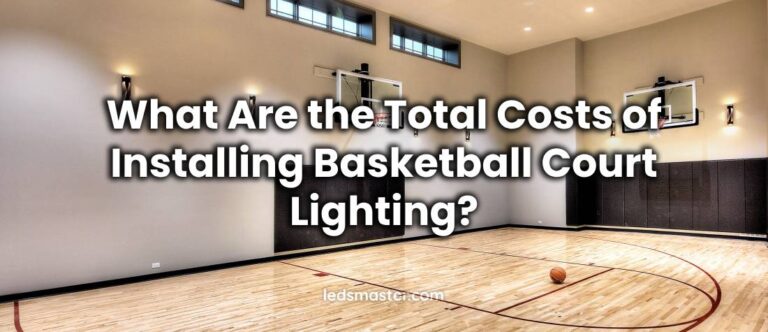
The lights are where most of the upfront money goes. For a mid-sized indoor basketball court—think a high school gym with seating for a few hundred people—the fixtures usually cost between $10,000 and $30,000. That range depends on how bright the court needs to be and how many fixtures you use. A typical setup might have 18–24 high-quality LED lights, each running somewhere between 200 and 400 watts.
That amount of power is what it takes to hit the usual indoor brightness levels of 500–1000 lux. Recreational courts might stick closer to 500 lux, while schools hosting competitive games or tournaments often push for the higher end so players and spectators have clear visibility from every corner.
For outdoor courts, the cost per fixture is often a little cheaper because you’re using pole-mounted floodlights instead of ceiling-mounted systems. But since there’s no roof to bounce light off of, you need taller poles—usually 8–15 meters high—and carefully aimed lights to get even coverage. Most single outdoor courts need 6–8 poles with 2–3 LED floodlights on each, and once everything is added up, the total cost usually lands between $15,000 and $40,000.
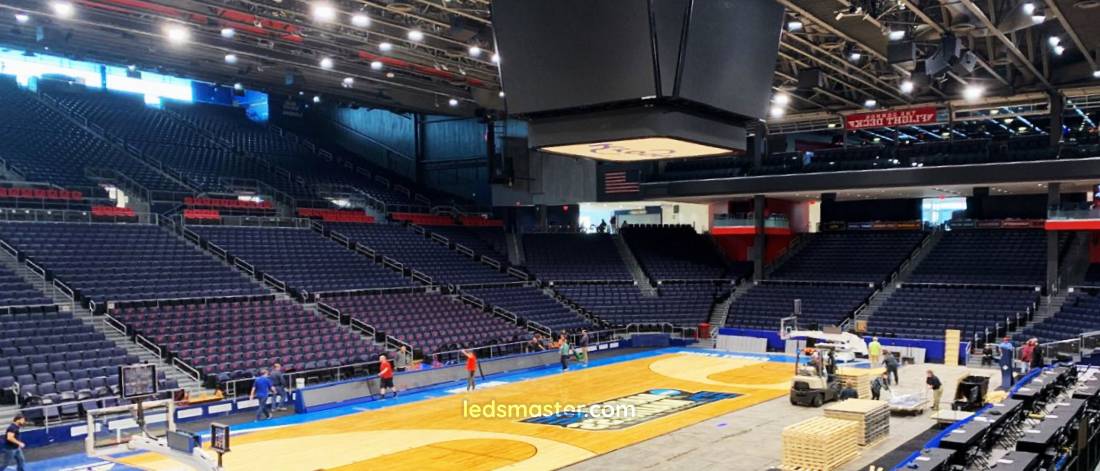
Professional arenas are on a different level. Televised games need extremely bright, flicker-free lighting for slow-motion cameras and high-definition broadcasts, plus dramatic effects for player entrances and halftime shows. These systems can easily cross the $100,000 mark, with some topping $150,000 for advanced control features and ultra-high uniformity.
After buying the lights, you still need to get them up in the air and wired correctly. Indoor courts have it a little easier because the structure is already there. The lights are mounted to ceiling beams 7–12 meters high, and the wiring usually connects to existing power lines inside the building. Labor and wiring for a standard gym setup might cost another $5,000 to $10,000 depending on the local rates and whether the court already has basic electrical infrastructure in place.
Outdoor installations are a bigger project. Crews have to dig trenches for underground cables, pour concrete for the poles, and sometimes even bring in heavy equipment to lift the lights into place. Each pole can weigh hundreds of pounds once the fixtures are mounted. Because of all that, outdoor installation often costs $10,000–$20,000, especially if the site didn’t have lighting before. And if the poles need to be taller than 12–15 meters to avoid shadows or light spill, the costs climb even higher because the fixtures themselves need to be brighter to cover the court from that height.
Buying and installing the lights is just the beginning—you also have to pay for electricity every time the court lights up. Here’s where LED technology really changes the game.
Let’s say you have a 20-fixture LED setup, each pulling 300 watts. That’s a total of 6,000 watts, or 6 kilowatts (kW). If the lights run 3 hours a day, 365 days a year, the system uses about 6,570 kilowatt-hours (kWh) annually. At the national average electricity rate of $0.15 per kWh, that works out to around $985 per year in energy costs.
Now compare that to a traditional metal halide system with the same number of fixtures, each using 1000 watts. That’s a total of 20,000 watts, or 20 kW, running for the same 1,095 hours per year. At the same electricity rate, the annual cost jumps to $3,200 per year. Over ten years, the LED system saves more than $20,000 just on power bills, and that doesn’t even count the cost of replacing burnt-out bulbs on the old system.
For bigger arenas with 40–50 fixtures, the energy costs for LED systems might reach $3,000–$5,000 annually, but older lighting systems could easily double or triple that number.
Even the best lights need care over time. The good news is that LEDs last a long time—50,000 to 100,000 hours, which translates to 20–30 years if the lights only run a few hours a day. During that time, they keep almost all of their brightness, so the court stays well-lit without constant replacements.
Metal halide lamps, on the other hand, usually last 15,000–20,000 hours before burning out completely, but they start losing brightness after just a couple of years. That means a gym might replace them every 5–7 years, not because they stopped working, but because the light levels dropped below safe playing conditions.
Routine maintenance for a modern LED system usually runs $500–$2,000 per year, covering basic cleaning, occasional wiring checks, and maybe swapping out a driver or two if one fails. Larger arenas with dozens of fixtures and advanced control systems can see annual upkeep closer to $5,000 or more, but that still beats the constant bulb changes, lift rentals, and labor costs tied to older lighting systems.
Not all basketball court lighting systems are created equal. Some setups cost half as much as others, even for courts of similar size. The price depends on several factors that affect both the initial investment and long-term expenses.
One of the biggest cost drivers is how bright the court needs to be. Brightness is measured in lux, and higher lux levels usually mean more fixtures or more powerful LEDs.
For example, a casual outdoor court hosting neighborhood pickup games might only need 200 lux, which can be achieved with 6–8 poles and 2–3 LED floodlights per pole. That setup might cost $15,000–$20,000.
On the other hand, a professional arena hosting televised games might aim for 1,500 lux or more. Achieving that requires high-output LEDs, more precise beam angles, and sometimes dozens of fixtures, which can easily push the price beyond $100,000.
Court size also matters. A full-sized NBA court is 28 by 15 meters, whereas many school gyms or recreational courts are slightly smaller, maybe 25 by 14 meters. The larger the space, the more fixtures are needed to maintain uniform lighting across the entire playing surface, which directly increases both the equipment and installation costs.
Where the lights go makes a difference too. Indoor courts usually use ceiling-mounted fixtures, while outdoor courts rely on pole-mounted floodlights. Taller poles or higher ceilings require more powerful lights to achieve the same brightness at floor level.
For instance, an LED fixture mounted at 12 meters may need 400–500 watts to hit the target lux, while one at 8 meters might only need 250–300 watts. Designers also have to consider beam angles, reflectors, and spacing to prevent hot spots or dim corners. Using better optics increases the cost upfront, but it improves uniformity and reduces energy waste.
Lighting doesn’t have to be all-or-nothing. Adding dimmers, motion sensors, or programmable schedules can add to the initial investment, sometimes $2,000–$10,000 extra depending on the size of the court and the complexity of the system.
However, these features often pay for themselves over time. Motion sensors or timers can cut energy use by 30–50% when the court isn’t in use, and dimmers allow gyms to adjust brightness for practice sessions versus full tournaments, keeping energy bills lower while extending the life of the fixtures.
The cost of installation varies widely depending on where the court is located. Installing poles in a rural area with easy access might only cost $8,000–$12,000, while doing the same job in a major city with stricter codes and higher labor rates could run $15,000–$20,000 or more.
Electricity prices also matter. Running a 6 kW LED system for 3 hours a day costs around $985 per year at $0.15/kWh. But in states with higher rates, that same setup could cost $1,500 annually. Over ten years, differences in local power rates can add thousands to the total ownership cost.
Even the ground conditions for outdoor courts can affect expenses. Poles need concrete foundations, and if the soil is rocky or unstable, labor and material costs rise. Similarly, indoor gyms with high ceilings may require scaffolding or lifts to mount fixtures, which increases installation expenses.
Lighting a basketball court doesn’t have to break the bank. With some smart planning and modern technology, it’s possible to save money without compromising brightness or uniformity.
LEDs may feel pricey upfront, but they make a huge difference in both energy consumption and maintenance. A typical metal halide setup might pull 1000 watts per fixture, while an LED equivalent can produce the same brightness with just 300–400 watts. That’s a 60–70% reduction in power use, which can translate into thousands of dollars saved annually on electricity.
For example, a 20-fixture LED system running three hours a day costs roughly $985 per year in energy, compared to about $3,200 for the same number of metal halides. Even if the LED fixtures cost $15,000 more upfront, the energy savings can pay back that difference in 3–5 years, after which the savings continue year after year.
LEDs also last 50,000–100,000 hours, compared to 15,000–20,000 hours for metal halides. That means fewer replacements, less labor, and lower long-term maintenance costs, which is especially helpful for schools or community courts with limited staff or budgets.
It’s tempting to install more lights than you think you need, but more fixtures don’t always mean better lighting. Proper planning ensures the court is bright, even, and safe, without wasting money.
Modern lighting design software can simulate beam spread, mounting height, and uniformity, helping you place fixtures efficiently. A well-designed system with 20 high-quality 300-watt LEDs might provide the same lux levels as 30 cheaper 200-watt lights, but it uses less electricity and reduces installation costs. Even slight adjustments in fixture spacing or beam angle can cut down on the number of lights needed while keeping uniformity ratios above 0.7, which is what most standards recommend.
Smart lighting controls are more than a convenience—they’re a cost-saver. Timers, dimmers, and motion sensors can reduce electricity use significantly.
For instance, a gym that’s empty during school hours doesn’t need full brightness. Dimming the lights to 50% or turning them off automatically can cut annual running costs by 20–30%. Advanced control systems also allow zoning, so certain parts of the court can stay on while others are off, which is especially useful for outdoor courts used for both basketball and other activities.
One of the easiest ways to reduce upfront costs is to take advantage of incentives. Many states and municipalities offer rebates for energy-efficient LED lighting upgrades. Some programs cover a percentage of the fixture cost or installation, which can reduce the initial investment by $2,000–$5,000 for a standard court.
Schools, parks, and recreation departments often qualify for grants aimed at improving energy efficiency or updating sports facilities. Checking with local utility companies or government programs before buying fixtures can significantly lower the sticker price and make LED upgrades more feasible.
Finally, thinking ahead can save money. Combining LEDs, smart controls, and proper fixture placement creates a system that stays efficient for decades. Fewer replacements, lower electricity bills, and minimal maintenance mean the total cost of ownership is much lower than what it looks like on paper at installation. Over 10–15 years, these savings can easily offset higher upfront costs, making it a smarter choice than going for the cheapest lights possible.
When you add everything up—lights, installation, electricity, and upkeep—a mid-sized basketball court with a good LED system might cost $30,000–$50,000 upfront, with annual running costs under $1,500.
Compare that to an older metal halide setup burning three times the power and needing constant bulb replacements, and the savings over 10–15 years can easily hit $30,000 or more.
So while LED systems feel pricey at first, they often pay for themselves in energy and maintenance savings long before they reach the end of their lifespan. For anyone running a court, from schools to city parks, looking at the total cost over time makes a lot more sense than chasing the lowest sticker price.