

When you think about it, basketball is a super fast-paced sport. The ball moves at crazy speeds, players cut across the court in seconds, and the action often happens above eye level. If the lighting isn’t right, it can mess with everything—from timing a three-pointer to spotting an open teammate.
For players, good lighting helps in judging distances and ball trajectories accurately. Imagine trying to shoot from the corner, but that spot is 30% dimmer than the rest of the court. Your eyes need to adjust in milliseconds, and even a small difference can throw you off. That’s why many indoor courts aim for uniformity ratios above 0.7—basically, the darkest spot on the court should be at least 70% as bright as the brightest spot. It keeps things consistent so players aren’t dealing with weird shadows or bright patches.
Spectators feel the difference too. Courts used for televised games often go up to 1000–1500 lux so cameras can capture every dunk, block, and buzzer-beater clearly. If the lighting is too dim or uneven, cameras pick up grainy images, and viewers at home complain about “bad angles” when it’s really just the lighting messing things up.
Even referees benefit from better lighting. Calls under the basket or along the sidelines become easier to see, especially when players are moving at full speed. So, in a way, lighting design doesn’t just affect the vibe—it can actually change how the game plays out.
Designing basketball court lighting isn’t just about tossing a few bright fixtures up and hoping for the best. There’s a whole science behind it, and even small changes in how lights are installed, aimed, or calibrated can completely change how the game feels for players and spectators. Let’s break it down into the main things that designers look at and why they matter so much.
When people talk about lighting levels, they usually use lux or sometimes foot-candles (fc) as the standard measurement. One foot-candle equals about 10.76 lux, but most designers stick with lux because it’s easier for large spaces.
For indoor recreational courts—think school gyms or community centers—300–500 lux is usually enough. That’s bright enough for weekend games or practices where players just need decent visibility without feeling like they’re on center stage.
But as soon as you start hosting competitive leagues or televised games, the numbers climb fast. College and pro arenas often aim for 1000–1500 lux, and some NBA arenas go beyond 2000 lux for slow-motion replays and 4K broadcasts. At that point, you’re not just lighting the court—you’re creating a stage where every dunk, block, and buzzer-beater needs to look crystal clear from any angle.
Outdoor courts have different rules because natural light mixes with artificial lighting. Evening games typically need 200–400 lux, but semi-professional or serious amateur leagues often push for 350–400 lux so players can keep the same pace they would under daylight conditions.
Another factor people forget is mounting height. A fixture at 12 meters spreads light differently from one at 8 meters. Taller poles often need higher wattage to maintain the same lux levels on the ground, so there’s a tradeoff between fixture power, pole height, and beam spread that designers carefully balance using lighting simulation software.
 Brightness alone doesn’t guarantee a good experience. Color temperature, measured in Kelvin (K), changes how natural everything looks on the court. Most indoor basketball courts go with a neutral white tone, around 4000–5000K. That range keeps things bright without washing out colors or making the court feel too clinical.
Outdoor courts usually shift cooler, around 5000–6000K, since this mimics daylight and helps players transition smoothly when games stretch into dusk or nighttime. Cooler lighting also gives better contrast for the orange basketball and the painted lines on the floor, which is why professional broadcasts often prefer it.
Go too warm—say, under 3500K—and the court takes on a yellowish tint that makes the game look dim and old-fashioned. Push it above 6500K, and it starts feeling cold and harsh, almost like a parking lot instead of a basketball court. That sweet spot between 4500–5500K indoors and 5000–6000K outdoors is where most designers land.
Imagine playing on a court where one corner looks like midday and the other feels like early evening. That’s what happens when uniformity isn’t handled properly. The uniformity ratio, usually defined as minimum lux divided by maximum lux, shows how evenly light is spread.
For basketball, designers typically aim for 0.7 or higher. That means if the brightest spot on the floor is 1000 lux, the darkest spot should be no lower than 700 lux. Anything less than that, and players start noticing shadows or dim patches, which can throw off depth perception on long passes or jump shots.
High-end systems often use photometric modeling software to position each fixture so beam angles overlap just enough to even out brightness without wasting energy. A standard full-sized indoor court (28 by 15 meters) might need 18–24 fixtures precisely aimed to hit that 0.7 ratio. Professional arenas with multiple camera angles sometimes go even higher, up to 0.8 or 0.9, because TV cameras exaggerate contrast differences compared to the human eye.
One thing players hate? Looking up for a rebound and catching a direct beam of light right in the eyes. Glare can mess with shooting accuracy, reaction time, and even safety if someone loses track of the ball mid-air.
Designers measure glare using something called the Unified Glare Rating (UGR), and for sports lighting, lower is always better. A UGR below 22 is usually recommended for basketball courts. To hit those numbers, designers often use asymmetric beam angles, anti-glare shields, or indirect lighting systems that bounce light off ceilings before it hits the court.
Indoor setups sometimes combine direct and indirect lighting—direct fixtures handle the main playing area while indirect ones fill in shadows and soften reflections off glossy wooden floors. Outdoors, poles are tilted carefully so the beams overlap on the court but stay out of players’ and spectators’ sightlines.
Modern LED systems help a lot here. Unlike old metal halide lamps that scatter light everywhere, LED optics can be fine-tuned to aim light exactly where it’s needed while avoiding spill light into the stands or nearby neighborhoods.
Designing lighting for a high school gym isn’t anything like planning an outdoor court in a park. The space, mounting options, and even weather conditions totally change how the lights need to be set up.
Indoor basketball courts have one huge advantage: walls and ceilings that help bounce light around. That extra reflection means designers can use more focused beam angles while still getting nice, even coverage across the floor.
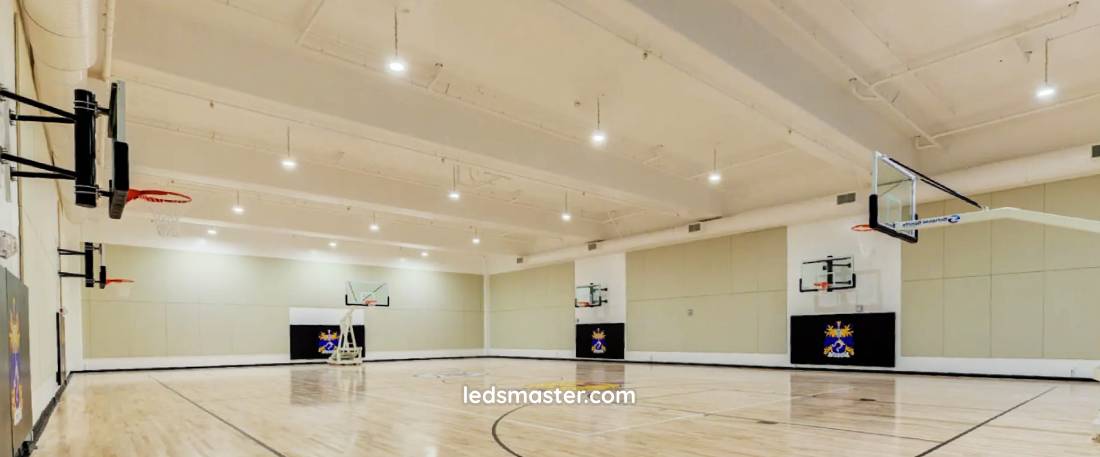
Most gyms mount fixtures somewhere between 7–12 meters high, depending on ceiling height. For a standard court that measures 28 meters by 15 meters, this usually means installing 18–24 LED fixtures with overlapping beams to hit uniformity ratios above 0.7. This keeps the court looking evenly lit so players don’t deal with distracting bright spots or dim corners.
Because indoor systems don’t have to deal with rain or wind, designers can use lighter fixtures with more precise optics—things like narrow-beam reflectors or even indirect lighting setups that bounce light off the ceiling first. This indirect approach softens shadows and can cut glare dramatically, especially on glossy hardwood floors.
Many modern systems go a step further with dimmable LEDs and even DMX or DALI controls, so facilities can tweak brightness levels based on what’s happening. A casual practice might run at 400–500 lux, while a championship game could crank things up to 1000 lux or more.
The main challenge indoors is avoiding reflections on the shiny floor or backboards. Poorly aimed lights can make it look like there’s a mirror on the floor, which throws off depth perception for players and looks awful on camera. That’s why most designs use 3D lighting simulation software before a single fixture is installed.
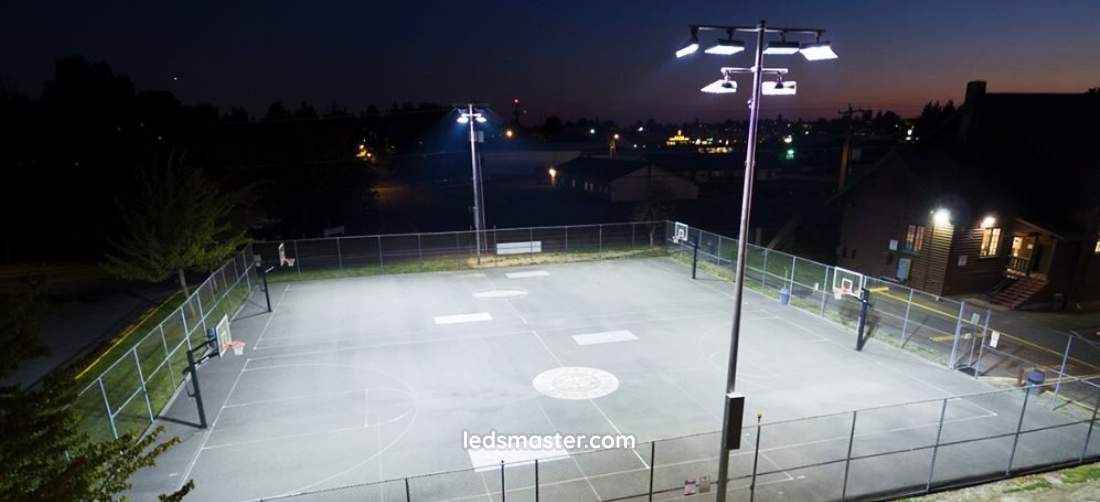
Outdoor basketball courts are a whole different story. With no walls or ceilings to help bounce light, everything relies on pole-mounted fixtures, typically set at 8–15 meters high. Taller poles help reduce shadows and improve uniformity, but they also require higher-wattage LEDs to maintain proper lux levels across the court.
For example, a community park court might use six poles with 2–3 fixtures each, aiming for 200–400 lux depending on whether it’s for casual games or local tournaments. Semi-professional setups sometimes go even higher, hitting 350–400 lux so games feel more like daytime even at night.
Weatherproofing is a must outside. Modern LED floodlights usually come with IP65 or IP66 ratings, meaning they’re completely sealed against dust and can handle heavy rain. Some even include anti-corrosion coatings for coastal areas where salty air would otherwise eat through the fixtures.
Another headache outdoors? Light spill. Neighbors definitely don’t want their bedroom lit up like Madison Square Garden at midnight. To fix this, designers often use asymmetric beam angles and full cut-off optics so light stays on the court instead of leaking into the surrounding area. Some systems even include automatic dimming after hours so the court shuts off or drops to 20% brightness when no one’s playing.
The poles themselves need to be engineered for wind loads too. A 12-meter pole with three fixtures can catch a surprising amount of wind, so most outdoor courts use tapered steel poles rated for local weather conditions. It’s one of those things people don’t see but keeps the system safe and stable year-round.
When you add it all up, good basketball court lighting makes a huge difference for players, spectators, referees, and even TV broadcasts. From lux levels and uniformity ratios to glare control and smart systems, the details shape how the game looks and feels.
Indoor and outdoor courts each bring their own challenges, but with modern LED technology, getting bright, even, and efficient lighting has never been easier. Whether it’s a neighborhood court or a professional arena, the right lighting design transforms the game into something smoother, sharper, and way more fun to play and watch.