
Lighting a basketball court might sound simple—you just need lights, right? But in reality, getting the right number of lights can make a huge difference in how the court feels and functions. Too dim, and players strain their eyes or struggle to track the ball. Too bright, and you’re wasting money and energy. Figuring out how many lights to install isn’t just about guessing; it involves understanding the court size, competition level, and a few other factors that can impact the overall experience. Let’s break it down.
Why We Need to Consider the Number of Lights
Imagine walking onto a basketball court at night that’s only partially lit. Shadows dominate the corners, making it hard to see the ball, players, or even the boundaries. That’s why lighting isn’t just decoration—it directly affects how the game is played and enjoyed.
Lighting also impacts safety. Poorly lit areas can lead to trips, falls, or collisions. On the flip side, overly bright courts can create glare, making it uncomfortable to play. Beyond players, proper lighting matters for spectators and referees. In professional or semi-professional games, visibility is everything—a single missed call could happen just because the court was dimly lit.
And then there’s the practical side: the cost. Installing lights is expensive, not just in buying fixtures, but also in wiring, poles, and labor. Overestimating the number of lights can blow up your budget, while underestimating might lead to additional installation work later. Considering the number of lights upfront saves both money and hassle down the road.
How to Estimate the Number of Lights for a Basketball Court
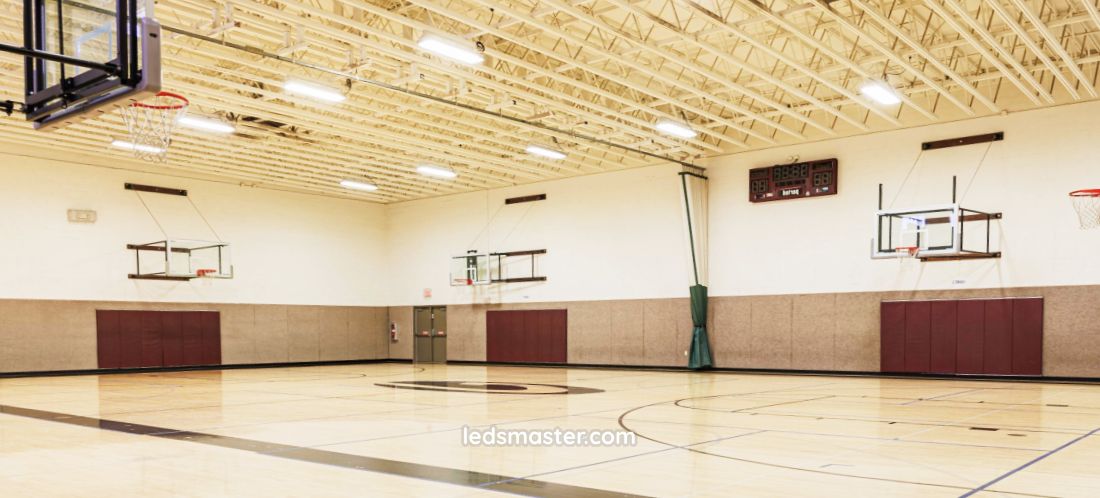
Figuring out how many lights your basketball court needs isn’t as simple as picking a number and hoping it works. There are a few key steps to follow, and understanding court size, light intensity, and fixture placement is essential.
Start with Court Dimensions
The first thing to look at is the size of your court. A standard basketball court measures 94 feet by 50 feet, roughly 4,700 square feet of playing surface. High school courts are a bit smaller at 84 by 50 feet (around 4,200 square feet). Smaller recreational courts, like those in community centers or backyards, might only be 60 to 70 feet long, which obviously changes how many fixtures you’ll need.
The bigger the court, the more lights you need to ensure every corner is evenly lit. You don’t want players shooting from the three-point line only to have the ball disappear into a dim spot. For larger indoor courts, lights are usually mounted on poles around the perimeter or hung from high ceilings. The height of the fixtures matters too: taller mounting points allow a wider spread of light but usually require more fixtures or higher output to maintain consistent brightness at floor level.
Consider Illumination Levels
Next up is how bright you want the court to be. Light levels are measured in lux, which tells you how much light reaches the surface. Indoor recreational courts usually aim for around 300 to 500 lux, which is enough for casual games where players just need to see the ball and each other clearly.
For high-level competitions, college games, or professional NBA matches, brightness requirements are much higher—sometimes exceeding 1,500 lux, particularly for broadcast or televised events. To achieve that, some NBA arenas install dozens of fixtures. Outdoor courts usually sit a bit lower, around 200 to 300 lux, which is enough for evening pickup games or small tournaments.
Estimating Number of Fixtures
A practical way to estimate is to think about how much area a single light can cover at a decent brightness. A typical 400W LED or metal halide fixture can illuminate roughly 1,000 square feet.
This generally translates to the following ranges:
| Court Type | Approx. Number of Fixtures |
|---|---|
| Standard Basketball Courts | 15–30 |
| High School Courts | 20–50 |
| Outdoor Recreational Courts | 4–10 |
| NBA / Broadcast-Level Courts | 50–150 |
Even within the same type of court, the number of lights can vary depending on spacing, mounting height, and desired uniformity.
Fixture Type and Beam Spread
Not all lights are the same. Metal halide, high-pressure sodium, and LED fixtures all have different distribution patterns and efficiencies. LEDs are more energy-efficient and often allow adjustable beam angles, so you can fine-tune how light spreads across the court. Metal halide lights may be cheaper upfront but often require more units to achieve uniform coverage.
Beam angle also matters. Narrow beams create intense spots of light but cover less area, while wider beams spread light more evenly at slightly lower intensity. For most indoor gyms, a 90–120 degree beam angle works well, while outdoor courts sometimes need 120–150 degrees to cover open spaces without leaving dim corners.
Factors Affecting the Number of Lights
When planning lighting for a basketball court, court size is just the starting point. A few other factors play a big role in how many fixtures you’ll actually need to get good, even coverage and a great playing experience.
Level of Competition
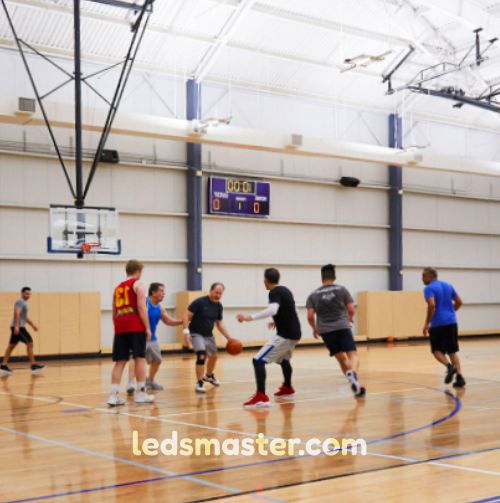 Who’s playing makes a big difference. For casual, recreational games, you don’t need super-bright lights—players just need to see the ball, hoop, and each other clearly. Around 200 to 300 lux is usually enough for backyard courts or community gyms.
High school tournaments, college games, or professional matches demand much brighter, more uniform lighting. Televised games often require 750 to 1,500 lux, depending on camera setups. Shadows or uneven lighting at this level can really affect the game—fast breaks, free throws, or three-pointers can be misjudged if part of the court is dim. The takeaway is simple: the higher the level of play, the more lights and the more uniform the coverage needs to be.
Overall Facility Size and Shape
Not every court is a simple rectangle. A standard 94-by-50-foot court is easy to light evenly, but gyms with odd shapes, extra walls, or irregular ceilings can make planning a bit trickier. Wider courts or those with higher ceilings usually need more fixtures or higher-mounted lights to keep the playing area consistently bright.
Ceiling height is another key factor. Indoor courts with ceilings around 20 to 30 feet can use standard fixtures to cover the floor evenly. Lower gyms require lights with wider beam angles to avoid dark spots. For outdoor courts, pole height and spacing become even more critical: too low, and harsh shadows appear under baskets or along sidelines; too high, and the light spreads too thin, reducing floor-level brightness.
Type of Lights
The kind of fixtures you choose also impacts how many lights you need. Modern LED lights are popular because they’re energy-efficient, last longer, and can be aimed precisely. Some even allow dimming or zoning, so you can brighten certain areas without adding extra fixtures.
Older technologies, like metal halide or fluorescent lights, often require more units to reach the same coverage. They also take longer to reach full brightness, which can be annoying if lights are switched on and off frequently. For large gyms or outdoor courts, LEDs usually provide better uniformity, reducing shadows and hot spots compared to traditional lights.
Surrounding Environment
The environment around the court affects lighting needs too. Outdoor courts near tall buildings, trees, or fences can cast shadows in unexpected spots, which may require extra fixtures. Indoor courts with reflective surfaces, like polished wooden floors, might need slightly fewer lights because reflections help spread illumination evenly.
Other small factors can matter as well: wall color, ceiling, flooring, and even hanging equipment like banners or bleachers can affect how light spreads. Light-colored surfaces reflect more light, improving brightness, while darker surfaces absorb it, meaning you may need extra fixtures to compensate.
What Happens If Too Few or Too Many Lights Are Installed?
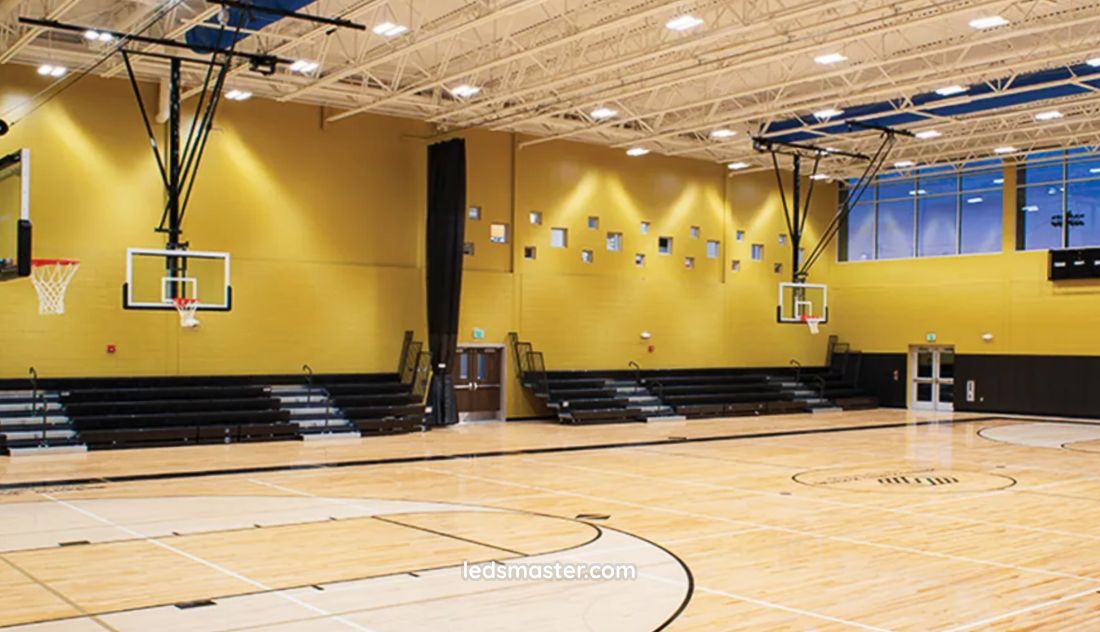
Getting the number of lights right is all about balance. Too few or too many fixtures can both create problems, affecting gameplay, safety, and even your budget.
Too Few Lights
If a court doesn’t have enough lights, shadows become a big issue. Imagine going for a fast break and the ball suddenly disappears into a dim corner. Players can misjudge passes, trip over boundaries, or even collide because some areas are darker than others. Even casual evening games feel frustrating when certain spots are always in shadow.
For professional or televised games, inadequate lighting is even more noticeable. Broadcast cameras need consistent brightness across the court, and too few lights can make games almost unwatchable. Referees may struggle to make accurate calls if players or the ball disappear in poorly lit zones.
Low lighting also puts a strain on players’ eyes. Constant squinting or adjusting can lead to discomfort or long-term eye fatigue. On outdoor courts, insufficient lighting might cut night game hours by half, since players can’t see clearly after sunset. For example, a standard 50-by-94-foot court with just 6 or 7 fixtures instead of 12–16 can create obvious dark spots along the sidelines and corners.
Too Many Lights
It might seem like brighter is always better, but overdoing it brings its own headaches. The first problem is cost. Each extra fixture adds purchase price, installation, wiring, maintenance, and energy bills. If an electrician charges per unit, adding just 4–6 extra lights could easily add $2,000–$5,000 to the bill for a mid-sized gym.
Too much light can also cause glare, especially when players look up for jump shots or layups. Inconsistent brightness or highly reflective surfaces—like polished wood or glossy paint—can actually make it harder to track the ball. Ironically, overlapping beams from too many lights can even create unexpected shadows in corners or under the basket.
From a practical perspective, over-lighting wastes energy. Extra fixtures can increase electricity bills by $500–$1,000 annually for a mid-sized indoor court. Beyond cost, it’s also an environmental concern, since unnecessary energy use increases the facility’s carbon footprint.
Finding the Sweet Spot
The goal is uniform coverage without going overboard. For standard courts, 15–30 well-placed lights usually do the trick. High school gyms often need 20–50, while smaller outdoor courts are fine with 4–10. NBA or broadcast-level arenas might require 50–150 fixtures, depending on lux requirements and ceiling height.
Placement matters more than sheer numbers. Strategically positioning fewer high-quality fixtures is better than cramming the court with too many lights. Getting it right ensures players see clearly, reduces eye strain, prevents shadows, keeps energy costs reasonable, and makes the court look professional and inviting.
Conclusion
When you think about it, figuring out how many lights to put on a basketball court is a mix of math, experience, and a little bit of trial and error. Count the square footage, consider competition level, check out your ceiling height or pole height, and think about light distribution. Factor in shadows, reflections, and glare, and you’ll have a much better idea of how many lights will work best.
It’s always better to plan carefully than to guess. With the right balance, your court will feel bright enough for crisp gameplay without wasting money or energy. And players will notice. Good lighting can even improve morale and performance, because nobody likes squinting while trying to make a fast break.
Getting it right might take some time, but the payoff is huge: a court that looks great, plays well, and lasts longer without constant upgrades.