
If you’ve ever squinted watching a late-evening basketball game or noticed shadows on a court, you’ve felt what happens when lighting is off. Getting the light right isn’t just about making things look good — it affects how players see the ball, how spectators enjoy the game, and even whether broadcasters can capture it cleanly. Let’s dig into what illuminance levels (lux or foot‐candles) are used in different basketball settings, why maintaining enough light matters, and how people actually measure and plan for those lighting levels.
Why Do We Need to Maintain Adequate Lux / FC
Good lighting on a basketball court does more than just “brighten” the space. First, it ensures safety: players need to see the floor, ball, and other players clearly — misjudging a dribble or missing an opponent because of poor lighting can lead to injuries. Then there’s performance: good vision helps with reaction times, precision of shots or passes, and reduces eye strain. For spectators, the experience improves when lines are sharp, the ball is visible against background and uniform colours, and glare or patchy lighting doesn’t distract. For televised or streamed games, broadcasters require consistent lighting so cameras don’t produce flicker, weird colour shifts, or over/under exposed zones.
Also, maintaining lighting at the right level over time matters because lights degrade, fixtures get dirty, or lamps lose output. If you design for just the minimum and then let things drop, then visibility drops even more. So designers often build in margin or safety buffers.
Average Lux / FC for Basketball Courts
When it comes to basketball court lighting, the numbers really do change a lot depending on whether you’re dealing with an indoor arena, an outdoor playground, or a full-blown professional venue with cameras everywhere. The main idea is simple: the more competitive or broadcast-heavy the game is, the brighter and more uniform the lighting needs to be. But once you start digging into the numbers, things get interesting because it’s not just about brightness — it’s about illuminance, uniformity ratios, horizontal vs vertical lighting, and making sure everything looks good both to the players and the audience.
| Court Type / Usage | Lux (lx) | Foot-Candles (fc) |
|---|---|---|
| Indoor – Recreational / Training | 200–300 | 20–30 |
| Indoor – High School / College Games | 500–750 | 50–75 |
| Indoor – Professional / Broadcast (NBA, FIBA) | 1,500–2,000 | 150–200 |
| Outdoor – Recreational | 200 | 20 |
| Outdoor – Regional / Semi-Pro Games | 500 | 50 |
| Outdoor – Professional / Broadcast | 2,000 | 200 |
Indoor Courts
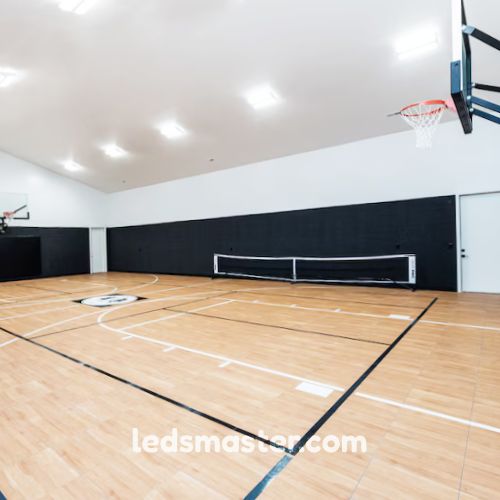 For indoor gyms and arenas, lighting levels usually go up as you move from recreational play to professional events. A casual indoor basketball court used for pickup games or training sessions can often work well with about 200–300 lux, which translates to roughly 20–30 foot-candles (fc). That’s bright enough for players to see the ball, court lines, and each other clearly without straining their eyes, especially if the ceiling isn’t super high and you’re not dealing with large crowds or broadcast cameras.
But once you step into a high school or college arena where games draw more spectators and maybe even local streaming, the lighting requirements jump significantly. You might see recommendations for 500–750 lux, or about 50–75 fc, so the court stays evenly lit from baseline to baseline. This bump in lighting power helps eliminate dark corners, reduces glare issues, and keeps the uniformity ratio — which compares the brightest and darkest spots on the floor — within acceptable limits. Typically, designers aim for ratios like 1.5:1 or better, meaning the brightest spot isn’t more than 50% brighter than the darkest spot. If you’ve ever watched a game where the corners of the court looked way dimmer than the center, that’s what poor uniformity looks like.
Now, professional or broadcast events take things to a whole different level. The NBA, FIBA World Cup, and other top-tier leagues often require 1,500–2,000 lux (about 150–200 fc) across the entire playing surface. And it’s not just about the floor — vertical illuminance is key too because cameras need players’ faces, the ball mid-air, and even the crowd behind the action to be evenly lit. TV cameras are unforgiving when lighting levels drop too low, and things like color rendering (CRI above 80) and flicker-free performance become just as crucial as raw brightness numbers.
Outdoor Courts
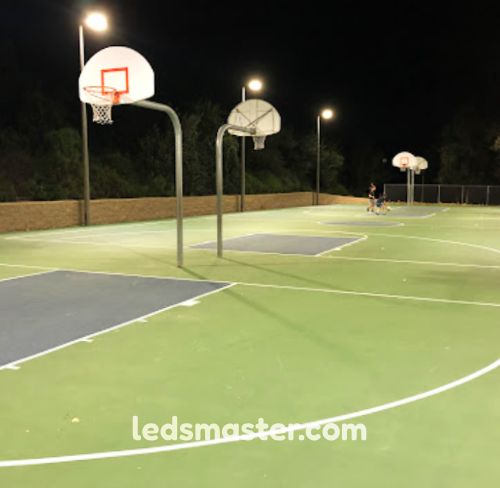 Outdoor courts have their own set of challenges. You’ve got no walls to reflect light, poles at different heights, possible glare from nearby streets, and sometimes you need to balance light spill control so you’re not blinding the neighbors. For recreational outdoor courts, about 200 lux (20 fc) usually gets the job done for casual evening games. It gives enough light for players without turning the whole park into a floodlit stadium.
But if you’re looking at regional tournaments or semi-pro events outdoors, then lighting levels often climb to around 500 lux (50 fc) so that spectators can follow the game clearly and camera setups — even if just for local streaming — can capture usable footage. The key outdoors is to keep uniformity ratios tight because shadows from tall poles or uneven fixture placement can ruin visibility fast.
For Competition Such as NBA or FIBA
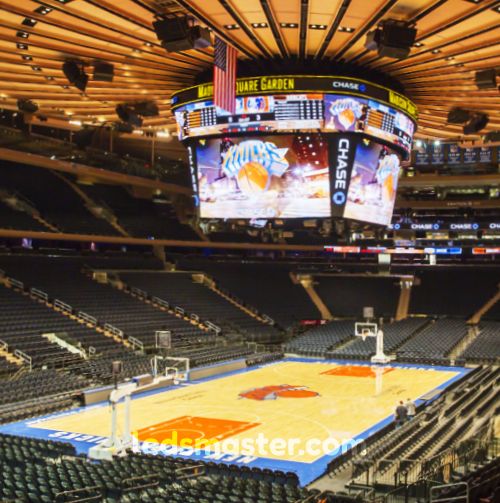 When you hit top-tier professional basketball — think NBA playoffs or FIBA international tournaments — the numbers really crank up. Most guidelines recommend around 2,000 lux average horizontal illuminance across the main court area, with strict limits on variation so there are no glaring hotspots or underlit zones. A common target is keeping the max-to-min ratio at something like 1.2:1 to 1.5:1 or even tighter for broadcast games.
Why so bright? Because high-speed cameras, slow-motion replays, and massive HD screens demand even, flicker-free, high-CRI lighting so everything from the sweat on a player’s face to the logo on the basketball pops clearly on screen. Even the vertical illuminance — the amount of light hitting players and objects from the side — has to be measured carefully to ensure fans and TV viewers see crisp, detailed action from every angle.
For context, 2,000 lux is nearly ten times brighter than what you’d use for a typical recreational court, and it often takes dozens of high-powered LED fixtures, each delivering tens of thousands of lumens, carefully aimed and spaced to avoid glare while hitting all the uniformity and broadcasting specs.
How to Measure the Lux Values
So we’ve talked about how much light you need, but how do you actually check if your court hits those lux or foot-candle levels? Knowing the target numbers is one thing; proving you’ve got them is another. There’s a pretty standard way lighting designers and facility managers handle this, and it all starts with the right tools and a plan.
Instruments and Units
First off, you need to know what you’re measuring. Lux (lx) is the metric unit, meaning lumens per square meter. Foot-candles (fc), on the other hand, measure lumens per square foot. Since one square foot is smaller than one square meter, the same amount of light will read as a bigger number in lux. To switch between them, you can use this conversion:
1 foot-candle ≈ 10.764 lux
So, for example, if a high school gym needs 500 lux on average, that’s roughly 46–47 foot-candles if you’re using the imperial system.
To get actual readings, you’ll use a light meter — sometimes called an illuminance meter. These are handheld devices with a sensor that measures how much light lands on a specific point. Some advanced meters even log the data automatically so you can analyze it later.
Setting Up a Measurement Grid
You don’t just take one reading in the middle of the court and call it a day. To get a real sense of uniformity and average lighting, pros break the court into a measurement grid.
For example, a full-size basketball court is about 28 meters long by 15 meters wide. Designers might set up a grid with readings every 2–3 meters along both length and width. That could easily give you 40–60 data points depending on how dense the grid is. Each point gets measured at the playing surface level — usually about 1 meter above the floor, because that represents eye level for players and referees.
Once all those readings are collected, you calculate:
| Term | Description | Formula Example |
|---|---|---|
| Average Illuminance | Total of all measured light values divided by number of points | (Sum of All Readings) ÷ (Points) |
| Minimum Illuminance | The lowest single light reading on the court | Lowest Value Recorded |
| Uniformity Ratio | Compares brightness levels across the court to check evenness | Min ÷ Average or Min ÷ Max |
For recreational courts, a uniformity ratio of 0.5 or 0.6 (meaning the darkest spot is at least half as bright as the average or max) might be okay. For professional or televised games, though, you often want 0.7 or even 0.8 so there are no noticeable dark patches when you look at the broadcast footage.
Measuring Vertical Illuminance
Horizontal light levels tell you how bright the court floor is, but they don’t tell you how well players’ faces, the ball in mid-air, or even the hoop structure are lit. That’s where vertical illuminance comes in.
To measure it, the light meter’s sensor is turned vertically, facing the main camera positions or typical viewing angles. For big arenas, standards often require vertical readings at heights like 1.5 meters above the floor (roughly player chest height) and even higher points to ensure the lighting works for cameras capturing dunks, rebounds, and crowd shots.
Dealing with Glare and Light Positioning
Here’s the thing — even if you hit all the right lux numbers, the game can still look bad if glare isn’t controlled. Glare happens when lights are too direct or positioned poorly, creating harsh reflections and hot spots that distract players and spectators.
Designers fix this by carefully aiming fixtures, using shields or diffusers, and sometimes choosing specific beam angles so light spreads evenly without blasting anyone straight in the eyes. For arenas with high-definition cameras, glare control gets even more attention because cameras exaggerate bright spots that might not bother the human eye as much.
Logging and Analyzing the Results
Once all the readings are taken, the numbers usually get plugged into lighting software or standard calculation sheets. That’s where you see if the actual court meets the average lux, uniformity ratios, and vertical lighting requirements for your specific level of play — whether it’s a community gym or an NBA playoff venue.
What Factors Affect How Many Fixtures and Wattage You Need
It’s tempting to think lighting a basketball court is just a matter of hitting a certain lux or foot-candle target and calling it a day. But the real story is a lot more involved. How many fixtures you need, what wattage they should be, even what type of lights you choose — all of that depends on a bunch of factors that interact with each other. Some of them are obvious, while others only show up when you start looking at uniformity ratios, glare control, and long-term maintenance.
Court Size and Mounting Height
Bigger courts need more light, plain and simple. A standard full-size basketball court is about 28 meters long by 15 meters wide (roughly 94 by 50 feet). If you’re mounting fixtures at, say, 7 meters high (about 23 feet), you need a different wattage and beam angle than if you’re hanging them from a 12-meter ceiling.
Higher mounting points usually mean you need narrower beam angles and sometimes higher wattage to push enough light down without losing intensity before it hits the court. On the other hand, lights that are too close might give you hot spots or uneven coverage unless you use more fixtures spread out carefully.
Fixture Type and Efficiency
The type of lighting fixture you choose makes a huge difference. These days, LED lighting dominates because it delivers more lumens per watt, lasts longer, and doesn’t flicker the way older metal halide lamps sometimes did. A good high-bay LED fixture might put out 30,000–40,000 lumens while drawing only 200–300 watts, whereas older tech might have needed twice the wattage for the same brightness.
LEDs also give you instant on/off with no warm-up time, better color rendering index (CRI) for televised games, and dimmable options so you can adjust lighting levels for practice vs competition nights.
Beam Angles and Aiming Strategy
It’s not just about brightness; it’s also about where the light goes. A fixture with a 120-degree beam spread will cover more area but with less intensity, while a 60-degree beam focuses light in a tighter spot. Designers use a mix of beam spreads and mounting angles to keep lighting levels even across the entire floor and reduce shadows under the backboards.
Aiming is another big deal. If the lights are tilted poorly, you might end up with glare in players’ eyes or wasted light spilling into the stands instead of the court. Some arena designs even use computer-aided aiming layouts to make sure every fixture hits exactly the right spot.
Uniformity and Maintenance Factor
Lighting levels change over time. Fixtures get dirty, lenses yellow, LEDs slowly lose brightness. That’s why designers apply what’s called a maintenance factor — basically building in extra light at the start so that even after a few years, when brightness drops maybe 10–20%, you’re still meeting the minimum lux requirements.
Uniformity is just as key. The max-to-min or average-to-min ratios often have strict limits in pro venues. For example, NBA standards might require a uniformity ratio of no worse than 1.5:1, meaning the brightest spot can’t be more than 50% brighter than the darkest spot on the court. Hitting that ratio often means adding more fixtures at lower wattage rather than fewer super-bright ones.
Color Rendering and Color Temperature
For regular recreational games, color quality might not seem like a big deal. But for televised events, color rendering index (CRI) matters a lot. A CRI above 80 or 90 ensures jerseys, court markings, and even players’ skin tones look natural on camera.
Color temperature is measured in Kelvin (K). Most professional courts use a neutral white or daylight tone, usually around 4,000–6,000 K. Too warm (like old yellowish lights) makes the game look dull; too cold (bluish light) can feel harsh and unnatural.
Regulations and Standards
Finally, there are rules and standards you simply have to meet. Organizations like FIBA, NCAA, and the NBA have detailed lighting specs covering everything from average horizontal illuminance to vertical lighting at camera positions. Local building codes might also restrict light spill outdoors or require certain energy-efficiency levels.
For example, FIBA’s TV Level 1 spec for major international games calls for 2,000 lux average horizontal illuminance, a 0.7 minimum-to-average uniformity ratio, and a CRI above 80. Meeting all that often requires a carefully designed layout with dozens of high-end LED fixtures, each precisely aimed and balanced for both brightness and uniformity.
Conclusion
In plain terms, how much light a basketball court needs depends heavily on what level the games are at, whether they’re indoors or outdoors, and whether cameras are involved. Casual evening play might get by with a few hundred lux; big televised games want more like 1,500-2,000 lux to make everything look crisp, reduce shadows, give good visuals for cameras, players, spectators. Measuring with a grid, checking uniformity, controlling glare, choosing good fixtures, all plays a part.
If you’re planning or upgrading a court, starting with knowing your purpose (recreation, school competition, pro broadcast) and then hiring someone (or using software) to model the lighting for your specific space makes a big difference. Happy court lighting!