
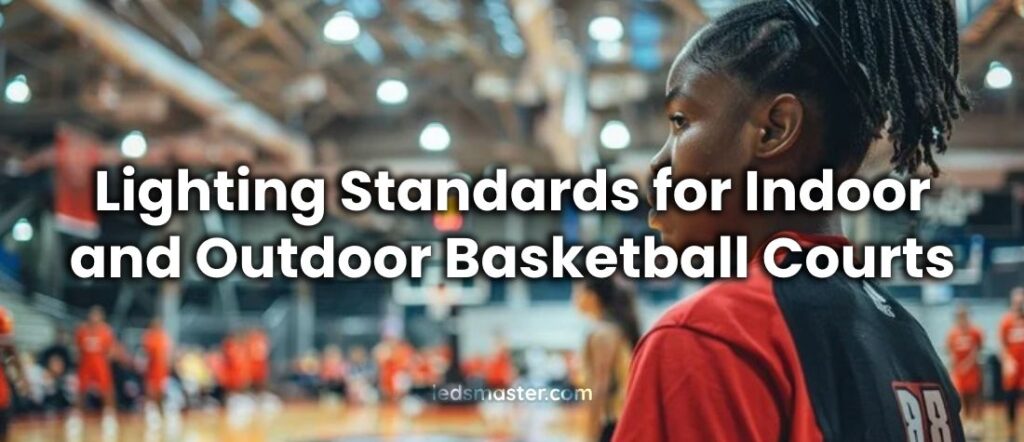
When it comes to basketball, good lighting isn’t just about turning on a few bright bulbs. It shapes how players react, how spectators watch, and even how games are filmed. Knowing the lighting standards for both indoor and outdoor courts helps ensure a safe, visually comfortable, and high-performing environment.
How Bright Should a Basketball Court Be?
When it comes to basketball, brightness isn’t just about seeing the court—it affects player performance, safety, and spectator experience. The right lighting ensures players can track fast-moving balls, judge distances for passes or shots, and react quickly, while fans get a clear view of all the action.
Indoor Court Brightness Levels
Brightness is usually measured in lux (lx) or foot-candles (fc). For indoor recreational courts, 300–500 lux is often sufficient. That’s enough light to see clearly, avoid eye strain, and still feel comfortable—players won’t feel like they’re under stadium lights blinding them.
If the court hosts tournaments, college games, or televised matches, the number jumps. Professional arenas often aim for 1000–1500 lux, especially around high-activity areas like the three-point line, key, and baskets. For perspective, a standard indoor court with 20 LED fixtures at 300 watts each can reach about 1,200 lux in the center, with careful aiming to maintain uniform coverage at the edges.
Even small differences in lux can affect gameplay. For instance, at 500 lux, players can comfortably dribble and pass, but long-range shooting or tracking a fast rebound may feel slightly more challenging. At 1,200 lux or higher, every movement becomes clearer, and television cameras capture sharper, more accurate images, which is why broadcast courts push the numbers up.
Outdoor Court Brightness
Outdoor courts are trickier because daylight and weather conditions come into play. Evening or night games usually need 200–400 lux, depending on competition level. Casual recreational games can manage with 200–250 lux, while serious amateur leagues benefit from 350–400 lux.
Fixture height matters outdoors too. Poles ranging from 8–15 meters help reduce shadows, but taller poles need higher-wattage LEDs—200–400W per fixture is common—to maintain proper illumination on the playing surface. Asymmetric beam angles are often used to focus light on the court while minimizing spill light to surrounding areas, reducing glare for neighbors and keeping light pollution low.
Uniformity – Making Every Corner Visible
Brightness alone isn’t enough if it’s uneven. Uniformity measures how consistent lighting is across the court. A ratio of 0.7 or higher—meaning the dimmest spot is at least 70% as bright as the brightest—keeps shadows from forming and prevents players from misjudging passes or shots.
For example, if one corner of an indoor court is 1,200 lux and another is 700 lux, that’s below the recommended ratio and can cause noticeable differences in perception. Professional lighting designers often use photometric mapping software to plot fixture placement, beam spreads, and mounting angles to ensure consistent lux across the entire 28 x 15 meter court.
Even minor variations can matter. Shadows under the basket or at the free-throw line may cause a player to misjudge a rebound by 10–20 centimeters, which can affect scoring and game flow. Proper uniformity improves safety and enhances player confidence.
Color Temperature – Finding the Right Tone
Color temperature, measured in Kelvin (K), affects how natural and comfortable a court feels. Indoor courts usually stick with neutral white, 4000–5000K, which balances brightness and comfort. This temperature makes the orange basketball stand out against hardwood or synthetic floors while minimizing eye strain during long practices or games.
Outdoor courts tend toward a slightly cooler color, around 5000–6000K, to mimic daylight. Cooler light helps maintain clarity during dusk or early evening games and reduces visual fatigue. Incorrect color temperature can distort the ball’s appearance, make the floor look uneven, or even affect players’ reaction time during fast breaks or long-range shots.
Glare Control – Seeing Without Squinting
Glare is one of the most overlooked aspects of basketball lighting. Players are constantly looking upward for rebounds, jump shots, or passes. Poorly aimed fixtures can cause direct glare, temporarily blinding players or creating hotspots.
Designers reduce glare using tilted fixtures, shields, louvers, or diffusers. Some systems use indirect lighting, bouncing light off ceilings or reflective panels to soften intensity while maintaining lux levels. Properly controlled glare ensures players can track fast-moving objects accurately, and spectators aren’t distracted by overly bright spots.
For example, an indoor court with 20 LED fixtures tilted correctly at 15–20 degrees and equipped with louvered shields can reduce glare by 30–40%, making it easier to follow the ball from baseline to baseline. Outdoor courts may combine asymmetric floodlights with shielding to achieve the same effect while avoiding spilling light into nearby streets or residences.
Key Differences Between Indoor and Outdoor Basketball Court Lighting
Lighting a basketball court isn’t one-size-fits-all. Indoor and outdoor setups face different challenges, and the design choices can affect visibility, energy efficiency, and player experience.
Indoor Court Requirements
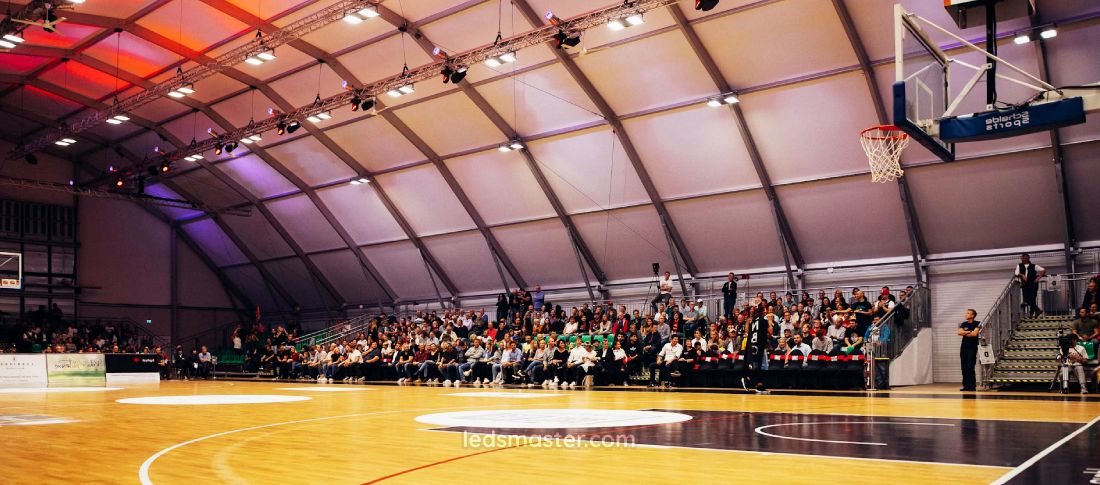
Indoor gyms have the advantage of walls and ceilings, which help bounce light and spread it more evenly across the court. That can reduce the number of fixtures needed compared to an outdoor court of the same size. Typical indoor courts use ceiling-mounted LEDs at heights between 7 and 12 meters, often with adjustable angles to optimize uniformity and minimize hotspots.
Even with fewer fixtures, heat management is a key concern. LEDs generate heat, and if they’re installed in enclosed housings without proper ventilation, their lifespan can decrease by 10–20%. Good indoor designs include fixtures with built-in heat sinks or airflow channels, ensuring consistent brightness over years of use.
Glare control indoors is also tricky. Polished hardwood floors and reflective backboards can create uncomfortable bright spots if lights aren’t aimed properly. Many gyms use louvers, shields, or diffusers to soften direct light, while keeping the court bright enough for fast action. Some setups also integrate dimming controls, allowing coaches or facility managers to adjust lux levels—300–500 lux for practice versus 1000–1200 lux for tournaments or televised events.
Smart control systems are becoming more common indoors. With programmable timers and sensors, facilities can cut energy use by 20–30% when the court isn’t in use, which adds up to significant savings over a year, especially in multi-purpose gyms.
Outdoor Court Considerations
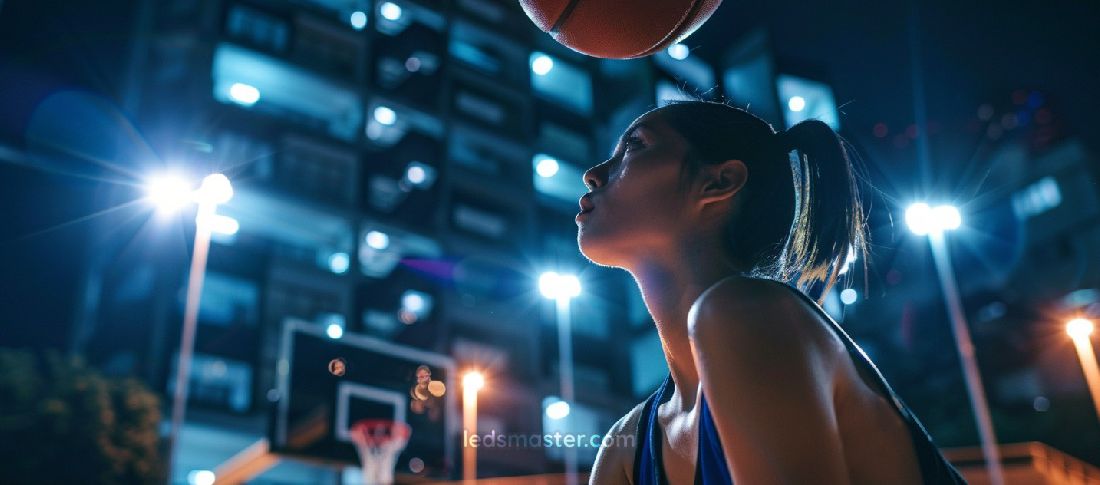
Outdoor courts face a completely different set of challenges. Without walls or ceilings, all lighting comes from pole-mounted fixtures, usually 8–15 meters high. Taller poles help reduce shadows but require higher-wattage LEDs, typically 200–400W per fixture, to maintain consistent lux across the playing surface.
Weatherproofing is a must outdoors. Fixtures generally need an IP65 rating or higher to resist rain, dust, heat, and cold. Exposure to the elements means that UV-resistant lenses and corrosion-proof housings are also common, ensuring that light output doesn’t degrade over time.
Another consideration is light spill and glare for nearby residents. Outdoor courts often use asymmetric beam angles to direct illumination precisely onto the court while minimizing light pollution. Proper aiming prevents complaints and ensures players aren’t blinded during night games.
Maintenance and accessibility are more complex outdoors. Poles need to support heavy floodlights, and replacements require safe lifting equipment. Some municipalities even schedule annual inspections to check for lens cleaning, fixture stability, and wiring integrity, which keeps the court functional and safe for years.
Comparing Indoor and Outdoor Needs
In short, indoor lighting benefits from reflective surfaces and controlled environments, allowing for lower wattages per fixture and easier integration of smart controls. Outdoor lighting needs higher wattages, robust weatherproofing, and careful beam control to maintain lux levels and prevent spill light. Both environments require attention to glare, uniformity, and color temperature, but the strategies to achieve them differ significantly.
For example, a 28 x 15 meter indoor court might achieve 1,200 lux with 20 LED fixtures at 300W each, while an outdoor court of the same size could need 6 poles with 3 fixtures per pole at 350W each to reach 400 lux in evening conditions, all while keeping light off surrounding areas.
Both setups, however, share the same goal: a well-lit, safe, and visually comfortable environment for players, referees, and spectators alike.
Why LED Lighting Works So Well for Basketball Courts
Switching to LEDs has transformed how indoor and outdoor basketball courts are illuminated. Beyond just saving energy, LEDs improve visibility, safety, and overall player experience.
Energy Efficiency and Cost Savings
LEDs use a fraction of the power compared to older technologies. For example, a 400W metal halide fixture can often be replaced with a 150–200W LED while maintaining the same lux levels on the court. That’s a 60–70% reduction in electricity consumption.
Take a standard high school gym with 20 LED fixtures running three hours a day. Annual energy costs for an LED system would be around $1,000, compared to roughly $3,000 for metal halide lamps under the same usage. Over a decade, the facility could save $20,000–$25,000 just on electricity, without counting maintenance savings. Outdoor courts running longer evening sessions can see even bigger reductions, especially with motion sensors or dimming during non-game hours.
Longevity and Lower Maintenance
LEDs last a lot longer than traditional HID lamps. With a lifespan of 50,000–100,000 hours, LEDs can serve a court for 20–30 years if used a few hours daily. Metal halides, on the other hand, burn out after 15,000–20,000 hours and start losing brightness after just a few thousand hours, forcing early replacements.
Fewer replacements mean lower labor costs, less downtime for the court, and fewer lift rentals for high-mounted indoor or pole-mounted outdoor lights. For large arenas, replacing dozens of metal halides every 3–5 years can cost $5,000–$10,000 in labor and bulbs, while LED systems drastically reduce that number.
Better Light Quality for Players and Spectators
LEDs deliver instant-on brightness with no warm-up time, unlike metal halides that may flicker or take 5–10 minutes to reach full output. They also provide better uniformity, meaning shadows and hotspots are minimized across the court. Color temperature can be fine-tuned—usually 4000–5000K indoors and 5000–6000K outdoors—which helps players track the ball accurately and reduces eye strain during long sessions.
For televised or streamed games, LEDs are a game-changer. Traditional lamps can flicker under slow-motion cameras, creating distracting visual artifacts. LEDs have stable drivers, reducing flicker and ensuring that slow-motion replays look smooth, while asymmetric lenses allow more light on action zones like baskets and three-point lines, saving energy on less critical areas.
Environmental and Safety Advantages
LEDs are greener because they consume less electricity, reducing the carbon footprint of a facility. They produce less heat, which helps indoor gyms save on cooling costs, and unlike older HID lamps, LEDs contain no toxic mercury.
Safety is improved as well. Fewer flickers and more uniform lighting reduce eye strain, headaches, and even mistakes during fast gameplay. Poles and fixtures also stay cooler, minimizing fire risks or heat-related damage.
Player Experience and Perceived Professionalism
Finally, LED courts feel brighter, cleaner, and more professional. Players notice better visibility for passes, layups, and long-range shots, while spectators experience clearer, more comfortable viewing, whether in-person or via broadcast. The combination of energy efficiency, durability, and lighting quality makes LED systems an upgrade that pays for itself over time.
Bringing It All Together
Designing basketball court lighting involves more than installing bright fixtures. Indoor and outdoor courts have unique requirements, from lux levels and color temperature to uniformity, glare control, and weatherproofing. Switching to LED technology brings a host of benefits—energy savings, long life, better lighting quality, and smarter control options.
Players notice the difference immediately: the ball is easier to track, depth perception improves, and the court feels brighter and more professional. Spectators enjoy a more visually comfortable experience, and facility managers save money on energy and maintenance. With proper planning, both indoor and outdoor courts can achieve lighting that keeps the game fast, fun, and safe for everyone.