
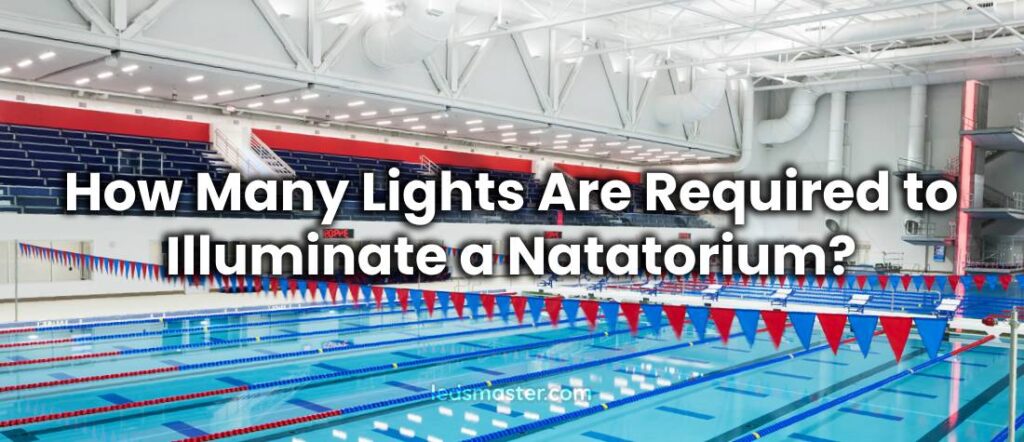
Designing an effective lighting system for a natatorium isn’t just about picking bright fixtures, it’s about aligning the number and placement of lights with the pool’s unique characteristics and usage. Several critical factors come into play, from the level of competition hosted to the ceiling height, surface finishes, and pool dimensions. Each element contributes to how much light is needed and how it should be distributed to ensure safety, clarity, and comfort for everyone in the facility.
Factors Affecting the Number of Lights
Level of Competitions Hosted
The level of competition hosted in a natatorium has a strong influence on the lighting layout and intensity. Facilities designed for recreational swimming or general fitness do not require the same lighting rigor as those certified for professional competitions. For example, leisure pools may aim for functional visibility, while Olympic-standard pools demand high-lumen, broadcast-ready lighting that delivers consistent illumination across all lanes.
Competitive events require enhanced lighting for clarity, fairness, and safety. In national and international contests, lighting is expected to meet specific lux levels (typically 750–1000 lux), uniformity ratios, and high color rendering indexes (CRI > 80) as dictated by governing bodies like FINA or NCAA. These specifications ensure that swimmers are clearly visible at all times, both to spectators and to judges, and are suitable for HD broadcast.
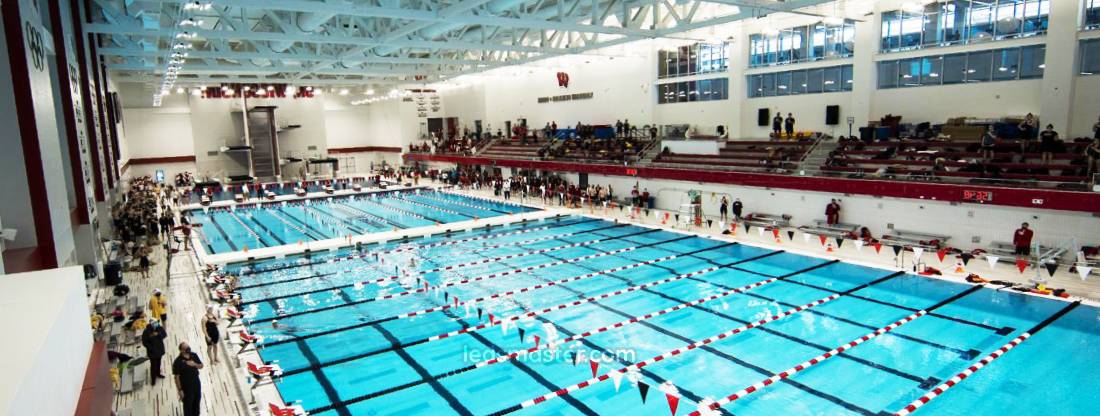
To meet these standards, an Olympic-size pool (50 m × 25 m) often requires at least 40 to 60 LED fixtures, depending on ceiling height and fixture wattage. Pools hosting televised or high-level meets may use even more, particularly if fixtures are spaced to achieve optimal overlap and minimize shadowing.
The higher the prestige and technicality of the event, the more demanding the lighting setup becomes. Pools hosting frequent championship meets must often invest in more advanced fixtures, customized mounting strategies, and real-time lighting control systems to accommodate varying needs throughout the season.
| Factor | Condition | Estimated Number of Lights |
|---|---|---|
| Level of Competition | Recreational / Leisure pool | 16–24 fixtures |
| Olympic-standard (50 m × 25 m) | 40–60 fixtures | |
| Televised / Championship events | 60+ fixtures | |
| Ceiling Height | Low (6–8 meters) | 25–40 fixtures |
| High (12–15 meters) | 50–70 fixtures | |
| Pool Surface Area | 25 m × 12.5 m training pool | 16–24 fixtures |
| 50 m × 25 m Olympic pool | 40–60 fixtures | |
| Underwater lights (per side, 50 m pool) | 15–30 fixtures | |
| Reflectivity / Interior Finishes | Highly reflective surfaces | 20–30% reduction in fixture count |
| Dark/matte surfaces | +10 to 15 fixtures |
Height of the Ceiling
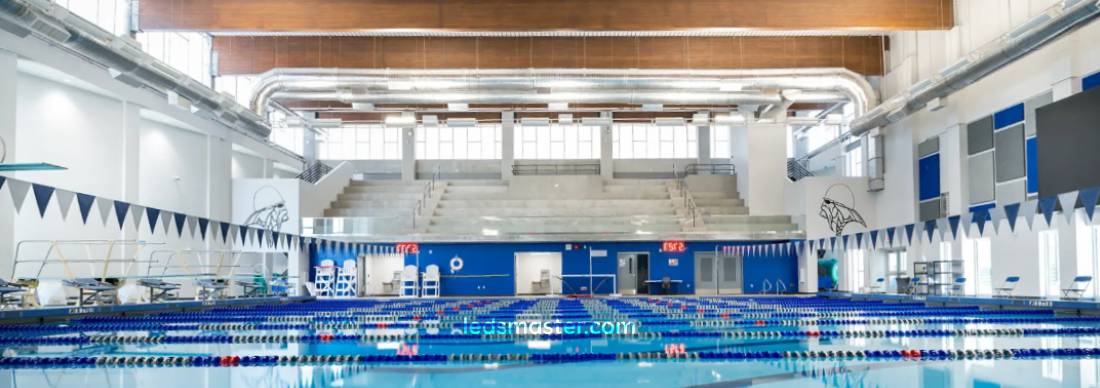
The ceiling height in a natatorium plays a major role in determining both the number and type of fixtures required. Higher ceilings (over 10 meters) increase the distance between the light source and the water surface, which reduces effective brightness unless offset by higher-wattage LEDs or narrower beam angles.
For example, a ceiling height of 12 to 15 meters often necessitates using 30,000- to 60,000-lumen fixtures mounted with focused optics to ensure adequate reach. In these settings, you may require 50–70 fixtures for full coverage of a large competitive pool.
In contrast, lower ceilings (around 6 to 8 meters) provide better proximity to the pool surface, potentially allowing for fewer lights—typically 25–40 fixtures for a mid-size natatorium. However, these installations must address glare control more carefully, as closer-mounted lights can introduce harsh reflections that impair visibility and comfort.
Additionally, facilities with complex ceiling architecture—such as trusses, skylights, or ducts—may need custom brackets and special lensing to adapt light spread and positioning. In all cases, mounting height affects light uniformity and the overall visual experience.
Surface Area of the Swimming Pool
The most immediate and calculable factor that influences how many lights a natatorium needs is the total surface area of the pool. Larger pools cover a wider footprint and demand more comprehensive lighting solutions to eliminate dark zones and achieve even illumination.
A standard 50 m × 25 m Olympic pool requires approximately 40 to 60 overhead LED lights spaced evenly in parallel rows along the length of the pool. For comparison, a smaller 25 m × 12.5 m training pool may only require 16 to 24 fixtures, assuming efficient spacing and appropriate lumen output.
Wider pools or those with spectator seating, diving wells, or multiple swim zones often require additional lateral rows or angled side lighting to reach corners and outer edges. Some layouts also incorporate underwater lights, spaced about 2 to 3 meters apart along the walls, adding another 15–30 fixtures depending on pool dimensions and design preferences.
Pools with irregular shapes—such as therapy zones, wave areas, or competition warm-up pools—require bespoke lighting layouts. In these cases, photometric software is used to simulate beam overlap and calculate fixture quantity based on actual pool geometry.
Reflective Qualities and Interior Finishes
The materials and colors used on the walls, ceiling, and pool surfaces significantly affect how much light is needed. Spaces with light-colored, glossy, or reflective finishes help amplify brightness by reflecting more light across the room. For example, white-painted ceilings, polished ceramic tiles, and bright vinyl liners can reduce the required number of fixtures by up to 20–30%, depending on reflectivity.
Conversely, dark or matte finishes—such as gray concrete walls or navy-blue pool tiles—absorb more light and reduce internal reflection. This loss must be compensated by either increasing fixture wattage or adding extra lights. A facility with low-reflectance finishes may need 10 to 15 additional fixtures compared to an equivalent pool with highly reflective surfaces.
Even the water surface contributes: still, clean water reflects light upward and enhances ambient brightness, while turbulent or chemically-treated water may scatter light and reduce effectiveness. Similarly, deck finishes like anti-slip rubber or textured tiles affect how light is bounced into surrounding areas.
Appropriate Number of Lights and Pool Safety
Visual Comfort for Swimmers and Spectators
The visual experience inside a natatorium greatly depends on the distribution and intensity of its lighting. Swimmers require consistent, balanced illumination to navigate the water safely. Shadows cast across lanes or patches of excessive brightness near the water’s edge can interrupt a swimmer’s rhythm, affect lap timing, or contribute to disorientation—especially during flip turns and underwater phases of a race.
Lane markers, backstroke flags, pool edges, and depth markings must remain clearly visible at all times, and any inconsistency in lighting can compromise this visibility. This becomes even more relevant when underwater lighting is used in tandem with overhead fixtures, requiring coordination to avoid color mismatches and intensity disparities.
From a coaching and safety standpoint, consistent lighting is also beneficial. Lifeguards and trainers must maintain full visibility of every corner of the pool, including less active zones like diving wells or shallow areas. Poorly illuminated sections increase the risk of unnoticed incidents or delayed emergency response.
Spectators attending competitive events benefit as well. Uniform lighting enhances the clarity of fast-moving action, allows for better viewing angles, and minimizes strain during long events. Well-lit seating areas and unobstructed lines of sight also contribute to an enjoyable viewing experience.
Recommended Number of Lights per Pool Size
Determining the correct number of light fixtures depends on the size and layout of the pool. For standard 25-meter pools used for training and community recreation, between 12 to 20 LED high bay fixtures are typically sufficient, assuming each provides at least 20,000 to 30,000 lumens and is properly spaced for uniform coverage. Olympic-size pools (50 meters in length) often require 30 to 50 lights, depending on ceiling height, beam angle, and whether separate zones—like warm-up lanes or diving wells—need dedicated coverage.
Underwater lighting should supplement rather than replace overhead lighting. For full-length visibility, pools commonly incorporate one underwater fixture every 2 to 3 meters along the sidewalls, equating to 15–25 underwater lights per side for a 50-meter pool. These are usually placed at a depth of about 1 meter to avoid direct eye glare while ensuring proper bottom illumination.
Lighting calculations must also factor in ceiling height, reflective surfaces, and the intended use of the facility—recreational, competitive, or broadcast. Photometric modeling is often employed during the design phase to ensure consistent light levels of 300 to 750 lux, depending on standards such as those from FINA, NCAA, or local building codes.
Minimizing Glare and Shadow Zones
One of the recurring challenges in natatorium lighting design is the control of glare and shadows. Water reflects and refracts light in unpredictable ways, which can result in visual discomfort for both swimmers and viewers if lighting is not carefully planned.
Overhead lights positioned too directly above the pool may create intense glare on the water’s surface. Improperly angled fixtures can lead to deep shadow zones, especially at the bottom of the pool or along wall intersections. This not only disrupts aesthetics but can present safety concerns for swimmers who rely on visual cues to orient themselves.
Solutions often involve a combination of asymmetrical lighting layouts, cross-lighting strategies, and glare-resistant fixture optics. Using wide-beam LEDs with frosted diffusers or specialized lensing systems can help spread light more evenly while avoiding overly intense reflections. Fixture mounting height and tilt angle are also fine-tuned during the design process to balance brightness and minimize discomfort.
When glare is properly mitigated, swimmers enjoy better visual comfort, lifeguards can maintain uninterrupted surveillance, and the architectural appeal of the space is preserved. Every reduction in glare and shadow improves both functionality and the overall experience inside the facility.
Emergency and Safety Lighting Considerations
Beyond routine use, lighting systems in natatoriums must be engineered to support emergency situations, power outages, and evacuation scenarios. The primary lighting grid is typically backed up by a series of emergency fixtures connected to battery systems or generators.
These emergency lights are positioned to provide immediate, clear visibility of the pool, exit routes, and gathering points. Even though the quantity of emergency fixtures is lower compared to the main lighting system, their design ensures wide-angle coverage to prevent any part of the natatorium from becoming dangerously dark.
In facilities with large swimming areas or multiple zones, dedicated emergency lights are installed along stairways, entrance and exit corridors, locker room passages, and first aid stations. Their illumination levels must meet minimum lux requirements outlined by safety standards, such as those from the International Building Code or local regulations.
Some modern natatoriums also incorporate automatic testing systems for emergency lights that run diagnostics on battery life and fixture operation at regular intervals. This ensures compliance and prepares the system for sudden use, eliminating the risk of unlit exits during an outage.

Lighting Uniformity and Standards
Recommended Lux Levels by Activity
| Pool Type | Lux Level Range | Purpose |
|---|---|---|
| Recreational Pools | 200–300 lux | Casual swimming and public use |
| Training Pools | 400–600 lux | Technique analysis and coaching |
| Competitive Events | 800+ lux | Swimming competitions and water polo |
| International/Broadcasted Events | 1000+ lux | High-speed cameras and broadcast clarity |
Lux levels serve as the standard measure for how much light illuminates a surface, and the appropriate levels vary based on the nature of pool use. Recreational pools generally operate within the 200 to 300 lux range, which is adequate for casual swimming and public use without the demand for technical visibility. However, training pools often require higher illumination levels—typically between 400 and 600 lux—to enable coaches to assess stroke mechanics, body positioning, and technique with precision.
For competitive events, the requirements rise substantially. Swimming competitions, water polo matches, and synchronized swimming events often call for 800 lux or more, depending on the scale and governing standards. International-level events, especially those broadcast on television, may demand 1000 lux or greater to support high-speed cameras, enhance athlete visibility, and eliminate shadow zones.
Achieving these elevated lux levels uniformly across both the water and deck surfaces can be technically complex. Lighting must avoid bright hotspots or underlit areas that can impact visual comfort and swimmer orientation. Uniformity, more than just brightness, defines lighting quality in a natatorium.
Color Rendering Index (CRI) for Visual Clarity
While lux measures quantity of light, CRI—Color Rendering Index—assesses the quality. A CRI above 80 is considered optimal for aquatic environments, where color differentiation can affect performance, safety, and visual cues. Markings on the pool bottom, lane ropes, warning flags, and team uniforms must be easy to distinguish under artificial lighting.
Poor CRI can distort colors, making it harder for athletes and officials to interpret their surroundings. In competitive settings, this can lead to timing errors, misread signals, or hindered performance. Additionally, a high CRI contributes to the visual sharpness required for televised coverage, offering crisp contrast and realistic hues for broadcast audiences.
From an architectural perspective, a high CRI improves the interior ambiance by allowing painted surfaces, banners, and branding elements to appear more vibrant and appealing, supporting both functionality and aesthetics.
Uniform Distribution and Fixture Placement
Beyond lux and CRI, uniformity in light distribution determines the usability of the space. Fixtures must be arranged to ensure that no zone within the pool receives disproportionately high or low levels of light. Uneven lighting creates glare zones and dim pockets that impair spatial orientation and depth perception.
A well-designed fixture layout includes overlapping light cones to balance brightness while avoiding excessive direct exposure to the water’s surface. This balance is vital for events where swimmers rely on consistent visual input to guide their strokes, turns, and starts.
Obstacles such as ceiling beams, ventilation ducts, and architectural overhangs must be factored into fixture placement to avoid light interference and maintain a smooth gradient of brightness across all surfaces. The angling of fixtures, especially when mounted on high ceilings, requires precise calculation to eliminate glare while ensuring even floor coverage.
Energy Efficiency and Fixture Types
LED Fixtures and Operational Savings
LED lighting continues to gain preference in modern natatoriums due to its operational efficiency and cost advantages. LEDs convert a greater percentage of electricity into visible light, reducing wasted energy in the form of heat. This performance translates to a lower power requirement for achieving the same lux output compared to traditional technologies such as metal halide or fluorescent fixtures.
With longer lifespans—often exceeding 50,000 hours—and stable light output over time, LED fixtures reduce the frequency and cost of replacements. These savings are particularly valuable in aquatic centers, where accessing ceiling-mounted lights for maintenance can involve scaffolding, lifts, and service downtime.
Another benefit is the lack of warm-up delay. LEDs reach full brightness instantly, which makes them compatible with motion sensors, smart controls, and emergency lighting schemes. Their responsiveness adds to overall operational flexibility.
Smart Controls and Adaptive Lighting
Many facilities now integrate smart lighting systems with sensors, timers, and automated control logic. These systems allow lighting to adjust in real-time based on occupancy, scheduled events, or natural light levels streaming through windows or skylights.
For example, during early morning hours or setup time, lights can operate at 30–50% capacity. Brightness can increase automatically during competitions or high-traffic periods, optimizing energy usage while maintaining appropriate visibility. Some systems even allow staff to control lighting remotely via mobile applications or digital interfaces.
By tailoring light output to actual needs rather than fixed schedules, adaptive lighting significantly reduces electricity usage. It also helps extend the lifespan of fixtures by reducing the hours they operate at maximum output, offering both sustainability and financial benefits.
Maintenance and Durability Considerations
Natatoriums present unique environmental challenges for lighting systems. The air contains elevated levels of humidity and chlorine, both of which can corrode or degrade electrical components over time. Fixtures must be sealed to withstand moisture ingress and built from corrosion-resistant materials like stainless steel or coated aluminum.
LED systems, with their low heat output and sealed construction, are generally better suited for these conditions. Fewer moving parts and no reliance on ballasts or fragile tubes reduce the likelihood of failure. Maintenance is limited to periodic cleaning of lenses or protective covers to remove water spots, dust, and condensation film.
Facilities with high-mounted lights may also opt for systems that include tilt or hinge mechanisms, allowing fixtures to be lowered safely for maintenance. This reduces downtime and labor costs associated with replacing or adjusting equipment located far above the pool.
In short, choosing lighting systems with durability and ease of maintenance in mind strengthens the long-term viability of the installation and ensures safe, uninterrupted operation for swimmers, coaches, and spectators alike.
Budgeting and Project Planning
Initial Installation Costs
Lighting systems in a natatorium represent a major capital investment, and the number of lights required directly affects the initial budget. For example, a standard 25-meter pool typically requires 16 to 24 LED fixtures, while a 50-meter Olympic pool may demand 40 to 60 high-output fixtures, depending on ceiling height, light placement strategy, and reflectivity of interior finishes.
Installation costs include not only the fixtures but also mounting brackets, conduits, junction boxes, dimmers, and control systems. For large venues or those with unique ceiling structures, custom mounting solutions and adjustable beam angles may be needed, raising both material and labor costs. The higher the ceiling or the lower the room’s reflectivity, the more powerful and numerous the lights must be.
Retrofitting an existing facility introduces additional variables. Electrical upgrades may be necessary to support the combined load of 40 or more LED fixtures, especially if older wiring or panels are in place. Reinforcing ceilings or installing new supports can further increase costs. Photometric simulations and professional lighting designs—often costing several thousand dollars—are essential for ensuring code compliance and performance optimization. These pre-installation services should be factored into the budgeting phase to avoid delays and unexpected expenses.
Operational Expenses Over Time
Beyond installation, lighting systems contribute significantly to a natatorium’s ongoing costs. LED systems, while initially more expensive, offer up to 50–70% reductions in energy use compared to legacy HID or metal halide fixtures. For a facility running 40 to 60 LED lights at 400–600 watts each, operational energy savings can translate into tens of thousands of dollars annually.
LEDs also feature long lifespans (50,000–100,000 hours) and low maintenance needs, minimizing replacement labor and reducing disruption to pool operations. In a large pool with 50 fixtures, even modest improvements in fixture reliability can avoid several costly service interruptions each year.
Facility operators can estimate costs by calculating the total wattage of all fixtures (e.g., 60 fixtures × 500 watts = 30,000 watts or 30 kW) and multiplying by average operating hours and local electricity rates. Smart controls, such as occupancy sensors and daylight-responsive dimming, further reduce waste and extend system longevity.
A thorough cost-benefit analysis typically shows that modern lighting systems pay for themselves within 5 to 10 years, especially when factoring in lower maintenance, utility savings, and system automation. Facilities can often redirect savings into program development, staffing, or other improvements.
Compliance with Local Codes and Incentives
Lighting plans must align with local and national codes, such as minimum lux levels for aquatic safety (e.g., 300 lux for general use, 750–1000 lux for televised events). Codes may also address emergency lighting, glare reduction, and energy efficiency standards under guidelines like ASHRAE 90.1 or the International Building Code.
To satisfy regulatory requirements, facilities installing 40 or more fixtures must typically provide photometric reports, wiring diagrams, and fixture specifications during the permitting phase. Partnering with a licensed electrical engineer or certified lighting designer is strongly advised to ensure full compliance and speed up approvals.
Incentives can ease budget constraints. Many utility companies offer rebates for switching to high-efficiency LED systems, with savings proportional to fixture count. For example, a utility may provide $100–$200 per fixture, reducing the upfront cost by $4,000 to $12,000 in a 50-light project. In some regions, tax credits or green building grants are also available to support lighting upgrades aligned with environmental goals.
By incorporating code compliance and incentive programs into the early planning stages, owners can maximize value and potentially unlock public or private funding opportunities to offset investment costs.

Conclusion
A natatorium is more than just a place for swimming; it’s a place where athletes train, children learn, communities gather, and performances unfold. Proper lighting creates an environment that supports all of these experiences. When done right, it allows swimmers to perform at their best, lifeguards to see every corner of the water clearly, and spectators to enjoy a visually comfortable view. Lighting also contributes to the atmosphere, making the facility more welcoming, professional, or high-energy depending on the desired mood. By considering all the variables that influence fixture selection and placement—such as pool dimensions, ceiling height, reflectivity, and usage scenarios—it becomes possible to build a system that delivers optimal results. As technologies continue to advance and design approaches evolve, natatorium lighting stands to become more adaptive, efficient, and performance-oriented, creating better environments for everyone who enters the space.