
When it comes to tennis court lighting, people usually focus on the fixtures themselves, but the poles are just as influential. They do more than just hold lights in place — they determine how evenly the court is illuminated, how much glare players experience, and even how safe and durable the system is over time.
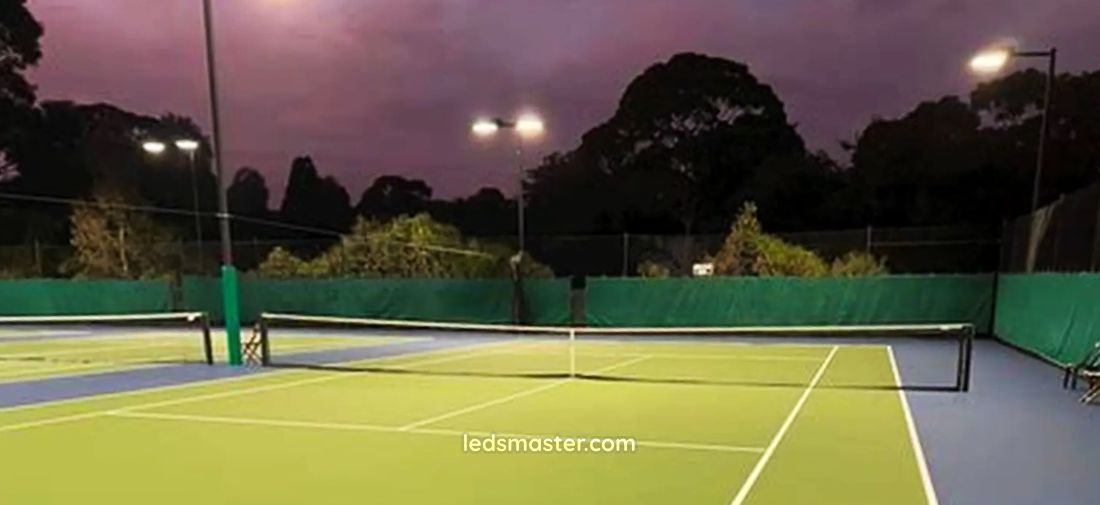
The height of a light pole directly affects illumination distribution on the court. Short poles may seem cost-effective, but they often create dark spots near the net or baseline, which can make fast serves or high lobs harder to track. For instance, a pole under 8 meters (about 26 feet) might leave corners of a standard 23.77m × 10.97m (78 ft × 36 ft) court dimmer than the center, causing uneven playing conditions.
Most outdoor tennis courts use poles in the 8–12 meter range (26–40 feet). Residential courts or backyard setups often do fine with 8 meters, especially when paired with modern LED fixtures that have precise beam control, while club-level or professional courts usually benefit from 10–12 meter poles. Taller poles spread light more evenly, allowing fewer hot spots and a more consistent vertical and horizontal illumination. For broadcast or tournament-level setups, this height can help maintain horizontal lux levels of 1300–1500 while keeping vertical illuminance around 1000 lux, which ensures the ball is visible from every angle.
Another big role of poles is controlling glare and light spill. Improper pole height or placement can cause light to shine into players’ eyes or even onto neighboring properties. Residential courts are particularly sensitive — a light spill of even 10 lux beyond the fence line can trigger complaints.
By combining proper pole height with angled fixtures, designers can focus light where it’s needed most. Poles around 10–12 meters with lights tilted 20–25 degrees downward are ideal for reducing glare while keeping the court brightly lit. Asymmetric optics and anti-glare visors on fixtures work even better, allowing the court to stay illuminated while the surrounding area remains mostly dark. Proper placement can cut light spill by 30–50% compared to poorly positioned systems, making courts more neighbor-friendly without compromising player visibility.
Stability is another area where poles play a huge role. A shaky pole can make even high-end fixtures ineffective, and in extreme cases, it can be dangerous. Outdoor tennis courts are exposed to wind speeds of 80–100 km/h (50–62 mph) or more, so poles need to withstand significant lateral pressure without bending or vibrating.
Steel poles are the most common choice for heavier LED fixtures, with diameters of 150–200 mm and wall thicknesses around 5–8 mm. These specifications allow poles to support 2–4 fixtures each weighing 15–30 kg (33–66 lbs). Poles are usually anchored in concrete footings at least 1 meter deep, sometimes deeper depending on soil type, which provides additional stability.
Aluminum poles are lighter and easier to install but might need thicker walls or additional bracing to handle heavier fixtures or strong winds. Fiberglass poles are corrosion-resistant and flexible, making them suitable for coastal courts with high salt exposure, but they often cost more and may require extra engineering for taller installations.
Where you place your poles can dramatically affect the playing experience. Standard outdoor courts often use 4 poles per side, with each pole holding 2 fixtures, giving a total of 8–16 lights per court. Poles should sit at least 1–1.5 meters outside the sidelines to prevent interference with play and to ensure safety.
Spacing and alignment also matter. If poles are unevenly spaced or misaligned, it can create “hot spots” — areas of excessive brightness — and leave other areas dim. Careful pole positioning, combined with angled fixtures, ensures that horizontal uniformity ratios stay at 0.7 or higher, which means the darkest part of the court is still 70% as bright as the average.
A well-chosen and properly installed pole system lasts for decades. Modern LED fixtures can run 50,000–100,000 hours, which translates to 10–20 years of play, and a sturdy pole often outlives the lights themselves. Choosing poles made of corrosion-resistant materials and correctly anchoring them reduces maintenance headaches, prevents rust, and keeps the lights safe in high winds.
Some poles even include tilting mechanisms or winch systems, making it easier to perform maintenance or replace fixtures without cranes or lifts. This can save clubs both time and money over the lifetime of the system.
Light poles may look simple at first glance, but they’re really the backbone of a functional, safe, and comfortable tennis court lighting system. Correct height, material, placement, and stability not only improve illumination uniformity but also reduce glare, manage light spill, and provide long-lasting support for your fixtures. Investing in good poles upfront ensures that players get a consistently bright court while minimizing maintenance and avoiding safety hazards for years to come.
Choosing the right poles for a tennis court isn’t just about grabbing something tall and sturdy. The poles influence light distribution, glare control, maintenance convenience, and overall system longevity. Several key factors should guide your decision.
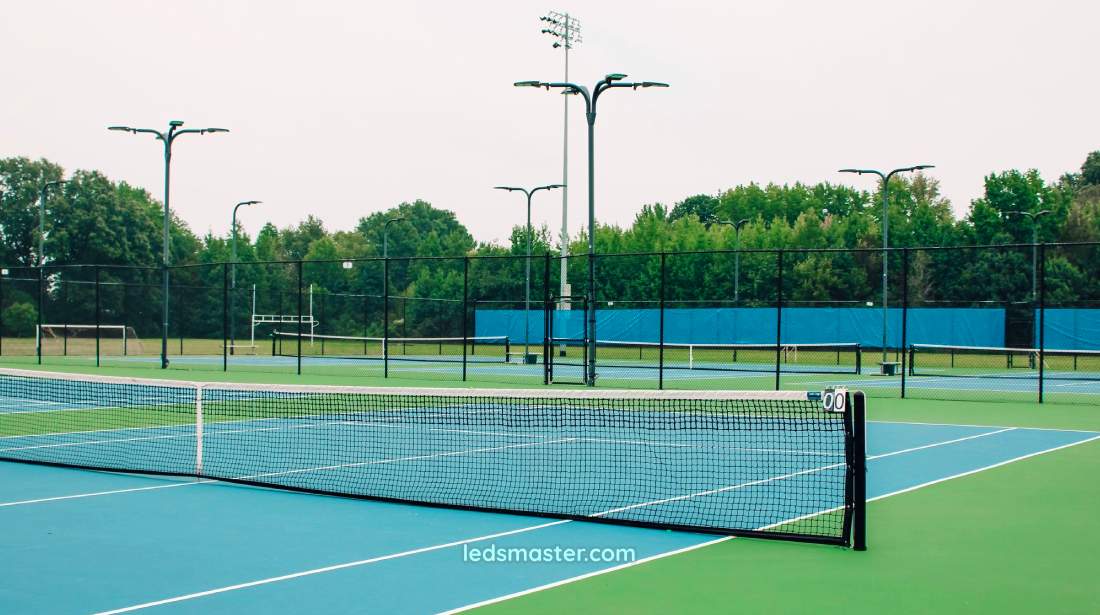
The material of a pole determines its strength, durability, and resistance to weather. Steel, aluminum, and fiberglass are the main options.
Steel poles are by far the most common. They’re strong enough to handle multiple heavy LED fixtures without bending or swaying and can be powder-coated or galvanized to resist rust, which is crucial for outdoor courts exposed to rain and humidity. Steel also tolerates wind loads better, making it a preferred choice for professional and club-level courts.
Aluminum poles are lighter, which makes installation easier and slightly cheaper, but they may require thicker walls or extra support if your fixtures are heavy. Fiberglass poles are flexible and corrosion-resistant, which makes them ideal for coastal areas with salty air. The downside is the higher upfront cost and sometimes the need for more engineering for taller installations.
Pole height affects how the light spreads across the court. Standard tennis court poles usually range from 8 to 12 meters (26–40 feet). Shorter poles around 8 meters work well for residential courts with smaller footprints, especially when using modern LEDs with tight beam control. Taller poles, 10–12 meters, are often chosen for professional or multi-court setups because they spread light more evenly and reduce glare for players.
Pole height is also linked to fixture beam angle and number of lights. Higher poles can use fewer fixtures to achieve the same lux level because the light spreads over a wider area. Lower poles need more fixtures and careful angling to avoid shadows or hot spots. Some systems even use telescoping poles, which allow you to raise or lower fixtures for maintenance or different types of play — handy but more expensive upfront.
Poles need to safely support the total weight of all attached fixtures, brackets, and sometimes electrical boxes. LED tennis court fixtures typically weigh 15–30 kilograms (33–66 pounds). Multiply that by 2–4 fixtures per pole, and the pole could be carrying up to 120 kilograms (265 pounds) or more.
To account for wind, vibration, and any extra equipment, poles are usually rated to hold 20–30% more than the expected weight. Wind load is another factor — outdoor courts can experience gusts exceeding 100 km/h (62 mph). Steel poles with diameters of 150–200 mm and wall thickness around 5–8 mm are commonly used to handle this pressure without bending.
Even the strongest pole is only as good as its foundation. Most outdoor tennis court poles are anchored in concrete footings at least 1 meter deep, though heavier poles or softer soil may require deeper foundations. The base typically includes anchor bolts that secure the pole while allowing a little flexibility to absorb wind loads.
Some poles come with tilting or pivoting mechanisms, which let maintenance crews lower the pole to change fixtures without needing lifts or cranes. This feature is particularly useful for taller poles around 12 meters, saving time and reducing installation risks.
Other factors can influence your choice. Powder-coated or galvanized finishes help resist corrosion, especially in rainy or coastal climates. Pole diameter and wall thickness not only affect weight tolerance but also the long-term stability against swaying in high winds. Some high-end setups even integrate smart lighting control wiring within the pole itself, keeping cables protected and the installation neat.
Overall, picking the right pole isn’t just about holding up the lights — it’s about ensuring consistent illumination, reducing glare, handling environmental stress, and making future maintenance safer and easier.
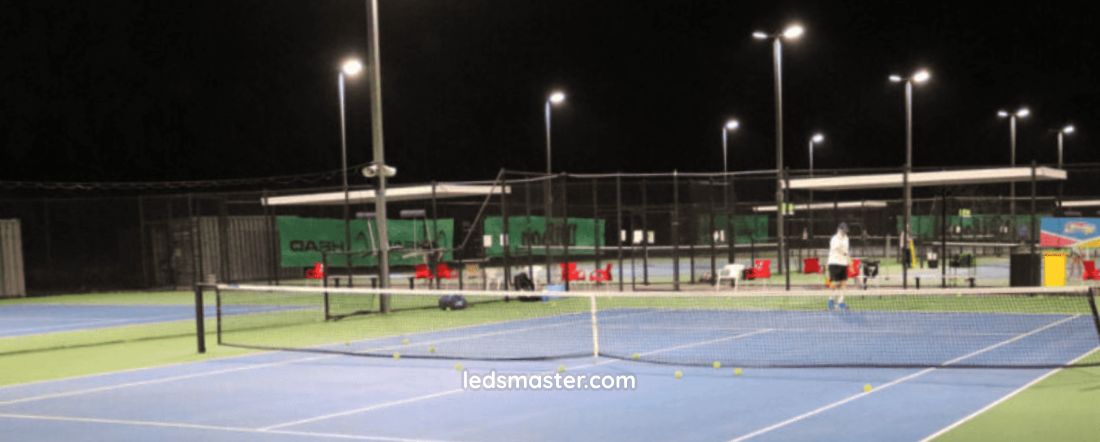
Installing lights on tennis court poles is more than just screwing fixtures in place. Proper installation impacts glare, uniformity, durability, and safety. Every detail, from pole positioning to wiring, contributes to how well the court performs at night.
Where you place your poles makes a huge difference. Poles should sit at least 1–1.5 meters (3–5 feet) outside the court lines to avoid interfering with play or posing hazards to players. For a standard 23.77m × 10.97m (78 ft × 36 ft) court, this spacing allows room for players to move freely while ensuring light coverage reaches the court edges.
Most standard outdoor courts use 4 poles per side, each holding 2 fixtures, for a total of 16 lights. Smaller or residential courts might use 6–8 fixtures on 3–4 poles, especially when high-efficiency LEDs are used. Consistent spacing between poles is key because unevenly placed poles can create “hot spots” where some areas are overlit while others remain dim. Overlapping the light beams slightly between poles helps maintain uniformity ratios above 0.7, keeping the court evenly lit from baseline to net.
The angle of your lights affects both visibility and comfort. Fixtures should generally be tilted 20–25 degrees downward to direct light onto the playing surface while minimizing glare into players’ eyes. Poles that are too low or fixtures angled incorrectly can send light directly at players or into neighboring properties, causing discomfort or complaints.
Asymmetric optics are especially helpful for multi-court setups. These optics direct light forward and downward, concentrating illumination where it’s needed and reducing spillover to adjacent courts or spectator areas. With proper angling, a professional setup can maintain horizontal illuminance of 700–1000 lux for club-level play while keeping vertical illuminance around 500–600 lux, making the ball easy to track mid-air.
For taller poles (10–12 meters), a slightly smaller tilt, around 15–20 degrees, may be used because the height already spreads light across the court. For residential poles at 8 meters, the standard 20–25 degrees works best to avoid dark corners or shadows near the baseline.
Proper wiring is another piece of the puzzle. All connections should be weatherproof, properly grounded, and secured against vibration. LED fixtures include drivers that may require surge protection, so following manufacturer guidelines is crucial to avoid damaging the system.
Having a licensed electrician handle all connections ensures compliance with electrical codes, reduces the risk of shorts or shocks, and keeps fixture warranties valid. Outdoor courts often use IP65-rated connectors and waterproof junction boxes, which protect against rain, humidity, and dust.
Electrical planning should also consider future upgrades. Running extra conduit inside the poles allows for additional fixtures or smart controls later without digging or replacing poles. Some modern systems include dimmers or sensors that adjust brightness based on match type or time of day, which can save up to 30–50% on electricity for casual play.
Maintenance is often overlooked during installation, but it can make or break long-term usability. Taller poles (10–12 meters) usually require lifts or cranes to access fixtures, which adds cost and complexity. Telescoping or tilting poles allow you to lower fixtures to ground level, making bulb replacement or cleaning easier and safer.
For residential courts, 8-meter poles are manageable with ladders or simple lifts. Poles designed with maintenance access in mind save hundreds of dollars per year in service costs and reduce downtime, especially for club or community courts that see daily use.
After installation, several checks are recommended. Make sure poles are stable and anchored properly, fixtures are securely mounted, and aiming angles are consistent across the court. Even minor misalignment can create uneven light distribution, increase glare, or compromise safety during storms.
A well-installed system should withstand wind gusts over 100 km/h (62 mph) without noticeable sway. Concrete footings should be at least 1 meter deep, with anchor bolts rated to handle the combined weight of the pole, fixtures, and brackets — often 150–200 kilograms per pole when fully loaded.
Proper checks also include verifying uniformity on the court surface. Using a lux meter or photometric simulation helps ensure that horizontal and vertical illumination ratios meet design targets, avoiding dim spots near the baseline or net.
By paying attention to pole positioning, fixture angling, wiring, maintenance access, and safety, you can create a tennis court that’s bright, even, and comfortable for players. Well-installed poles not only support the lights but also help reduce glare, manage light spill, and make long-term maintenance easier, ensuring the court looks and plays great for years.
Investing in high-quality, well-installed poles pays off over the life of the lighting system. Modern LED fixtures can last 50,000–100,000 hours, which translates to 10–20 years of play. Poles that are strong, corrosion-resistant, and properly anchored will easily outlast the lights themselves, making them a long-term foundation for your tennis court.
Even if you plan to upgrade fixtures in the future, a solid pole installation lets you swap out lights without major structural changes. That flexibility can be a big advantage for clubs or community centers that want to modernize their lighting over time