

Lighting a warehouse isn’t just about hanging some lights and calling it good. You want enough light so people can see clearly and safely, but not so much that you’re wasting energy or creating glare. Getting the right balance between watts (how much power you use) and lumens (how much light you get) means better visibility, lower costs, and fewer headaches down the line.
What are watts and lumens in lighting?
Let’s get clear on the basics before jumping into numbers.
Watts measure how much electrical power a lighting fixture draws. When you see “100 W,” that’s the power consumption — how much energy is used. Lower wattage doesn’t always mean dim light though; thanks to LEDs and modern tech, you can get bright light with relatively low watts.
Lumens are about light output — how much visible light comes out of the fixture. The more lumens, the brighter (or more intense) the light. So if you want brightness, you look at lumens; if you want to control electricity cost, you watch watts. The ratio of lumens per watt is a measure of efficiency (how much light you get for each unit of power).
So, when planning warehouse lighting, you want fixtures that provide enough lumens to meet your tasks, while keeping wattage (and costs) reasonable.
Average watts and lumens needed for warehouse lighting
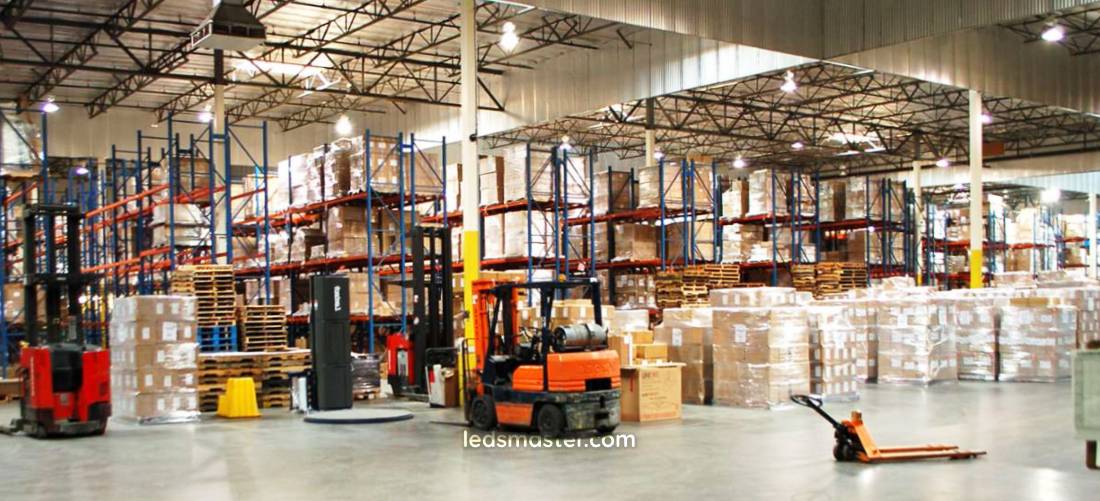
When people talk about how much light a warehouse needs, they usually break it down into lumens per square foot (often called foot-candles). It’s an easy way to standardize things because warehouses come in all shapes and sizes, and the same lighting setup won’t work everywhere. The “average” amount of light really depends on what the space is used for, how high the ceilings are, and what kind of work happens under those lights.
| Warehouse Use Type | Lumens per sq ft (Recommended) | Example Total Lumens (10,000 sq ft) | Fixture Wattage Example | Fixture Output Example | Estimated Fixtures Needed* |
|---|---|---|---|---|---|
| Bulk Storage | 10–15 | 100,000–150,000 | 150 W LED (~120 lm/W) | 18,000 lumens per fixture | 6–9 fixtures |
| General Picking / Task Work | 20–30 | 200,000–300,000 | 150–240 W LED | 20,000–30,000 lumens per fixture | 10–15 fixtures (20k lm) / 7–10 (30k lm) |
| Inspection / Packing Areas | 50+ | 500,000+ | 240 W LED (~125–135 lm/W) | 30,000–32,000 lumens per fixture | 16–17 fixtures |
Recommended lumens per square foot for different tasks
For basic storage areas where workers mostly move around pallets or large items and don’t need to read tiny labels, about 10 lumens per square foot is often enough. That level gives you decent visibility without wasting electricity.
But once you start dealing with areas where workers need to pick smaller items, inspect labels, or check inventory numbers, you usually have to bump things up quite a bit. A common range here is somewhere between 20 and 30 lumens per square foot, since tasks like order picking or quality checks need a brighter, more evenly lit environment.
Then there are those high-precision areas like packing stations, inspection tables, or shipping prep zones where lighting really matters. For these spots, it’s common to aim for 50 lumens per square foot or even more, depending on how detailed the work is. Imagine someone trying to spot a tiny defect in a product under dim lighting — it’s not going to end well. That’s why these workstations almost always get higher lumen levels than the rest of the warehouse.
How wattage connects to lumens in warehouse lighting
Now here’s where it gets practical. Lumens tell you how bright the light is, while wattage tells you how much energy you’re paying for to get that brightness. Modern LED high-bay fixtures are super popular for warehouses because they give you a lot of lumens without sucking up too many watts.
For instance, a 150-watt LED high-bay fixture often produces somewhere around 18,000 lumens, which works out to about 120 lumens per watt. That’s pretty efficient compared to older metal halide fixtures that might give you only 70–80 lumens per watt at best. If your warehouse ceilings are in the 20 to 25-foot range, you might need something stronger, like 240-watt LED fixtures that crank out 30,000 to 32,000 lumens each. These lights are typically spaced 20 to 30 feet apart depending on the layout, the height, and whether you want even coverage or just bright spots over certain zones.
Calculating total wattage for a warehouse
To figure out the total lighting load, you start with the warehouse dimensions. Say your warehouse is 10,000 square feet. If you want to hit 20 lumens per square foot, you’re looking at 200,000 total lumens.
Next, you divide that by the efficiency rating of your fixtures. Let’s say you’re buying LEDs rated at 150 lumens per watt. That means to reach 200,000 lumens, you’d need around 1,333 watts total (200,000 ÷ 150).
From there, you decide how many fixtures to install. If each fixture gives you 20,000 lumens, you’d need about 10 fixtures spread evenly across the warehouse. If you go for smaller fixtures with 15,000 lumens each, you’d need about 13–14 of them. The choice depends on your budget, layout, and ceiling height.
Of course, warehouses aren’t all one big open box. You might have tall racking systems creating shadows, or mixed areas where some spots need 50 lumens per square foot while others need only 15 lumens per square foot. In those cases, you break the calculation down by zone instead of treating the whole building the same way.
Factors that affect how many watts and lumens you really need
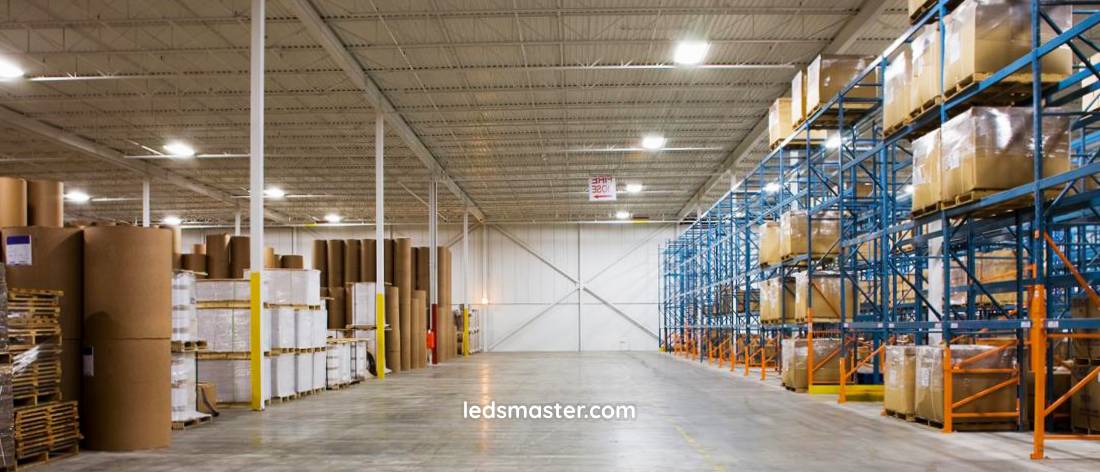
When it comes to lighting a warehouse, there isn’t a single formula that works for every space. The watts and lumens you need can change a lot depending on the building layout, ceiling height, work being done, and even the color of the walls. Below are some of the main things that can totally shift your lighting plan.
How ceiling height and mounting height come into play
The height where you hang the lights makes a huge difference. Think about it — in a warehouse with 20–30-foot ceilings, the light has a much longer way to travel before it hits the floor or work surfaces. Along the way, it spreads out, which lowers the light intensity in any one spot.
That’s why taller ceilings often call for higher lumen output fixtures or sometimes narrower beam angles so more of the light is focused straight down rather than spreading out sideways. For example, a high-bay LED fixture at 25 feet might need to push out 20,000 to 30,000 lumens to give the same brightness on the floor that a 10,000-lumen fixture would provide in a 12-foot-high building. Lower ceilings obviously don’t need as much power because the light isn’t traveling as far, so you can often get away with smaller wattage fixtures or fewer of them.
The type of work being done changes everything
A warehouse that’s just used for bulk storage is a totally different story from one where people are picking small parts, packing boxes, or doing quality control.
If most workers are only moving pallets or operating forklifts, the recommended light level might be as low as 10–15 lumens per square foot. But once workers need to read labels, scan barcodes, or spot defects, you’re often looking at 20–30 lumens per square foot or even more.
Narrow aisles with tall racks also make a difference — they block light and create shadows, so you either need more fixtures or ones with specific aisle optics designed to throw light evenly down long, narrow rows.
How surface reflectivity and color temperature affect brightness
Here’s something people often forget: walls, ceilings, and even floors change how bright a space feels. Light-colored surfaces bounce more light back into the room, making everything brighter without extra wattage. Dark walls or ceilings soak up light, so you need stronger fixtures to get the same brightness on the floor.
Then there’s color temperature, measured in Kelvin (K). Warehouses usually aim for something in the 4000–5000K range — that’s a neutral to cool white light. It looks brighter to the human eye compared to warm light (like 3000K) even if the lumen levels are the same, so it helps workers see clearly without necessarily cranking up wattage.
Fixture type and lighting efficiency
Old-school lighting like HID or fluorescent fixtures just can’t compete with LED high-bay lights anymore. An HID fixture might give you 70–90 lumens per watt, while modern LEDs can hit 120–180 lumens per watt or sometimes even more with premium models.
That difference adds up fast. Say you need 200,000 lumens in your warehouse. With HID lights at 80 lm/W, you’re burning through 2,500 watts. Switch to LEDs at 150 lm/W, and suddenly you need only 1,333 watts to hit the same brightness. That’s almost half the energy for the same light output.
Beam angle and optics also matter — a 60° narrow beam focuses light into a tighter area (good for tall ceilings), while a 120° wide beam spreads it out more for general lighting in open areas.
Getting the layout and uniformity right
It’s not just about raw brightness. A warehouse with super bright spots next to dark corners isn’t fun to work in and can even be unsafe. People’s eyes strain when moving between light and dark areas, and shadows in the wrong places can hide obstacles.
That’s why fixture spacing, aiming angles, and beam overlap are key. A well-planned layout avoids “hot spots” while keeping light levels even across the entire floor, so workers can see clearly no matter where they are.
Why maintenance and aging matter over time
Even the best LEDs don’t stay at peak output forever. Dust buildup on lenses and lumen depreciation as the LEDs age slowly bring down brightness. If you design your lighting right at the minimum needed today, you might find things looking too dim a few years down the road.
That’s why lighting designers often add a maintenance factor of 10–20% above the bare minimum. So if calculations say you need 200,000 lumens, you might install enough fixtures for 220,000 lumens to keep things bright as the years go by. It saves you from having to redo the whole lighting system too soon.
Practical guidelines for figuring out what you actually need
After going through all the factors like ceiling height, layout, and fixture efficiency, it helps to have some realistic reference points. These aren’t one-size-fits-all rules, but they give you a solid starting point so you’re not guessing in the dark — literally.
Rough lighting levels for different types of warehouse use
For a warehouse that’s mainly bulk storage with big pallets and minimal detail work, aiming for around 10–15 lumens per square foot is usually enough. That gives enough visibility for forklifts, general traffic, and safety without wasting energy on areas where nobody needs to read tiny labels.
Once you start doing moderate picking or general task work — like workers finding boxes, scanning barcodes, or sorting materials — the lighting standard often goes up to around 20–30 lumens per square foot. That extra brightness makes things like reading labels or spotting damaged packaging a lot easier and reduces eye strain during long shifts.
Then there are high-detail zones like inspection tables, packing stations, or quality control areas. These spaces sometimes need 50 lumens per square foot or more, especially if people are looking for small defects, reading fine print, or handling intricate products. It doesn’t make sense to light the whole warehouse this brightly, but for certain workstations, it can really pay off.
Turning lumens into total wattage and fixture counts
Let’s put this into a real example so it’s crystal clear. Suppose your warehouse is 20,000 square feet, and you want to keep things bright enough for general picking and packing, so you aim for 25 lumens per square foot.
First, you multiply:
20,000 sq ft × 25 lumens = 500,000 lumens total needed.
Now, let’s assume you’re using high-efficiency LED fixtures rated at 150 lumens per watt (a pretty common efficiency level these days). You divide the total lumens by that efficiency:
500,000 ÷ 150 = 3,333 watts total power draw.
That’s the whole warehouse. If you go with 20,000-lumen fixtures, you’d need about 25 fixtures. If you use 30,000-lumen high-bay lights, you could get away with 17 fixtures instead.
The choice depends on things like ceiling height, spacing, and how much uniformity you want. A larger number of lower-output fixtures might give you smoother light coverage, while fewer, higher-output lights might save on installation cost.
Accounting for mixed-use spaces and energy savings
A lot of warehouses aren’t just one big open area. You might have storage zones needing 15 lumens/sq ft, picking areas at 25 lumens/sq ft, and inspection tables at 50 lumens/sq ft all under the same roof. In that case, it’s better to break things down by zone rather than designing everything for the brightest area. That way, you’re not wasting power lighting the whole building like a surgical theater when only a few spots need it.
And if you really want to cut down on energy bills, combining this approach with motion sensors or dimming controls lets you keep light levels high where people are working while automatically lowering brightness in empty aisles. That can easily shave 30–40% off the power usage without affecting productivity.
Conclusion
Figuring out how many watts and lumens a warehouse needs depends on more than just size. What you store, how you use the space, how high the ceilings are, how efficient your fixtures are, and how even you want your light — all of that plays a role. Pick your target lumens per square foot based on tasks, and then choose fixtures that give you enough light without overdoing the power draw. A little planning now saves money, headaches, and gives everyone a safer, more comfortable place to work.