

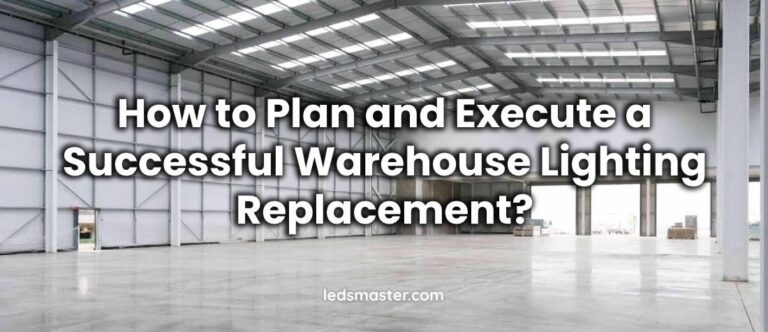

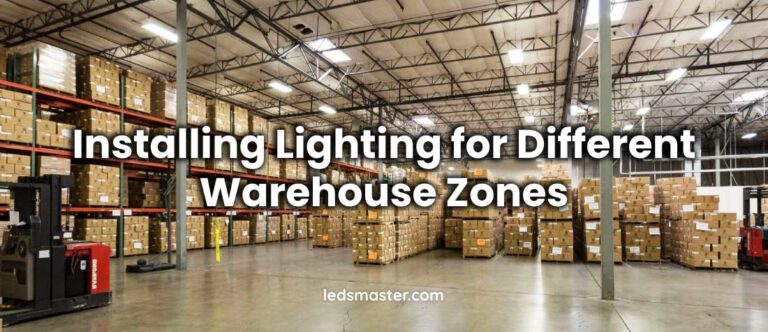
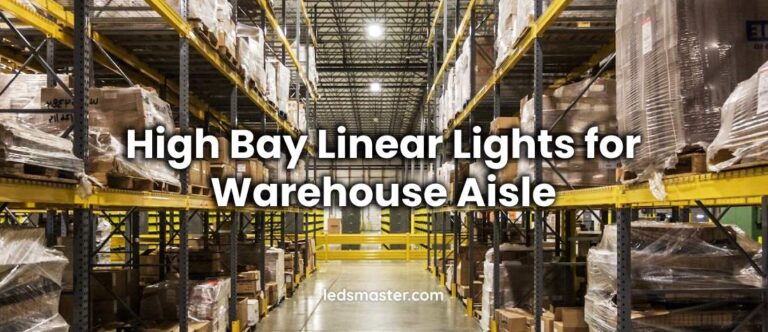
Lighting design for a warehouse is basically the process of planning how to illuminate the space to match both operational needs and comfort levels. Warehouses usually have high ceilings — often anywhere from 7 to 15 meters — and large open areas filled with racks, pallets, forklifts, and workers moving constantly.
So, designing lighting for these spaces isn’t as straightforward as hanging some fixtures from the ceiling. It involves calculating brightness levels, choosing suitable light distribution angles, minimizing shadows between aisles, and making sure workers can see labels, equipment, and pathways clearly.
A well-thought-out design combines both art and engineering. You’re not just choosing between LED or fluorescent lamps — you’re shaping how light behaves within a large, often industrial, environment. And with today’s technology, lighting design can also include automation, daylight harvesting, and even solar systems to make it both efficient and sustainable.
Designing lighting for a warehouse isn’t just about making sure it’s bright enough to see. It’s about finding that sweet spot between visibility, comfort, and efficiency — so workers can move safely, machines can operate accurately, and energy isn’t wasted. Every element, from brightness levels to beam angle, plays a role in shaping how well a warehouse actually functions day to day.
| Design Factor | Recommended / Typical Values | Practical Insights |
|---|---|---|
| Brightness (Illuminance) | • General storage: 150–300 lux (≈14–28 fc) • Detail work: 400–500 lux • High-precision zones: 600–750+ lux | Light levels depend on task type. Plan about 20% extra brightness to account for aging and dust (Maintenance Factor ≈ 0.8). |
| Uniformity Ratio | 0.6–0.8 (min/avg) | Keeps lighting even across aisles and racks. Anything below 0.5 can cause visual strain or unsafe dark patches. |
| Glare (UGR) | Below 19 (UGR < 19) | Lower UGR = better comfort. Use diffused lenses or angled fixtures (tilt 10–15°) to reduce glare on reflective surfaces. |
| Color Temperature (CCT) | 4000–5000K | Neutral to cool white — boosts focus and visibility without feeling too harsh or blue. |
| Color Rendering Index (CRI) | ≥80 | Ensures natural color appearance for labels, packaging, and machine vision accuracy. |
| Ceiling / Mounting Height | 7–15 meters (≈23–50 ft) | High-bay fixtures for ceilings above 6 m; choose narrower beams (60°–90°) for tall spaces, wider (100°–120°) for low bays. |
| Fixture Spacing (SHR) | 0.8–1.2 × mounting height | For 10 m mounting height, space fixtures 9–11 m apart for balanced light overlap. |
| Beam Angle | Narrow (30°–60°) = tall ceilings or aisles Wide (90°–120°) = open floors | For rack lighting, target 100–150 lux vertically on shelf faces for easier label reading. |
| Maintenance Factor (MF) | ≈0.8 | Design lighting 20% higher than target to compensate for dirt, dust, and aging. |
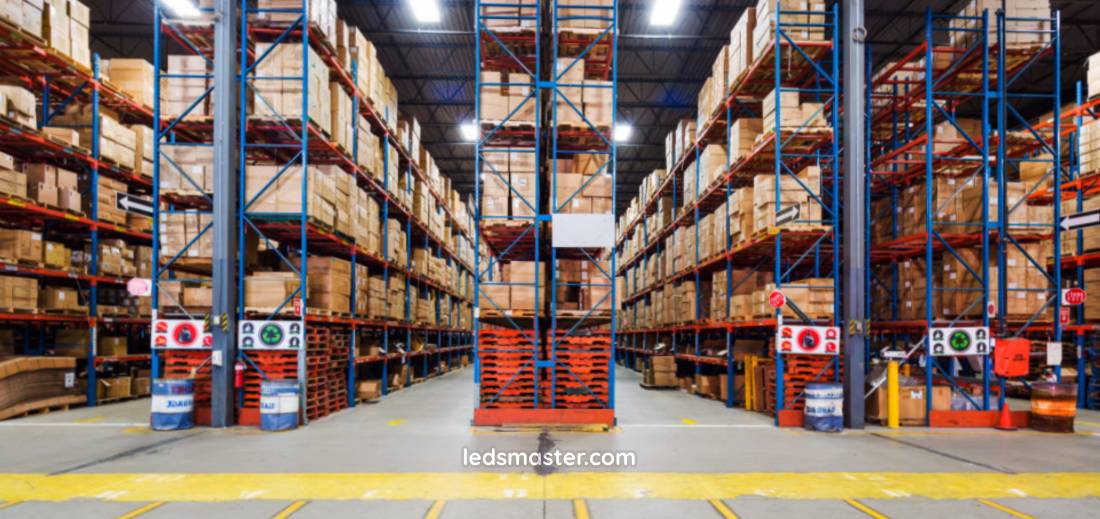
Brightness is the starting point of any lighting design. It’s typically measured in lux (lumens per square meter) or foot-candles (lumens per square foot). In warehouses, the right level of brightness depends heavily on what kind of work is being done.
For general storage areas where workers mainly move pallets or operate forklifts, a range of 150–300 lux usually does the job. But if your staff is doing more detailed tasks — say, checking barcodes, inspecting labels, or assembling products — the brightness should go up to at least 400–500 lux. Some high-precision zones can even go beyond 750 lux.
It’s also worth noting that lux levels naturally drop over time due to dust accumulation, lamp aging, or reflector wear. That’s why designers often include a maintenance factor (MF) of around 0.8, meaning they plan the initial illumination to be about 20% brighter than the target value to maintain consistent brightness over the years.
When light levels are too low, workers squint, make more errors, and fatigue sets in faster. On the flip side, lighting that’s too bright can bounce off shiny packaging or metal racks, creating glare. The goal is simple but delicate — to keep light comfortable, balanced, and functional across every zone.
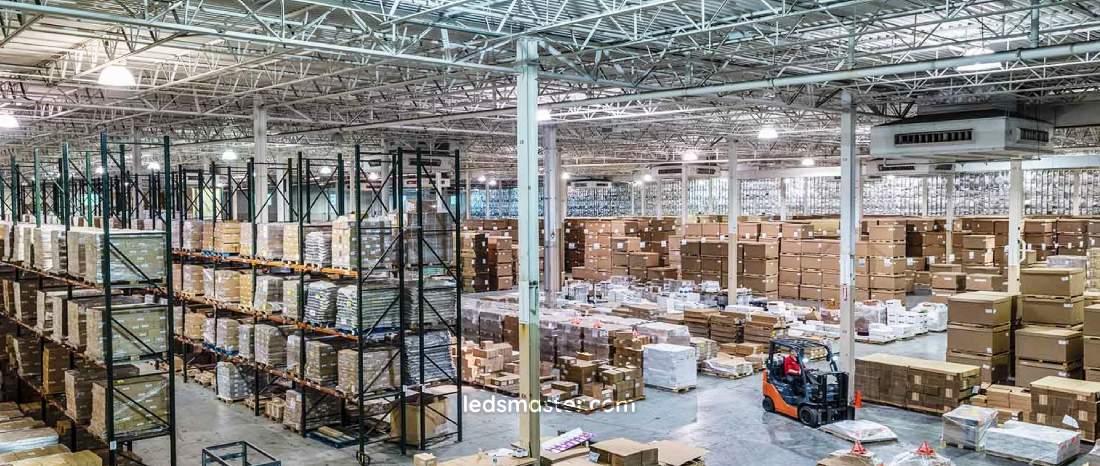
Uniformity might not sound glamorous, but it’s what separates a well-lit warehouse from a patchy one. It refers to how evenly light spreads across the space, preventing “bright spots” and “dark corners.”
The recommended uniformity ratio (minimum to average illuminance) for warehouses is around 0.6 to 0.8, depending on the space and layout. A lower ratio (like 0.4) means the light distribution is uneven, which can make it harder for workers to read labels or operate machinery safely.
Think about a forklift driver turning a corner: if one area is too bright and the next too dim, the human eye struggles to adjust, even if it’s just a few seconds. That constant adjustment can lead to visual fatigue over time. So maintaining smooth light levels helps people stay alert and reduces mistakes — especially in automated warehouses where cameras and barcode scanners rely on consistent light for accurate detection.
To improve uniformity, designers usually play with fixture spacing, beam angles, and reflectivity of surfaces. Even something as simple as painting walls a lighter color can help bounce light around and boost uniformity.
Glare is that unpleasant brightness that makes you squint — and in warehouses, it’s one of the most common complaints from workers. It often happens when lights are placed directly above shiny surfaces, or when overly powerful LEDs are used without proper optics.
There are two main types: discomfort glare (which causes eye strain) and disability glare (which actually reduces visibility). Either way, glare can be distracting and even risky, especially when operating forklifts or cranes.
To minimize glare, designers use diffused lenses, anti-glare optics, or indirect lighting layouts. The Unified Glare Rating (UGR) is a standard way to measure it — for warehouse work areas, keeping UGR below 19 is a solid benchmark.
It’s also helpful to position fixtures so that workers don’t have to look directly at the light source when scanning or handling goods. Even small details like tilting high-bay fixtures by 10–15 degrees can make a noticeable difference in comfort.
When we talk about color in lighting, it’s really about two things: color temperature (in Kelvin) and color rendering (CRI).
For warehouses, a color temperature between 4000K and 5000K usually works best. It produces a neutral to cool white light — bright enough to keep workers focused but not overly blue or sterile. Warmer tones (below 3500K) can feel too cozy or dim, while anything above 6000K might look too harsh or bluish.
Then there’s Color Rendering Index (CRI), which measures how accurately colors appear under the light compared to natural sunlight. A CRI of 80 or higher is typically recommended for warehouses, especially in areas where workers need to distinguish labels, wires, or materials. High CRI lighting also improves machine vision accuracy for automated picking or scanning systems.
Choosing the right color temperature and CRI isn’t just about looks — it affects alertness, accuracy, and even mood. Workers in spaces with well-balanced lighting tend to feel more awake and make fewer visual errors.
Warehouse ceilings can vary a lot — anywhere from 7 meters (about 23 feet) in small facilities to 15 meters (nearly 50 feet) in big distribution centers. That height matters a lot in lighting design.
The higher the ceiling, the stronger and more focused the lighting needs to be. High-bay LED fixtures (those designed for ceilings above 6 meters) often have narrower beam angles — around 60° to 90° — to push light down more effectively. For lower ceilings, low-bay lights with wider spreads (100°–120°) work better.
When lights are mounted too high without the right optics, the brightness at floor level can drop below usable levels. For instance, a fixture that delivers 20,000 lumens may only give around 150 lux on the floor if mounted at 12 meters — unless it’s designed for that height.
Mounting height also affects maintenance and accessibility. Designers often plan layouts that minimize downtime when fixtures need servicing, sometimes incorporating tiltable mounts or remote-controlled systems to make replacements easier.
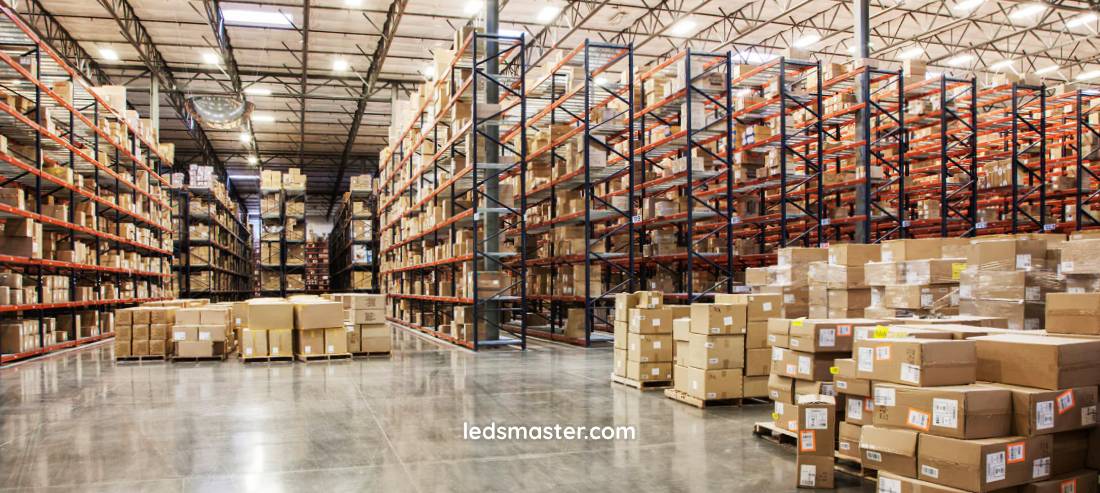
The distance between fixtures — often called spacing — is another key factor. It determines how evenly light overlaps and whether there’ll be any dark patches between beams.
Designers often use a spacing-to-mounting height ratio (SHR) to guide placement. For example, an SHR of 1.0 means the distance between fixtures equals their mounting height. If your fixtures are mounted 10 meters high, spacing them about 9–11 meters apart usually ensures smooth light coverage.
However, spacing isn’t a one-size-fits-all number. It depends on the beam angle, fixture output, and reflectivity of the environment. In spaces with tall racks or deep aisles, closer spacing or asymmetric beam lights are often used to ensure consistent illumination down each row.
A common trick is to run lighting simulations using tools like Dialux or Relux, which model how light will behave in 3D. These simulations help spot uneven areas before installation — saving both time and energy later.
The beam angle decides how the light spreads from a fixture. Narrow beams (around 30°–60°) are perfect for tall ceilings or focused lighting between racks, while wider beams (90°–120°) are better for open floor areas.
Modern warehouse fixtures often feature custom optical lenses or reflectors that shape the light more precisely. For example, “batwing” distribution lenses can spread light evenly across aisles without wasting brightness on the top shelves or ceiling.
The goal is to keep light levels uniform — not just horizontally across the floor, but vertically too, so rack faces and shelves are also visible. Good vertical illumination (often around 100–150 lux on the rack face) makes it easier to read product labels and prevents mistakes during picking.
Modern lighting design doesn’t stop with fixture placement. Control systems are becoming a major part of how warehouses manage light, energy, and automation.
Motion sensors are one of the most effective features. They detect movement and automatically turn lights on or dim them when an area isn’t in use. In warehouses with low foot traffic zones, motion-based lighting can cut energy consumption by 30–50%.
Daylight sensors (also called photocells) can adjust artificial light levels based on how much natural light is entering the space. In buildings with skylights or translucent roof panels, this can further reduce energy usage by 10–20%.
Then there’s the rise of wireless and networked lighting control, which connects all fixtures to a central system. This allows managers to monitor energy use, set schedules, and even analyze lighting data through software. Some advanced systems tie into Building Management Systems (BMS) or IoT platforms for remote control and predictive maintenance.
And yes, solar-powered lighting is slowly making its way into the warehouse scene — especially for facilities in sunny regions. Paired with battery storage and high-efficiency LEDs, solar lighting can provide reliable illumination while cutting carbon emissions and lowering operational costs.
Even with good planning, warehouse lighting doesn’t always turn out as expected. Sometimes, what looks great on paper ends up creating dark corners, blinding glare, or unnecessary energy waste once the system is up and running. Below are some of the most common problems designers and operators run into — and why they matter more than most people realize.
| Issue | Cause / Effect | Fix or Solution |
|---|---|---|
| Uneven Brightness | Wrong spacing, poor mounting height, or wrong beam angle; creates dark spots and shadows. | Do a lighting simulation before installation (e.g., Dialux); adjust spacing and beam angle for even coverage. |
| Glare and Eye Strain | Lights aimed straight down or reflected off shiny floors/racks; causes discomfort and safety risks. | Use diffusers or frosted lenses; tilt fixtures 10–15°; keep UGR < 19 in work areas. |
| Hard-to-Maintain Fixtures | Lights installed too high (10–15 m); short lamp life needs frequent replacements. | Choose long-life LEDs (50,000–100,000 hrs); use quick-release mounts or modular designs for easier maintenance. |
| Color Inconsistency | Mixed light types or color temperatures; uneven look and scanning errors. | Standardize CCT (4000–5000K) and CRI ≥80 across all fixtures; buy from the same supplier batch. |
| Energy Waste | Old HID/fluorescent lamps; lights always on even when areas are empty. | Switch to LEDs (150–180 lm/W); add motion and daylight sensors to save 30–60% energy. |
| Poor Vertical Illumination | Lights only focus on the floor; shelves and rack faces stay dim. | Add asymmetric aisle lights or side fixtures; aim for 100–150 lux on rack surfaces. |
| Heat, Dust, or Moisture Damage | Fixtures not suited for warehouse conditions; brightness drops over time. | Use IP65+ rated lights for protection; plan regular cleaning and heat management. |
One of the biggest issues in warehouse lighting design is uneven brightness. This usually happens when fixtures are spaced incorrectly, mounted at inconsistent heights, or use the wrong beam angle for the space. When some areas are much brighter than others, workers can’t see clearly as their eyes constantly adjust between light and dark zones.
Uneven light can cause shadowy aisles, making it difficult to read product labels or barcode tags, especially on the lower racks. For warehouses with tall shelving (say, 10 meters or higher), poor vertical illumination can make the top levels look dim while the floor appears overlit. This imbalance isn’t just uncomfortable — it can lead to picking errors and slower workflow.
The issue often traces back to skipping detailed photometric analysis before installation. Using software like Dialux or AGi32 to simulate light spread helps avoid these problems. Designers can test different beam angles (60°, 90°, 120°) and fixture spacing before committing, ensuring consistent lux levels throughout.
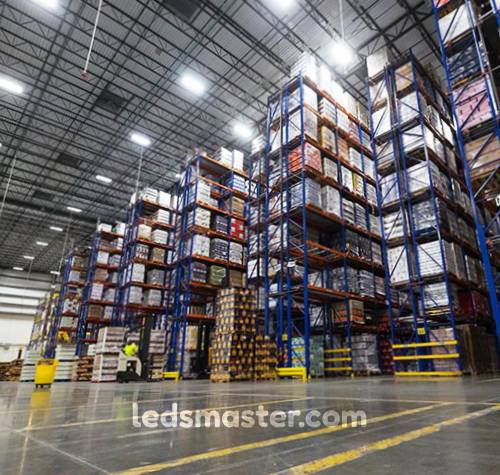 Another common problem is glare, and it’s more than just annoying — it can be dangerous. When fixtures are too bright, aimed directly downward, or positioned above reflective surfaces like polished concrete floors, glossy packaging, or metallic racks, they produce harsh reflections that strain the eyes.
Workers might squint, tilt their heads, or subconsciously avoid looking toward certain areas, which isn’t great if they’re driving forklifts or handling heavy loads. Over time, glare contributes to eye strain, fatigue, and even reduced accuracy in scanning and labeling tasks.
To reduce this, lighting design should consider UGR (Unified Glare Rating) — ideally below 19 for work zones and under 22 for general areas. Using diffusers, frosted lenses, or fixtures with glare shields helps scatter the light more evenly. Also, slightly angling high-bay lights instead of pointing them straight down can significantly reduce reflected glare from floors or metal surfaces.
Maintenance is another headache, especially in high-bay warehouses where fixtures are installed 10 to 15 meters above the ground. Replacing a single burned-out light might sound simple, but in reality, it can require renting a lift, halting traffic in that area, and coordinating safety measures.
This often happens because the original lighting layout didn’t consider accessibility and maintenance cycles. For example, using short-lifespan lamps like traditional metal halides or fluorescent tubes can lead to frequent replacements — some only last 10,000–15,000 hours. In contrast, modern LED fixtures often last over 50,000–100,000 hours, which can mean years of operation without a single change.
Some designers now plan lighting systems in zones, so maintenance can be done one section at a time without shutting down the entire warehouse. Others install fixtures with quick-release mounts or modular LED engines, making servicing faster and safer.
Not all light is created equal — and mixing different types of fixtures can make a warehouse look messy. Color inconsistency is a surprisingly common issue, especially when old lighting is upgraded in stages or when different suppliers’ products are combined.
For instance, one row might use LEDs with a color temperature of 4000K (neutral white), while another row uses older lamps at 5000K (cool white). The result? The warehouse looks uneven, and certain areas might even feel colder or warmer visually.
Besides the visual discomfort, inconsistent color rendering can also confuse automated systems that rely on optical sensors or cameras for reading barcodes and sorting items. Robots or vision-based equipment are calibrated to detect consistent lighting conditions — variations can lead to scanning errors or slower operations.
To fix this, designers need to ensure all fixtures have the same color temperature and a CRI (Color Rendering Index) of at least 80, ideally higher in detailed task areas. Standardizing lighting specifications across the facility prevents patchy color differences and keeps both human and machine vision reliable.
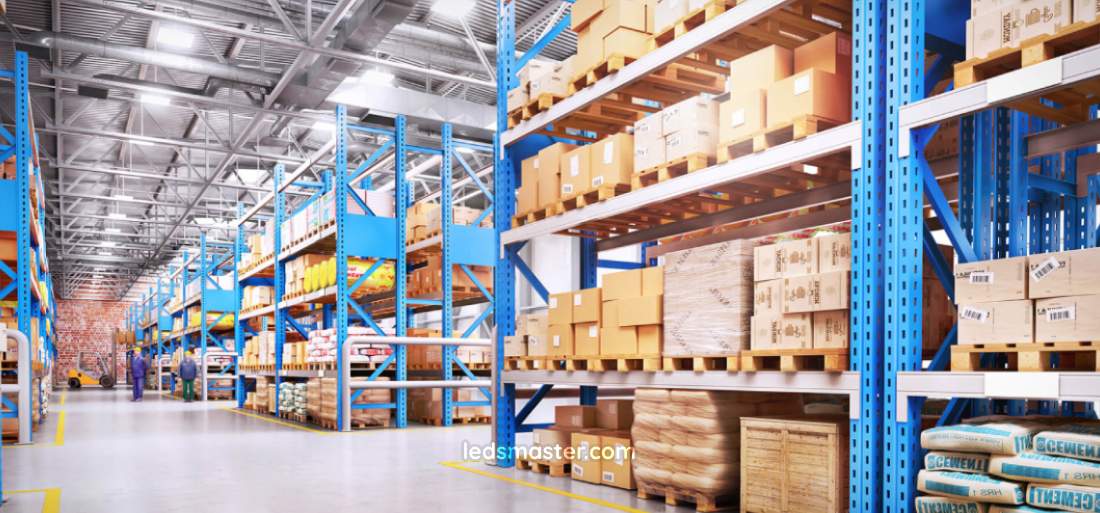
Many older warehouses still rely on HID (High-Intensity Discharge) or fluorescent lighting, which are not only less efficient but also generate a lot of heat. These systems typically convert only 60–70 lumens per watt, whereas modern LEDs can deliver 150–180 lumens per watt — more than double the efficiency.
Outdated lighting setups often waste huge amounts of electricity. For instance, a 400W metal halide fixture might be replaced by a 150W LED producing the same brightness. Across a warehouse with 200 fixtures, that’s a potential saving of 50,000 watts (or 50 kW) per hour of operation. Over a year, that can add up to tens of thousands of dollars in electricity savings.
But energy inefficiency isn’t just about the fixture type — it’s also about control. Warehouses that keep lights running 24/7, even in empty zones, waste a ton of energy. Without motion sensors or daylight controls, lights burn unnecessarily, shortening their lifespan and raising utility costs.
Modern smart control systems can solve this by automatically dimming or turning off lights in unused areas. Pairing them with daylight harvesting (where artificial light adjusts based on natural light availability) can further reduce energy use by 30–60%. The best part is that many businesses see a return on investment within 2–3 years after switching to efficient LEDs and smart controls.
One subtle but often-overlooked issue is poor vertical illumination — basically, not lighting the shelves properly. A warehouse might look bright overall when viewed from above, but the faces of racks or storage bins can still be dim. That’s a problem because workers and scanners need to clearly see product labels and barcodes placed vertically.
If the lighting design focuses only on horizontal lux levels (on the floor) and ignores the vertical plane, it can slow down operations and increase picking errors. Adding asymmetric beam fixtures or side-mounted aisle lights helps ensure even illumination on vertical surfaces, which boosts both accuracy and comfort.
Finally, some designs forget to consider how heat, dust, or humidity affect lighting over time. In a typical warehouse, especially those storing food or operating 24/7, fixtures might be exposed to higher temperatures or dust buildup, which reduces brightness by as much as 10–20% over a year.
If lights aren’t rated for the right IP protection (Ingress Protection), they can degrade quickly. For example, an IP65-rated fixture is dust-tight and can handle humidity or mild water exposure — perfect for industrial environments. Cheaper, lower-rated lights might save money upfront but fail sooner, creating more downtime and maintenance costs.
Lighting in a warehouse isn’t just about seeing clearly — it’s about creating a safer, more productive, and more energy-conscious workspace. A thoughtful lighting design touches almost every part of daily operations, from how fast workers move to how much money the company saves on electricity. Let’s take a closer look at why good lighting design actually matters so much.
Safety comes first in any warehouse, and lighting has a huge influence on that. Workers constantly operate forklifts, pallet jacks, and conveyor systems, often in tight aisles or around heavy machinery. Without the right lighting, it’s easy to miss a dropped tool, a stray box, or a moving vehicle.
Studies show that well-designed lighting can reduce workplace accidents by up to 25–30%, particularly in logistics and manufacturing environments. That’s not a small number — it can mean fewer injuries, less downtime, and lower insurance costs.
Proper lighting helps workers quickly spot obstacles, read warning labels, and interpret floor markings. For example, having consistent illumination of at least 150 lux in aisles and around loading docks gives drivers a clear line of sight. In high-traffic zones like receiving areas, higher brightness (around 300–400 lux) is often recommended for quicker reaction times.
Glare control also plays into safety. Bright reflections from polished floors or shiny packaging can momentarily blind operators. Using anti-glare lenses or well-angled high-bay fixtures helps reduce those hazards, keeping both visibility and comfort in check.
Simply put, a well-lit warehouse is a safer warehouse, and that safety pays off — in fewer mistakes, fewer injuries, and smoother operations overall.
Lighting also has a big effect on how well and how fast people work. When the workspace is evenly lit, with the right color temperature and brightness, workers can scan, sort, and identify products faster. Tasks that require attention to small details — like barcode scanning, packaging, or inspection — are much easier in clear, consistent lighting.
A report from the Illuminating Engineering Society (IES) notes that optimized warehouse lighting can improve picking accuracy by 10–15%. That might not sound huge at first, but in a busy warehouse processing thousands of orders per day, it can translate into hundreds fewer errors each week.
Good lighting also affects focus and energy levels. Under bright, neutral-white light (around 4000–5000K), people tend to stay more alert and less drowsy, especially during night shifts. On the other hand, poor lighting — especially flickering fluorescent lamps — can cause eye fatigue, headaches, and reduced concentration. Over time, that drains energy and slows productivity.
There’s a psychological side to it too: when the workspace looks clear and bright, people naturally move faster and feel more confident in what they’re doing. Lighting can quite literally change the pace of the entire operation.
Energy use is one of the biggest expenses in running a warehouse, and lighting often accounts for up to 40% of total electricity consumption. That’s why a smart lighting design can make a massive difference.
Switching from older HID or fluorescent fixtures to modern LED lighting instantly cuts power use. LEDs deliver around 150–180 lumens per watt, compared to just 70–90 lumens per watt for older lamps. Add motion sensors and daylight controls, and warehouses can often reduce lighting energy consumption by 30–70% without sacrificing performance.
Motion sensors are especially effective in large warehouses where not every zone is busy all the time. They automatically dim or turn off lights when no movement is detected — perfect for storage areas or infrequently accessed aisles. In spaces with skylights or translucent roof panels, daylight sensors can automatically adjust artificial lighting levels based on natural light, maintaining consistent brightness while saving energy.
Sustainability also plays a role. Many companies are aiming for carbon neutrality or LEED certification, and energy-efficient lighting design directly supports those goals. It’s not just about saving money — it’s about reducing carbon emissions and running a cleaner, greener operation.
And if you really want to go eco-friendly, solar-powered LED systems are becoming a real option for certain warehouses, especially in sunny regions. They can operate independently from the grid, which reduces utility bills and adds backup reliability during outages.
At first glance, a full lighting upgrade might seem expensive, but when you look at the long-term numbers, it’s actually one of the most cost-effective investments a warehouse can make.
Traditional lamps — like metal halides or fluorescents — usually last around 10,000–15,000 hours. In contrast, high-quality LEDs can run for 50,000 to 100,000 hours or more. That’s roughly five to ten years of continuous use, depending on operating hours.
Fewer replacements mean less downtime and lower maintenance costs. In high-bay warehouses where fixtures are mounted 10–15 meters high, every bulb change requires lifts, safety gear, and time — all of which cost money. With LEDs, those maintenance cycles become rare.
The energy savings add up fast, too. A 200W LED can often replace a 400W metal halide lamp while delivering the same brightness. Multiply that by a few hundred fixtures running 12 hours a day, and the difference in power bills can reach tens of thousands of dollars per year.
Over a five-year period, most warehouses see the total cost of ownership drop by 40–60% after switching to a well-planned LED system. Some facilities even recover their initial investment within just two to three years through energy savings alone.
So yes, good lighting design isn’t just about aesthetics or comfort — it’s also a smart financial decision that keeps paying back year after year.
Lighting also affects how people feel in the space — something that’s often overlooked in industrial environments. A warehouse that’s too dim, flickering, or overly harsh can easily drag down morale. People working in that kind of environment tend to feel tired sooner and less motivated over long shifts.
On the other hand, a bright, evenly lit, and natural-looking space feels more welcoming. Workers don’t have to strain their eyes, they can see what they’re doing clearly, and the overall atmosphere just feels better. Studies in workplace psychology have found that better lighting can improve mood and job satisfaction, which naturally leads to better performance and lower turnover.
Color temperature also plays a subtle role here. Neutral-white lighting around 4000–4500K creates a balanced environment — not too “blue” and cold, but not too warm either. It helps workers stay alert without feeling like they’re in a hospital or office space.
And while lighting can’t solve every workplace issue, it does influence how comfortable people feel throughout the day. When lighting feels “just right” — not glaring, not gloomy — workers stay focused longer, make fewer mistakes, and generally feel more positive about their work environment.
Warehouse lighting design might sound like a purely technical topic, but it actually shapes how the entire operation runs — from how efficiently products move to how safely people work. A thoughtful design balances brightness, uniformity, glare control, color quality, and smart systems to create a space that’s safe, efficient, and cost-effective.
Investing in good lighting is investing in people and performance. Whether it’s optimizing visibility for forklift drivers, saving energy through sensors, or simply creating a more comfortable atmosphere, every detail counts. Over time, that attention to light can mean fewer accidents, lower bills, and a smoother workflow that benefits everyone in the warehouse.