


Ever walked into a dimly lit warehouse and instantly felt how hard it was to focus or move around safely? That’s exactly why warehouse lighting matters. A good lighting system helps workers spot items quickly, reduces mistakes, and lowers the risk of accidents. For example, studies show that warehouses with balanced, bright lighting can increase worker accuracy by up to 20%.
Lighting also impacts how products are handled. When colors or labels are hard to read under poor lighting, picking errors can go up. Good lighting means clearer visibility and smoother operations, especially in 24-hour warehouses where employees work night shifts.
And it’s not just about the people—lighting also affects machinery. Forklifts and automated systems rely on visibility too. Shadows or glare can mess with sensors or slow drivers down. So, in a way, smart lighting design keeps both people and machines working safely and efficiently.
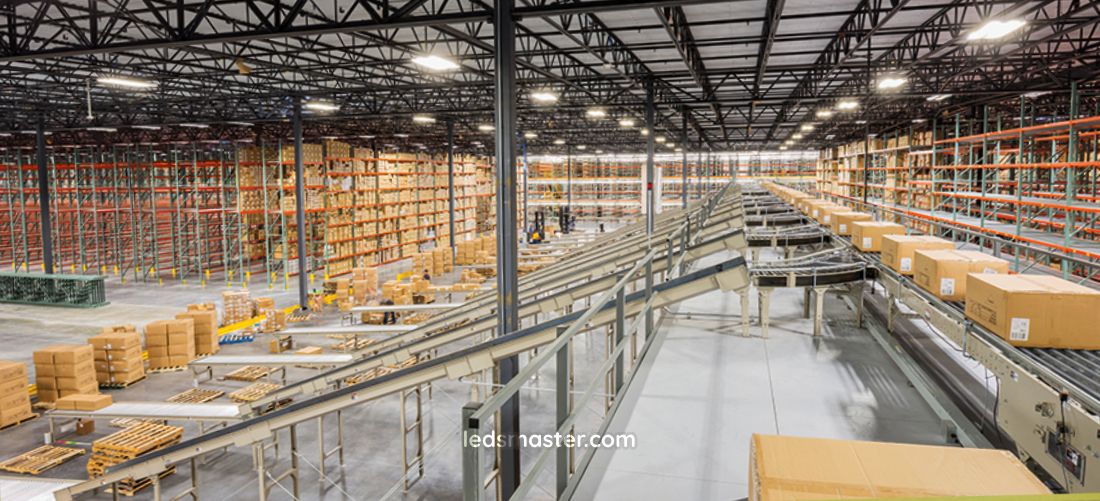
Designing lighting for a warehouse isn’t just about hanging a few bright lamps and calling it a day. There’s actually a bit of science and math behind getting it right — from figuring out how bright the space needs to be to understanding how light behaves at different heights and angles. Let’s break down some of the key parts that make a solid warehouse lighting plan.
| Parameter | Recommended Value / Range | Units / Notes |
|---|---|---|
| Illuminance | 100–500 | lx (10–50 fc) |
| Uniformity (Emin/Eavg) | ≥ 0.6 | ratio |
| Color Temperature | 4000–5000 | K |
| Color Rendering Index (CRI) | ≥ 80 | 0–100 scale |
| Glare (UGR) | ≤ 22 | — |
| Beam Angle | 60°–120° | degrees |
| Spacing-to-Mounting-Height Ratio | 1.0–1.5 | — |
When people talk about brightness, they’re usually referring to illuminance, which tells us how much light actually lands on a surface. It’s measured in lux (lx) or foot-candles (fc) — and if you’re used to working with imperial units, here’s a quick conversion: 1 foot-candle = 10.76 lux.
For most warehouse environments, general storage or picking areas should have around 150–300 lux (14–28 foot-candles) of light. But not all areas need the same level. Loading docks and passageways might get by with 100 lux, while packaging or inspection areas often go up to 500 lux because workers there need to read labels, check details, and spot small defects.
If you’ve got a mix of activities in one warehouse — say, some areas for sorting, others for forklift traffic — it’s smart to plan for different lighting zones. That way, you’re not wasting energy lighting up the entire building at 500 lux when only 20% of it really needs that intensity.
And here’s something people often forget: illuminance drops over time as fixtures age and get dusty. That’s called lumen depreciation. A new LED might start at 100% brightness, but after a few years, it can drop to around 80–85%. That’s why lighting designers often plan for a maintenance factor of about 0.8 — meaning they install slightly more light output upfront to compensate for future losses.
Uniformity is basically how evenly light spreads across your warehouse floor. You don’t want workers moving from a bright aisle to a dim one and constantly squinting to adjust — that’s tiring, and it can even cause headaches over long shifts.
Uniformity is expressed as a ratio between minimum and average illuminance (Emin/Eavg). For warehouses, a good target is 0.6 or higher, which means the darkest spots should be at least 60% as bright as the average. The more balanced the lighting, the easier it is for people to focus and for equipment like cameras or scanners to read barcodes accurately.
You can improve uniformity by adjusting fixture layout, mounting height, and beam angle. For example, wide-beam LED high bays (around 120°) are great for general storage areas, while narrow-beam ones (60°–90°) work better for tall racks or aisles where you want focused light.
A lot of modern lighting software, like DIALux or AGi32, can simulate this for you — showing a color-coded map of brightness across the warehouse before you even install anything. That helps avoid those “oh no” dark corners that everyone complains about later.
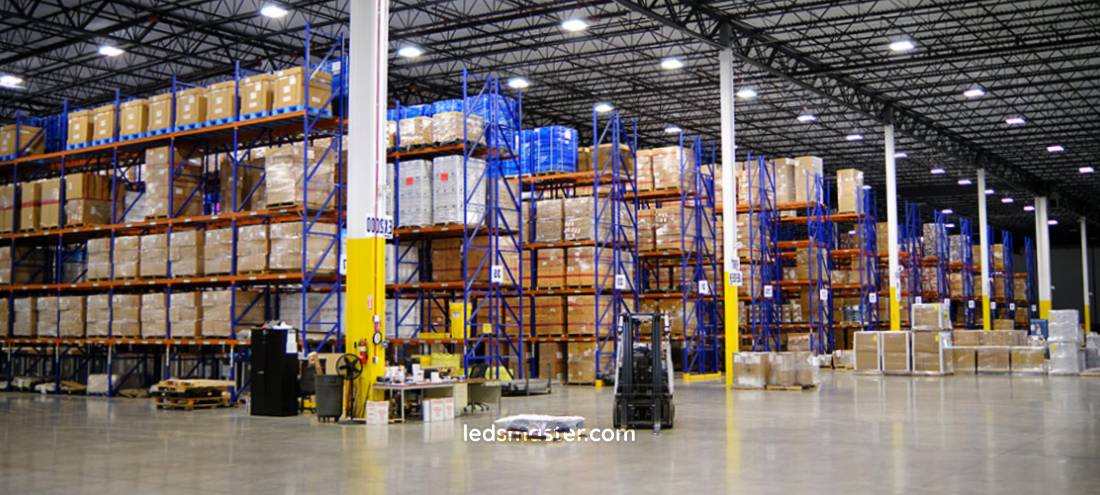
Color temperature affects how “white” or “blueish” the light feels, measured in Kelvins (K). Warmer tones (around 3000K) look yellowish, cooler ones (5000K–6500K) feel crisp and daylight-like.
For most warehouses, lighting in the 4000K to 5000K range works best. It gives off a neutral to cool white tone that helps people stay alert — especially during night shifts. If you’ve ever noticed how a brightly lit warehouse seems to make you more awake, that’s partly because cooler color temperatures stimulate focus and visual acuity.
Color Rendering Index (CRI) also matters. CRI tells you how accurately colors appear under a light source, on a scale of 0 to 100. A CRI above 80 is generally good for warehouses, while areas where color distinction matters (like product inspection) might need CRI 90 or higher. Poor CRI lighting can make red and brown packaging look almost the same — not ideal when you’re picking items from thousands of SKUs.
Even the brightest light can be annoying if it’s aimed wrong. Glare happens when a light source is too intense or positioned where people can see the bare LED or lamp directly. It can cause temporary blindness or just that uncomfortable squint we all hate.
To avoid that, fixtures are often designed with anti-glare lenses, diffusers, or reflectors that soften the beam. Positioning also plays a big role — lights should be angled so they shine down and across, not directly into people’s eyes or at reflective surfaces like polished floors.
The term Unified Glare Rating (UGR) is often used to measure discomfort from glare. For industrial spaces, a UGR of 22 or lower is usually recommended. It’s a simple way to check if your lighting design will be easy on the eyes.
Some LED high bays also feature micro-prismatic lenses that spread light more evenly and reduce hotspots. It’s a small detail but can make a big difference when you have workers spending 8–10 hours a day under those lights.
Here’s where the geometry comes in. The distance between fixtures — called light spacing — and the mounting height (how high the lights are installed) determine how smooth and even your lighting will be.
A common rule of thumb: the spacing-to-mounting-height ratio should stay between 1.0 and 1.5. That means if your lights are mounted 12 meters high, spacing them about 12–18 meters apart usually gives a nice, even spread. Go wider than that, and you’ll start seeing dark bands or uneven illumination.
Beam angle also ties in here. A narrower beam concentrates light downward, ideal for high-bay setups (8–15 meters), while a wider beam suits low-bay areas (4–6 meters). For example, a 90° beam at 10 meters can cover roughly a 7–8 meter diameter on the floor, depending on the fixture design.
Mounting height also influences brightness efficiency. Every extra meter of height can reduce ground-level brightness by about 10–15%, depending on the fixture. That’s why higher-output LEDs (around 150–200 lumens per watt) are preferred for tall warehouses — they push enough light down without wasting energy.
And don’t forget maintenance. If your lights are mounted 15 meters high, you’ll need lifts or scaffolding to reach them for cleaning or replacement. Many facility managers plan maintenance schedules around that, or they choose long-life LEDs (50,000–100,000 hours) to minimize how often someone has to go up there.
Choosing the right lighting for a warehouse isn’t a one-size-fits-all thing. The perfect setup depends on the ceiling height, layout, and what kind of work happens inside. Some areas might need focused, bright light for detail-oriented tasks, while others just need general illumination for navigation or storage. Let’s go through the main types of lighting you’ll often see in warehouse environments and what makes each one tick.
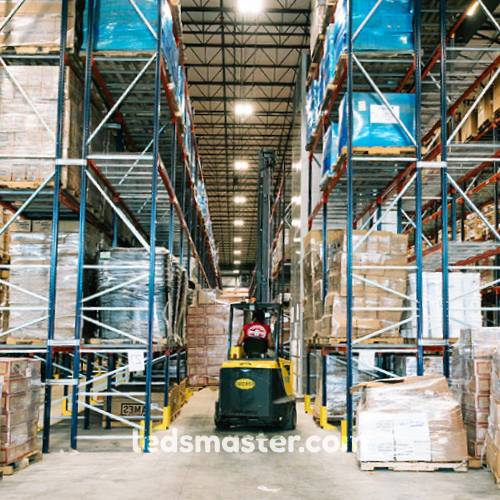 If you’ve got a tall warehouse ceiling — say, anything above 8 meters (around 26 feet) — then high bay lights are your best friend. They’re designed to throw powerful, concentrated light down from a high height, usually between 8 to 15 meters, without leaving dark patches. These fixtures come in various forms, like round UFO-style LEDs or rectangular linear types.
High bay lights typically deliver 10,000 to 40,000 lumens, depending on the wattage. For example, a 150W LED high bay can easily replace an old 400W metal halide, giving the same brightness at a fraction of the energy use. They’re great for large open spaces, tall racks, and production areas where light needs to penetrate deep.
On the other hand, low bay lights are better for spaces with ceilings below 6 meters (about 20 feet). These lights have wider beam angles — often 120° to 150° — to spread light more evenly across smaller areas. You’ll usually see them in packaging zones, smaller warehouses, or maintenance areas where a softer, more diffused light makes it easier on the eyes.
Some modern warehouses even mix the two, using high bays for open spaces and low bays in corners or offices. The trick is finding the balance so every part of the warehouse feels equally usable, no matter how tall or wide it is.
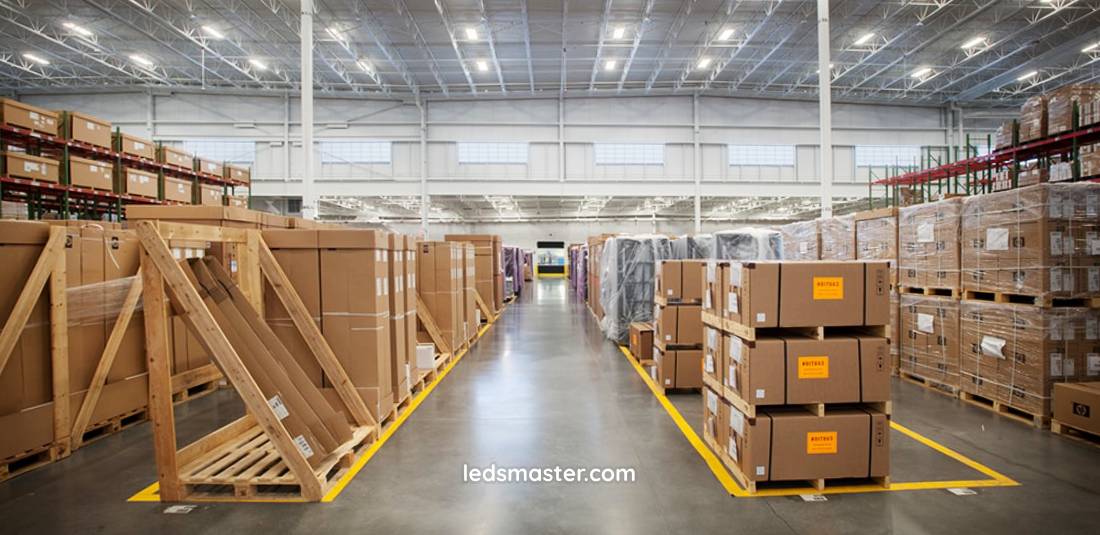
Linear lights are another go-to choice, especially for warehouses with rows of racks and aisles. These fixtures are long and slim — think of them as bright light bars that can be installed in continuous runs. The beauty of linear LEDs is that they eliminate shadows between aisles and create smooth, consistent lighting across large sections.
They come in lengths like 4 feet (1.2m) or 8 feet (2.4m), and their lumen output usually ranges between 3,000 to 10,000 lumens per fixture. Many can be daisy-chained together, so you can run a single electrical line through multiple units — super convenient for long aisles.
Another plus is how modular they are. Need more light? Just add another segment. They’re also light in weight, easy to install, and often come with integrated diffusers to minimize glare. Compared to traditional fluorescent tubes, they can save up to 60% on energy, and with lifespans of 50,000 hours or more, maintenance costs stay low.
You’ll often see them suspended between shelving rows or mounted directly onto ceilings. The even spread they provide helps forklift operators see clearly between tight spaces, which reduces the chance of bumps or scrapes on stored goods.
When it comes to outdoor areas — like loading docks, parking lots, or security zones — flood lights do the heavy lifting. These are the tough guys of the lighting world, designed to handle all kinds of weather while delivering broad, powerful illumination.
Flood lights typically come in wattages ranging from 100W to 400W, producing 10,000 to 40,000 lumens, depending on the fixture type. Modern LED flood lights often replace older halogen or metal halide models, cutting energy consumption by up to 70%.
They’re great for boosting security, too. Bright lighting discourages trespassing and makes it easier for cameras to capture clear footage. Some warehouses even connect flood lights to motion sensors or photocells, so they turn on automatically when movement or low light is detected — saving energy when the area isn’t in use.
And don’t underestimate the durability factor. Most high-quality flood lights come with IP65 or IP66 waterproof ratings, meaning they can stand up to rain, dust, and wind — perfect for outdoor environments where reliability is key.
It’s no surprise that LED lighting has completely changed the game in warehouse environments. LEDs are not just energy-efficient — they’re smarter, longer-lasting, and far more flexible than older light types.
A well-made LED high bay, for instance, can last up to 50,000 to 100,000 hours — that’s more than 10 years of use if you run them for 10 hours a day. They also maintain brightness much better over time, with lumen depreciation rates as low as 10% after several years.
In terms of energy use, LEDs can cut consumption by 60–70% compared to traditional metal halide or mercury vapor lamps. A warehouse switching 400W metal halides to 150W LED fixtures could easily save $15,000–$25,000 annually in electricity costs, depending on the facility size and usage hours.
Another big perk is that LEDs don’t need warm-up time — they turn on instantly, even in cold environments like refrigerated warehouses. They’re also fully compatible with smart control systems, allowing dimming, motion sensing, or daylight harvesting, which can further reduce energy bills by 20–30%.
And let’s not forget color quality. Most warehouse-grade LEDs have a Color Rendering Index (CRI) between 80 and 90, which means workers can see colors and labels clearly — no more confusing blue-ish or yellowish lighting that makes it hard to tell products apart.
Before LEDs took over, metal halide (MH) and mercury vapor (MV) lamps were the go-to choices for warehouses. They’re bright, no doubt — a 400W metal halide can produce around 36,000 lumens when new — but they come with a long list of drawbacks.
First off, they’re power-hungry. They use a lot of electricity, and much of that energy turns into heat rather than light. That’s not just inefficient — it can also make the building warmer, forcing the HVAC system to work harder.
They also have long warm-up times — sometimes 5 to 10 minutes before they reach full brightness. Not ideal if lights are switched on and off throughout the day. On top of that, their brightness fades quickly; after just a year or two, output can drop by 30–40%.
Color consistency is another issue. Over time, MH and MV lamps tend to shift color — from bright white to a dull pink or greenish hue — which can mess with visibility and accuracy in warehouse operations.
That’s why most modern facilities are moving to LED retrofit solutions. With retrofit kits, you can replace old MH or MV bulbs with LED equivalents without completely rewiring the system. It’s a quick upgrade that instantly improves brightness and efficiency while slashing maintenance costs.
Installing lighting in a warehouse might sound straightforward—just hang the fixtures and flip the switch, right? But in reality, it’s more like putting together a big, bright puzzle. Every warehouse has its quirks: different ceiling heights, shelf layouts, machinery zones, and even color schemes that affect how light bounces around. Getting it right means doing some planning up front and paying attention to the small details during installation.
Everything begins with a lighting layout plan. This step is basically the blueprint for your whole system. You’ll want to ask questions like:
Where do people work the most? Which areas need more light — like inspection or packing zones — and which spots just need general illumination?
You should also take ceiling height and storage rack placement into account. For example, a 12-meter-high warehouse with tall shelves will need high bay fixtures with narrower beam angles to reach the floor evenly, while an open-floor warehouse with lower ceilings might need wider-spread lighting.
It’s also smart to check for natural light sources, like skylights or big side windows. If your warehouse gets decent daylight during working hours, you can integrate daylight sensors to automatically dim the lights when sunlight is available — saving a noticeable chunk of energy.
Once you’ve got a rough idea of how the space is used, the next step is figuring out how much light you actually need. Lighting levels are usually calculated in lux (lx), which measures how much light hits a surface.
For warehouses, the recommended range is typically:
Let’s say you’re lighting a 5,000 m² warehouse that needs an average of 200 lux. You’d need around 1,000,000 lumens (200 × 5,000) in total. Then, divide that by the lumen output per fixture to estimate how many lights you’ll need. So if you’re using LED high bays that produce 25,000 lumens each, you’d need about 40 fixtures to hit that target.
Of course, that’s just the math part. You can also use lighting simulation software like DIALux, Relux, or AGi32 to visualize the setup and check how even the lighting will look before you start drilling holes. These tools even simulate shadows and reflections, which helps fine-tune your layout.
Now comes the hands-on part. Once you’ve finalized the design, mark the mounting points for each fixture based on your plan. Consistent spacing is key here — generally, lights should be placed 1 to 1.5 times the mounting height apart for even illumination.
For example, if your lights are installed 10 meters high, they should be roughly 10–15 meters apart. Also, try to line them up with aisles or rows to prevent shadows from racks and pallets.
Next, plan your electrical wiring routes. Cables should run through metal conduits or cable trays to protect them from dust, moisture, or accidental damage from forklifts. It’s also worth checking that the electrical load capacity and circuit breakers can handle the new setup — especially if you’re replacing older, high-wattage fixtures with new ones.
For large warehouses, many electricians divide the system into lighting zones, each with its own circuit and switch. That way, you can control sections independently — perfect for saving energy when only part of the warehouse is in use.
Installing the fixtures themselves is usually the most time-consuming part, especially for tall ceilings. Safety is everything here. Electricians typically use boom lifts or scaffolding to mount fixtures securely, following the spacing and angle you planned earlier.
Most LED high bays use suspension hooks, chains, or bracket mounts, depending on the type. Make sure each fixture is tightly secured and leveled — a tilted fixture can throw off light distribution and create uneven brightness.
During wiring, always confirm polarity and grounding, and test voltage before connecting to power. Once everything’s up, label each circuit clearly. It makes future maintenance or troubleshooting a lot easier.
After everything’s installed, it’s time to power on and see how it looks. Walk through the warehouse and measure brightness levels using a lux meter to make sure you’re hitting the targets.
If you spot any dark corners, glare spots, or uneven lighting, you can adjust fixture angles or add reflectors to balance it out. Sometimes, just rotating a light 10 degrees can make a big difference.
You might also want to install lighting controls — like motion sensors, dimmers, or timers. For example, motion sensors in less-used aisles can reduce electricity use by up to 40%, while smart dimming systems automatically adjust brightness based on daylight.
Even with LEDs, it’s a good idea to schedule periodic checks — maybe every 6 or 12 months. Over time, dust and dirt can reduce brightness by as much as 10–15%, especially in warehouses with heavy air movement or forklift traffic. Cleaning lenses and reflectors regularly helps keep the lighting consistent.
You can also monitor energy consumption trends after installation. If you notice unexpected spikes, that could signal an issue with the controls or power circuits. Many modern LED systems even come with built-in monitoring software to track performance and flag problems early.
Even the best lighting systems don’t last forever. Over time, brightness fades, energy use creeps up, and maintenance starts eating into your budget. That’s why every warehouse eventually reaches a point where it’s worth asking — when should we replace our lights, and what should we replace them with?
If your warehouse is still lit by metal halide (MH), high-pressure sodium (HPS), or fluorescent fixtures, there’s a good chance you’re spending way more than necessary. These older lamps were the go-to for years, but they simply can’t compete with modern LED technology in terms of performance or efficiency.
A good rule of thumb is that most warehouse lighting systems should be reviewed or replaced roughly every 5–7 years, depending on how many hours they run per day. For instance, if your lights are on 12 hours a day, 6 days a week, that adds up to over 3,700 hours per year — which takes a toll on lumen output and energy efficiency over time.
You’ll know it’s time to consider a replacement when you notice any of these signs:
Another thing to consider is maintenance cost. Metal halide bulbs, for example, often lose up to 30–40% of their brightness within the first 2 years, even though they technically “still work.” By the time they hit 60% of their original output, most facilities already find visibility dropping enough to justify an upgrade.
If you’re running fluorescent lights, the same idea applies — after about 20,000–25,000 hours, you’ll probably notice flickering, buzzing, or uneven brightness across the tubes. Not only is that annoying, it can also make employees less comfortable or focused on the job.
Switching to LED lighting doesn’t have to be confusing. The key is to focus on lumens, not watts. A lot of people make the mistake of trying to match wattage, but since LEDs produce more light per watt, the numbers don’t line up one-to-one.
For example, if you’re replacing a 400W metal halide high bay that delivers around 20,000–22,000 lumens, you’d only need a 150–160W LED high bay to get the same brightness. Likewise, an old 250W metal halide can usually be swapped for a 100W LED fixture, and a 1000W MH could be replaced with roughly 300–400W LED, depending on the brand and optical design.
You can also look at luminous efficacy, which tells you how efficiently a light converts electricity into visible light. LEDs typically deliver 130–180 lumens per watt, while older MH or HPS lamps often range between 70–90 lumens per watt. That’s nearly double the efficiency, meaning more brightness for less energy.
Here’s a simple example:
Let’s say you have 50 metal halide fixtures at 400W each — that’s 20,000 watts total. Replacing them with 150W LED high bays would drop your load to 7,500 watts, saving about 12.5 kW every hour they’re on. If your lights run 10 hours a day, 6 days a week, at $0.12/kWh, that’s roughly $4,700 in annual energy savings — and that’s before counting reduced maintenance costs.
One of the biggest questions facility managers ask is whether they need to completely replace the fixtures or just retrofit them. The good news? In many cases, retrofit kits make upgrading simple.
Retrofit kits allow you to replace the internal light source (and sometimes the driver) while keeping the outer fixture and mounting structure intact. It’s less invasive, faster to install, and can save 30–40% of the cost compared to a full overhaul. Many manufacturers design LED retrofit kits to fit directly into the sockets of traditional fixtures, so you can often reuse your wiring and layout.
However, if your existing fixtures are in poor condition, have damaged housings, or are outdated in shape or design, a full fixture replacement might be smarter long term. New LED fixtures often come with longer warranties (5–10 years), integrated smart controls, and higher energy efficiency — features that retrofits might not always include.
Before finalizing a replacement, it’s worth checking the specifications and certifications. Look for fixtures that are DLC-listed (DesignLights Consortium) or Energy Star certified, as these meet strict energy and performance standards.
Also, verify the color temperature (4000K–5000K) and CRI (80 or higher) to match or improve the quality of your current lighting. You can even test one or two LED units in your warehouse before committing — this helps you see how the light interacts with your space, shelves, and ceiling color.
Some lighting suppliers even offer photometric layouts, where they’ll simulate your warehouse using your ceiling height, layout, and racking dimensions to show exactly how the light levels will look with their products. It’s a great way to avoid guesswork and ensure consistent illumination across the floor.
Yes, upgrading to LED lighting costs money upfront — but it’s usually one of the fastest paybacks in facility management. Between energy savings, reduced maintenance, and fewer replacements, the investment often pays for itself in two to three years.
Plus, LEDs last so long that you’ll spend less time worrying about downtime. Imagine not having to change bulbs for the next decade — especially in warehouses where fixtures are mounted 12 or 15 meters high. That alone saves both labor and rental costs for lifts or scaffolds.
And beyond just cost, LEDs make the warehouse look and feel different. Better lighting means better visibility, fewer errors, and safer working conditions. For operations that run 24/7, that kind of reliability and comfort can make a real difference in productivity.
When it comes to warehouse lighting, cost isn’t just about buying the fixtures. The real picture includes what you pay upfront, how much you spend to run them every day, and what it takes to install and maintain the system. Breaking these numbers down helps show why LEDs, even with a higher initial price tag, often end up saving a lot more in the long run.
Let’s start with the basics — the lights themselves. The cost of a lighting fixture depends heavily on the type, wattage, design, and brand quality.
For example, a reliable LED high bay fixture designed for tall ceilings (around 10–15 meters high) usually runs between $100 and $300 each, depending on brightness and features. Cheaper models exist, of course, but they often cut corners on build quality, light output, or warranty coverage. On the higher end, premium smart LEDs with built-in dimming, motion sensors, or wireless controls can go for $350–$500 per unit.
If you need outdoor flood lights — for loading docks or security areas — those typically range from $150 to $500, depending on wattage and beam spread. For example, a 200W LED floodlight that outputs around 28,000 lumens might cost about $250, while a 400W version with a higher waterproof rating (IP66 or above) could be closer to $400–$500.
Then there are linear LED fixtures for aisles or low-bay areas, which often cost $80–$200 each, depending on length and lumen output. While that may seem like a lot at first glance, these LEDs can last up to 50,000–100,000 hours — that’s about 10 years of regular use — meaning you’ll go a long time before buying replacements.
It’s also worth mentioning that fixture cost is often offset by rebates or energy efficiency incentives from local utilities or government programs. In many regions, those rebates can reduce your upfront investment by 10–30%, making it easier to justify the switch to LEDs.
This is where LEDs really start to make a difference. The running cost — basically your electricity bill — is often the biggest ongoing expense in any lighting setup.
Let’s say you have a 100,000-square-foot warehouse with around 100 high bay lights. If those lights are older 400W metal halide fixtures, you’re burning through 40,000 watts (or 40 kW) every hour they’re on. If your facility operates 10 hours a day, 6 days a week, that’s roughly 2,500 hours per year. Multiply that out:
40 kW × 2,500 hours × $0.12 per kWh = $12,000 per year in electricity — and that’s just for lighting.
Now, replace those same lights with 150W LED high bays. You’re down to 15 kW total for the same brightness. The new energy cost becomes:
15 kW × 2,500 hours × $0.12 = $4,500 per year.
That’s a savings of about $7,500 every year, and that doesn’t even count the reduced maintenance costs (no bulb changes, fewer failures, and less downtime). For larger operations or facilities that run 24/7, the savings easily climb into the tens of thousands annually.
And since LEDs convert more electricity into light rather than heat, they also keep the building cooler. That means your HVAC system doesn’t have to work as hard, which can shave off another 5–10% in energy savings indirectly.
Installation cost can vary a lot depending on the warehouse’s size, ceiling height, and wiring complexity. On average, you can expect to pay between $50 and $150 per fixture for professional installation.
For example, swapping out old fixtures in an existing setup might be on the lower end if you’re using the same mounting points and wiring. But if you’re installing a brand-new system or changing layouts — say, adding additional rows or integrating smart lighting controls — labor costs can rise toward the higher end.
If your warehouse ceiling is especially tall (over 12 meters), installers will need boom lifts or scaffolding, which adds to the labor time and equipment rental fees. On big jobs, electricians might charge by the hour, usually between $75 and $120 per hour, depending on location and union rates.
Still, the installation is a one-time cost, and since LEDs last so long, you won’t have to worry about frequent replacements. Many facility managers prefer to schedule installation during planned maintenance shutdowns to minimize disruption to daily operations.
Traditional lighting systems like metal halide or fluorescent require regular bulb and ballast replacements — sometimes every 1–2 years. That means paying not just for parts, but also for labor, especially if fixtures are mounted high up.
LEDs, on the other hand, can run for 50,000–100,000 hours without needing a replacement. That’s roughly 5 to 10 years of continuous use. Over that period, you might easily save 30–50% in maintenance costs simply by not having to constantly change bulbs or rent lifts for replacements.
Some LED manufacturers even offer 10-year warranties, giving you peace of mind that you won’t be out of pocket for unexpected failures.
Even though the upfront cost of LED lighting can seem higher, the payback period is surprisingly short. Most warehouses recover their investment in 2 to 3 years, thanks to the combination of energy and maintenance savings.
To put it in perspective, let’s take a mid-sized warehouse spending $15,000 annually on lighting energy. Switching to LEDs cuts that down to about $6,000, saving roughly $9,000 per year. If the total upgrade costs $25,000 (including fixtures and installation), the payback time is less than three years — and after that, it’s pure savings.
After five years, that same facility could be ahead by $20,000–$25,000, and the lights would still have plenty of lifespan left.
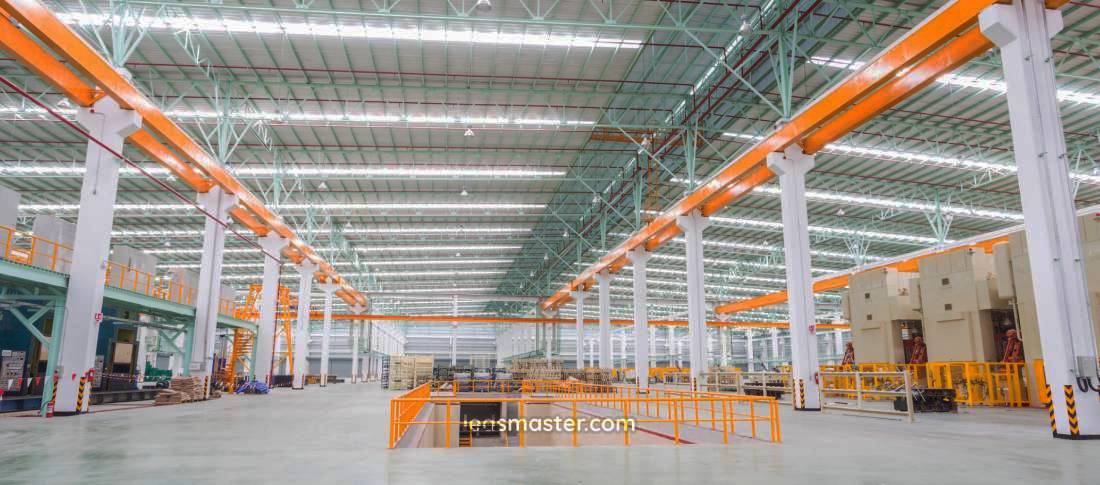
Switching to modern LED lighting can feel like a big investment at first, but the good news is that there’s a lot of financial support out there to make it easier. From rebates and grants to tax incentives and low-interest loans, warehouses have several options to help cover the cost of upgrading to energy-efficient lighting systems.
Many countries now run energy-efficiency initiatives aimed at helping businesses reduce electricity use. Depending on where your warehouse is located, you might qualify for government grants, low-interest “green” loans, or tax deductions for upgrading to LED lighting.
For instance, in the U.S., programs like the Energy Efficient Commercial Buildings Deduction (Section 179D) allow businesses to claim tax deductions based on energy savings from lighting retrofits. In Europe and parts of Asia, regional energy agencies often provide grant funding or cost-share programs that can cover anywhere from 10% to 40% of project costs, depending on the scale and efficiency improvement.
Even smaller warehouses can benefit from local energy conservation funds that reward companies for making eco-friendly upgrades. These programs aren’t just about saving energy — they’re part of broader sustainability goals to reduce carbon footprints and meet green certification standards like LEED or BREEAM.
One of the easiest ways to save money on lighting upgrades is through utility rebates. Power companies often offer rebates for each new LED fixture installed because reducing energy consumption helps them meet their own efficiency targets.
The rebate amount varies depending on your region and the fixture type, but it usually ranges between $20 and $150 per fixture. So, if you’re upgrading 200 lights, that could mean a rebate of $4,000 to $30,000 — a significant chunk of your upfront cost covered right away.
Some utilities also offer custom rebate programs, where they calculate savings based on total kilowatt-hour (kWh) reductions instead of just fixture count. For example, if your warehouse cuts energy use by 50,000 kWh per year, you might qualify for a performance-based rebate worth a few thousand dollars more.
The process can sound a bit technical, but it’s usually straightforward. Many lighting suppliers and contractors handle the rebate paperwork for you as part of their service. They’ll verify your equipment specs, submit energy calculations, and make sure everything qualifies under your local utility’s rules.
If your company has sustainability goals, upgrading warehouse lighting can also help you earn carbon reduction credits or boost your standing with environmental certifications.
By lowering your energy use, you’re directly reducing carbon emissions — and that reduction can be quantified. Some programs allow you to sell or trade carbon credits through verified markets, adding another layer of financial return beyond just lower utility bills.
For businesses aiming for corporate social responsibility (CSR) or ESG (Environmental, Social, and Governance) benchmarks, improving lighting efficiency can help demonstrate tangible progress. It’s not only good for the planet but also for your brand reputation — especially when dealing with clients who value sustainability in their supply chain partners.
Warehouses that have switched to LED systems often report reductions of 20–50 tons of CO₂ emissions per year, depending on size and usage. That’s a measurable improvement that can be proudly showcased in sustainability reports or marketing materials.
If navigating the financial side feels complicated, there are professionals who specialize in energy project funding and rebate management. Many lighting companies now work with energy consultants who can calculate your potential savings, apply for available incentives, and create an ROI plan that clearly shows payback timelines.
Some suppliers even offer zero-upfront-cost programs, where the cost of new lighting is financed through your energy savings over time. In other words, the lights start paying for themselves from day one, while you enjoy better illumination and lower bills.
It’s worth reaching out to local energy providers or national efficiency agencies to see what’s currently available — these programs change often, and sometimes they’re time-limited. The best part is that in many cases, the paperwork isn’t as painful as it sounds. Many suppliers will take care of the rebate submission on your behalf, so you don’t miss out on any available incentives.
Even if your warehouse lighting upgrade feels like a big expense upfront, combining rebates, energy savings, and maintenance reductions can significantly shorten your payback time. Many warehouses find that what starts as a 3-year return on investment drops closer to 18–24 months once incentives are applied.
That’s why it’s worth spending a bit of time researching what’s out there — or letting your lighting provider do it for you. Whether it’s a $20-per-fixture rebate or a larger government subsidy, those incentives add up fast and make the transition to LEDs not just a smart environmental choice, but a very practical financial one too.
Good lighting can totally transform how a warehouse functions—from improving visibility and workflow to saving thousands in energy costs. With a smart layout, well-chosen LED fixtures, and maybe some sensor automation, it’s possible to have a brighter, safer, and more cost-effective space.
Whether you’re building a new warehouse or thinking about upgrading an old one, it’s worth giving lighting the attention it deserves. A well-lit workspace isn’t just nicer—it pays for itself in the long run.